QUESTION IMAGE
Question
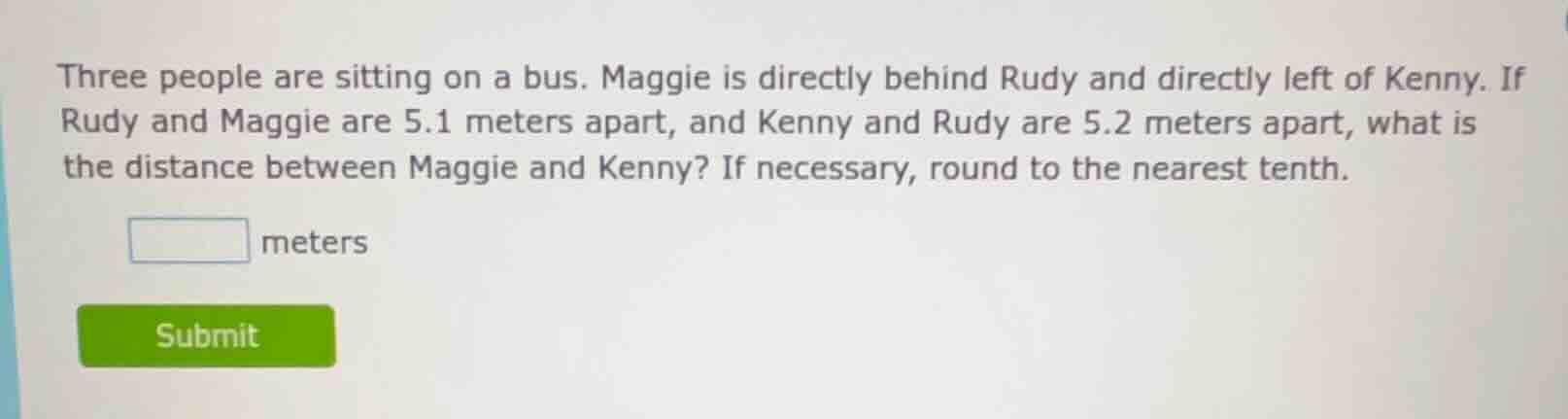
three people are sitting on a bus. maggie is directly behind rudy and directly left of kenny. if rudy and maggie are 5.1 meters apart, and kenny and rudy are 5.2 meters apart, what is the distance between maggie and kenny? if necessary, round to the nearest tenth.\boxed{} meters
Step1: Identify the triangle type
Maggie, Rudy, and Kenny form a right triangle, where the distance between Rudy and Maggie (5.1 m) and the distance between Maggie and Kenny (let's call it \( x \)) are the legs, and the distance between Rudy and Kenny (5.2 m) is the hypotenuse? Wait, no—wait, Maggie is directly behind Rudy (so vertical leg, length 5.1) and directly left of Kenny (so horizontal leg, length \( x \)), and Rudy to Kenny is the hypotenuse (5.2)? Wait, no, actually, Maggie is behind Rudy (so Rudy - Maggie is vertical, length 5.1) and left of Kenny (so Maggie - Kenny is horizontal, and Rudy - Kenny is the hypotenuse? Wait, no, let's visualize: Rudy is at a point, Maggie is directly behind (so same x-coordinate, lower y-coordinate, distance 5.1). Maggie is directly left of Kenny (so same y-coordinate as Maggie, Kenny is to the right, so Maggie - Kenny is horizontal, and Rudy - Kenny is the hypotenuse of the right triangle with legs 5.1 (Rudy - Maggie) and \( d \) (Maggie - Kenny), and hypotenuse 5.2 (Rudy - Kenny). So by Pythagoras: \( 5.1^2 + d^2 = 5.2^2 \)? Wait, no—wait, maybe I got the legs reversed. Wait, Maggie is behind Rudy (so Rudy to Maggie is vertical, length 5.1), and Maggie is left of Kenny (so Maggie to Kenny is horizontal, length \( d \)), and Rudy to Kenny is the hypotenuse (length 5.2). So the right triangle has legs 5.1 and \( d \), hypotenuse 5.2? Wait, no, that would mean \( 5.1^2 + d^2 = 5.2^2 \), but let's check: \( 5.2^2 - 5.1^2 = d^2 \). Let's compute that.
Step2: Apply Pythagorean theorem
The Pythagorean theorem states that in a right triangle, \( a^2 + b^2 = c^2 \), where \( c \) is the hypotenuse. Here, let's assume the right angle is at Maggie. So Rudy to Maggie is one leg (\( a = 5.1 \)), Maggie to Kenny is the other leg (\( b = d \)), and Rudy to Kenny is the hypotenuse (\( c = 5.2 \))? Wait, no, that can't be, because 5.2 is longer than 5.1, so maybe the hypotenuse is 5.2, and one leg is 5.1, so the other leg is \( d \). So \( d = \sqrt{5.2^2 - 5.1^2} \).
Compute \( 5.2^2 = 27.04 \), \( 5.1^2 = 26.01 \). Then \( 27.04 - 26.01 = 1.03 \). So \( d = \sqrt{1.03} \approx 1.0148 \approx 1.0 \) when rounded to the nearest tenth? Wait, that seems too small. Wait, maybe I mixed up the legs. Wait, maybe the hypotenuse is 5.2, and one leg is 5.1, so the other leg is \( \sqrt{5.2^2 - 5.1^2} \). Let's recalculate:
\( 5.2^2 = 5.2 \times 5.2 = 27.04 \)
\( 5.1^2 = 5.1 \times 5.1 = 26.01 \)
Subtract: \( 27.04 - 26.01 = 1.03 \)
Then \( \sqrt{1.03} \approx 1.0148 \), which rounds to 1.0? Wait, that seems odd. Wait, maybe I had the legs reversed. Wait, maybe Rudy to Maggie is one leg (5.1), Rudy to Kenny is another leg (5.2), and Maggie to Kenny is the hypotenuse? No, that doesn't make sense with the directions. Wait, "Maggie is directly behind Rudy" – so Rudy is in front of Maggie, same vertical line, distance 5.1. "Maggie is directly left of Kenny" – so Kenny is to the right of Maggie, same horizontal line, so Maggie and Kenny are on the same horizontal line, Rudy and Maggie on the same vertical line. So the three points: Rudy (x, y), Maggie (x, y - 5.1), Kenny (x + d, y - 5.1). So the distance from Rudy (x, y) to Kenny (x + d, y - 5.1) is \( \sqrt{(d)^2 + (5.1)^2} = 5.2 \). Ah! There we go. So that's the correct right triangle: legs are \( d \) (horizontal, Maggie to Kenny) and 5.1 (vertical, Rudy to Maggie), hypotenuse 5.2 (Rudy to Kenny). So then:
\( d^2 + 5.1^2 = 5.2^2 \)
So solving for \( d \):
\( d^2 = 5.2^2 - 5.1^2 \)
Step3: Calculate \( d^2 \)
\( 5.2^2 = 27.04 \)
\( 5.1^2 = 26.01 \)…

Snap & solve any problem in the app
Get step-by-step solutions on Sovi AI
Photo-based solutions with guided steps
Explore more problems and detailed explanations
\( \boxed{1.0} \)