QUESTION IMAGE
Question
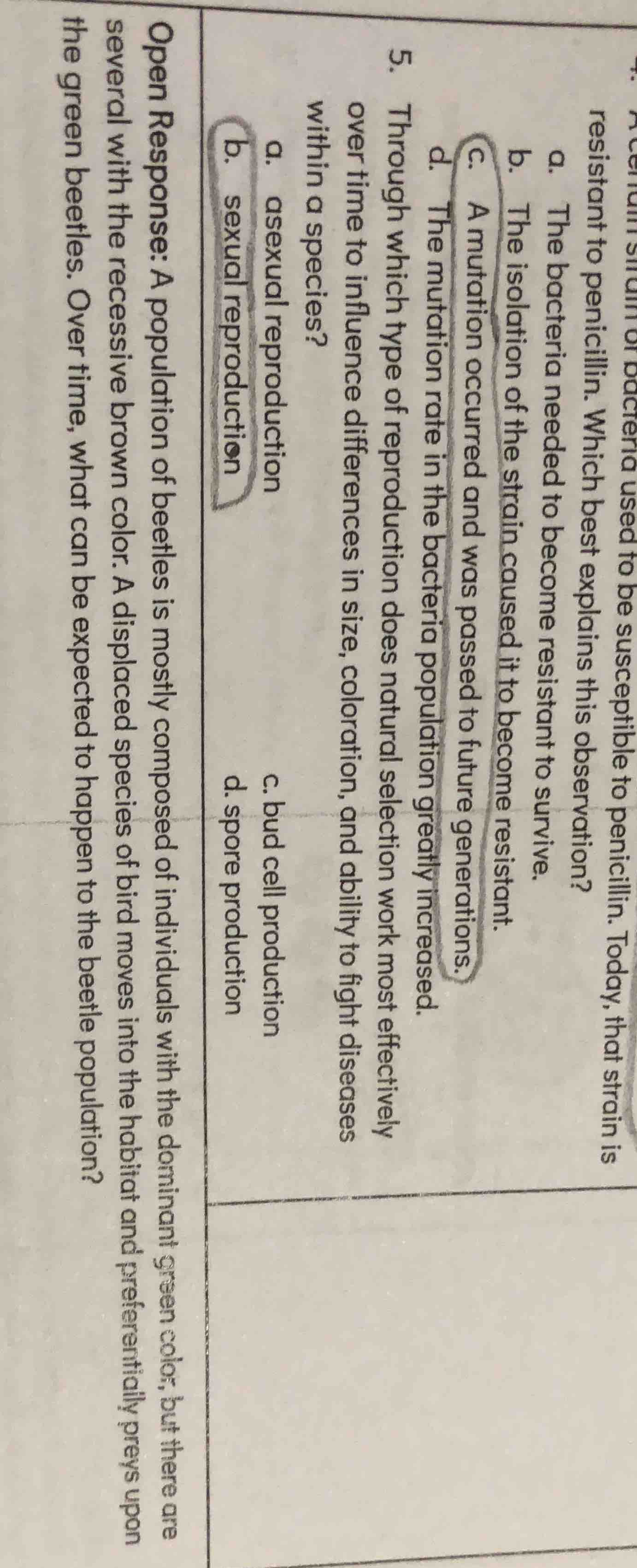
- through which type of reproduction does natural selection work most effectively over time to influence differences in size, coloration, and ability to fight diseases within a species?
a. asexual reproduction
b. sexual reproduction
c. bud cell production
d. spore production
Response
Question 4 (Bacteria Resistance)
Brief Explanations
To determine the best explanation for bacteria becoming resistant to penicillin:
- Option a: Bacteria don't "need" to become resistant; it's about survival of those with resistance, not a conscious need. Eliminate a.
- Option b: Isolation doesn't directly cause resistance. Resistance comes from genetic changes, not isolation. Eliminate b.
- Option c: A mutation for resistance can occur and be passed to future generations (if it helps survival), which fits natural selection. This is correct.
- Option d: Mutation rate increase isn't the main factor; it's the selection of existing resistant mutations, not a general mutation rate rise. Eliminate d.
Brief Explanations
To find which reproduction aids natural selection (influencing traits over time):
- Option a: Asexual reproduction produces clones, so less genetic variation. Natural selection needs variation, so asexual is less effective. Eliminate a.
- Option b: Sexual reproduction creates genetic variation (through meiosis, fertilization), providing more traits for natural selection to act on. This is correct.
- Option c: Bud cell production is asexual (e.g., in yeast), so limited variation. Eliminate c.
- Option d: Spore production (e.g., in fungi) is often asexual, with less variation. Eliminate d.
Brief Explanations
- Initial State: Beetle population has dominant green (G) and recessive brown (g) alleles. Birds (new predator) prefer green beetles.
- Selection Pressure: Birds eat more green beetles. Brown beetles (recessive) are less visible (assuming habitat matches brown better now, or green is more visible to birds).
- Survival and Reproduction: Brown beetles survive more, reproduce more. Their (g) alleles are passed on.
- Genetic Change: Over time, the frequency of the brown allele (g) increases. The population will shift: more brown beetles, fewer green beetles (unless green has other advantages). Natural selection (bird predation) favors brown, so the population evolves to have more brown individuals.

Snap & solve any problem in the app
Get step-by-step solutions on Sovi AI
Photo-based solutions with guided steps
Explore more problems and detailed explanations
c. A mutation occurred and was passed to future generations.