QUESTION IMAGE
Question
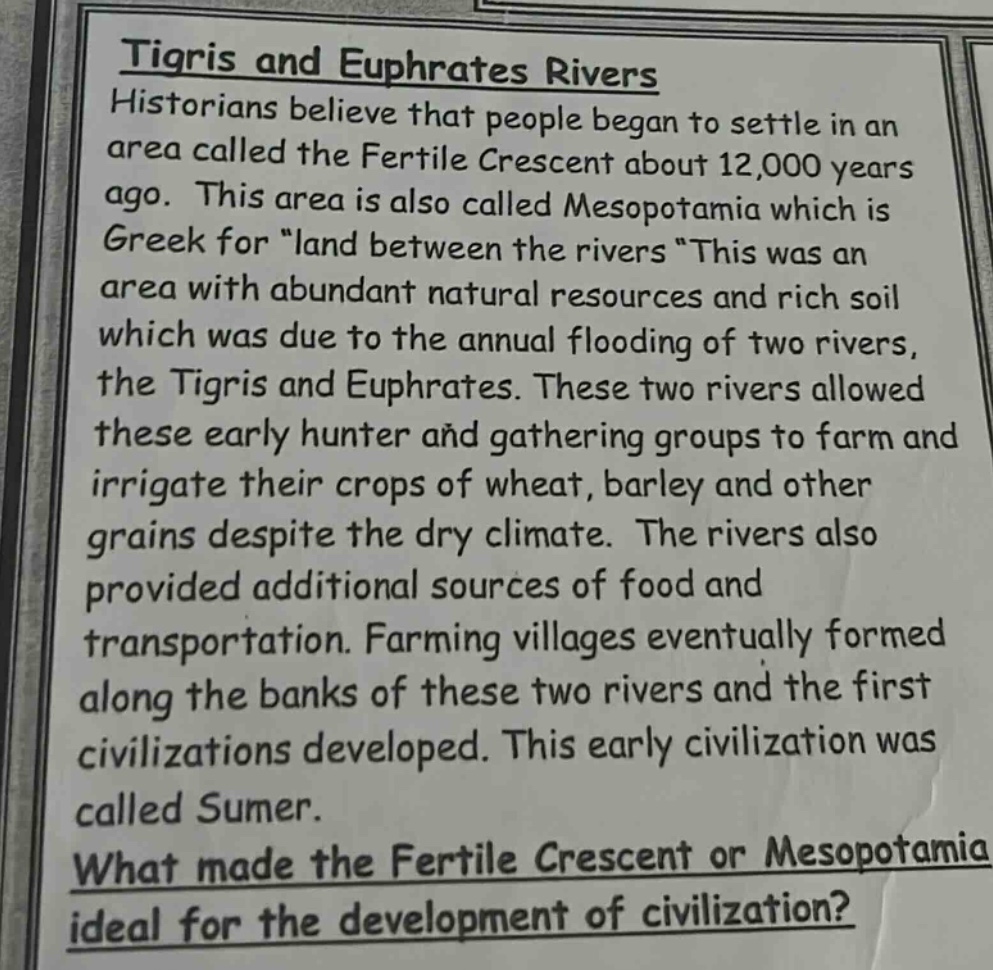
tigris and euphrates rivers
historians believe that people began to settle in an area called the fertile crescent about 12,000 years ago. this area is also called mesopotamia which is greek for \land between the rivers \this was an area with abundant natural resources and rich soil which was due to the annual flooding of two rivers, the tigris and euphrates. these two rivers allowed these early hunter and gathering groups to farm and irrigate their crops of wheat, barley and other grains despite the dry climate. the rivers also provided additional sources of food and transportation. farming villages eventually formed along the banks of these two rivers and the first civilizations developed. this early civilization was called sumer.
what made the fertile crescent or mesopotamia ideal for the development of civilization?
To determine what made the Fertile Crescent (Mesopotamia) ideal for civilization development, we analyze the text:
- Natural Resources & Soil: The annual flooding of the Tigris and Euphrates rivers created abundant natural resources and rich soil.
- Farming & Irrigation: The rivers enabled early groups to farm (wheat, barley, grains) and irrigate crops despite the dry climate.
- Food & Transportation: The rivers provided additional food sources (e.g., from the water) and transportation.
- Settlement & Civilization: Farming villages formed along the rivers, leading to the development of the first civilizations (like Sumer).

Snap & solve any problem in the app
Get step-by-step solutions on Sovi AI
Photo-based solutions with guided steps
Explore more problems and detailed explanations
The Fertile Crescent (Mesopotamia) was ideal for civilization development because:
- The Tigris and Euphrates rivers’ annual flooding created abundant natural resources and rich soil.
- These rivers allowed early hunter - gatherer groups to farm (wheat, barley, grains) and irrigate crops in the dry climate.
- The rivers provided extra food sources and transportation.
- Farming villages formed along the rivers, leading to the rise of the first civilizations (e.g., Sumer).