QUESTION IMAGE
Question
a time of conflict
directions: your purpose of reading is to determine the causes of the war of 1812. as you read each
section, underline details that help you understand the conflict between the united states and great
britain. after reading each section, answer the questions that follow.
americans on foreign seas - profits, pirates, and war
sea travel was dangerous in the early 1800s. sailors fought deadly storms and were threatened by
pirates. many americans, however, depended on trade with foreign nations and were forced to rely on
traveling by ship. in 1785 the empress of china returned to new york from china with a highly prized
cargo of tea and silk. the goods sold for a fabulous profit. soon, ships from new york, philadelphia,
and new england sailed regularly to china and india, transporting furs and other goods. american
merchant ships began sailing to south america, africa, and lands along the mediterranean sea. war
between france and britain in the mid - 1790s gave an additional boost to american shipping. to avoid
being captured or destroyed by the enemy, many french and british merchant ships remained at home.
american shippers profited from the situation and increased their trade. by 1800, the united states had
almost 1,000 merchant ships trading around the world.
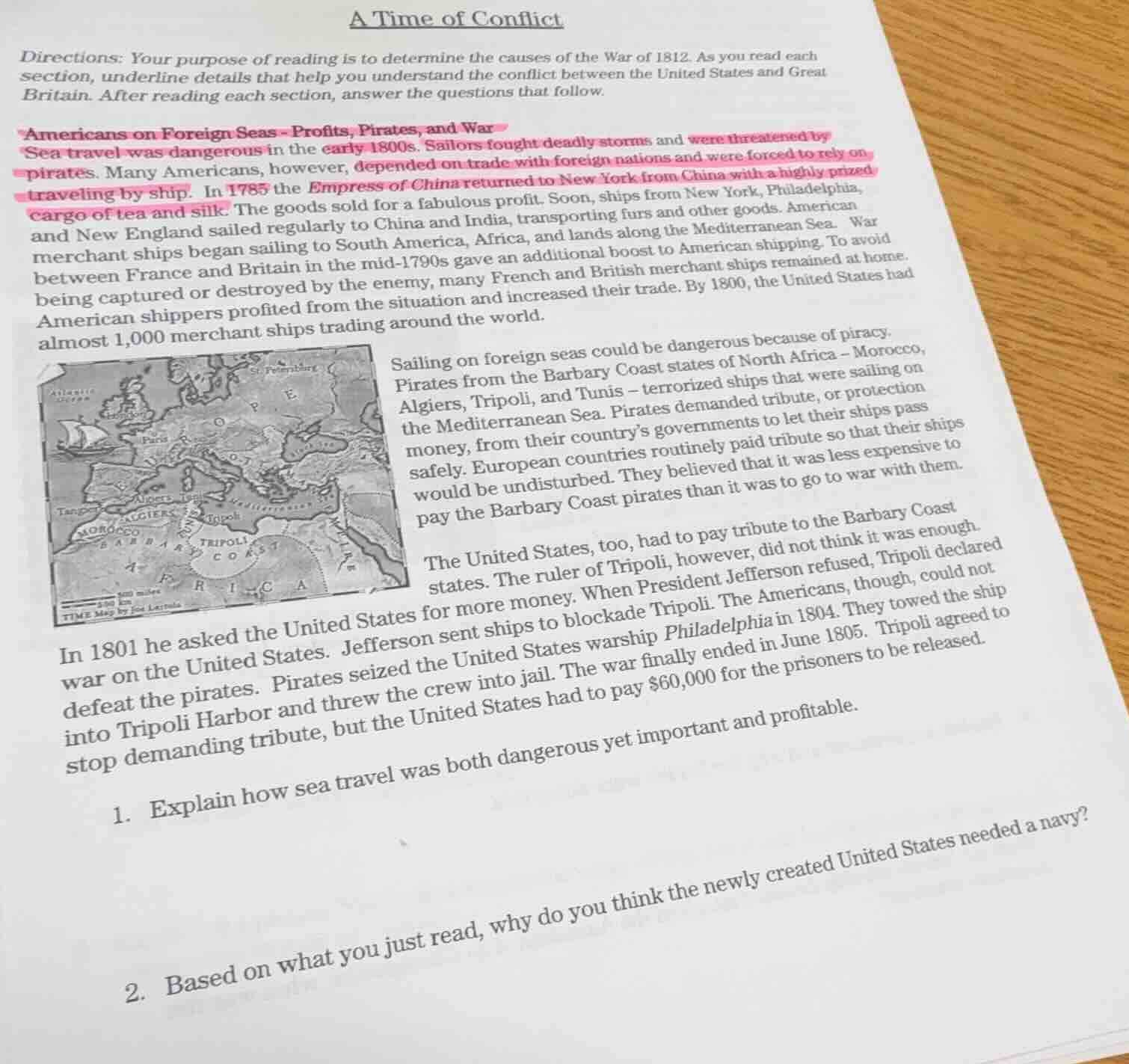
sailing on foreign seas could be dangerous because of piracy.
pirates from the barbary coast states of north africa - morocco,
algiers, tripoli, and tunis - terrorized ships that were sailing on
the mediterranean sea. pirates demanded tribute, or protection
money, from their country’s governments to let their ships pass
safely. european countries routinely paid tribute so that their ships
would be undisturbed. they believed that it was less expensive to
pay the barbary coast pirates than it was to go to war with them.
the united states, too, had to pay tribute to the barbary coast
states. the ruler of tripoli, however, did not think it was enough.
in 1801 he asked the united states for more money. when president jefferson refused, tripoli declared
war on the united states. jefferson sent ships to blockade tripoli. the americans, though, could not
defeat the pirates. pirates seized the united states warship philadelphia in 1804. they towed the ship
into tripoli harbor and threw the crew into jail. the war finally ended in june 1805. tripoli agreed to
stop demanding tribute, but the united states had to pay $60,000 for the prisoners to be released.
sea travel was both dangerous yet important and profitable.
- explain how sea travel was both dangerous yet important and profitable.
- based on what you just read, why do you think the newly created united states needed a navy?
Question 1
To explain how sea travel was both dangerous yet important and profitable, we analyze the text:
- Dangerous: The text states "Sea travel was dangerous in the early 1800s. Sailors fought deadly storms and were threatened by pirates." Also, pirates from the Barbary Coast (Morocco, Algiers, Tripoli, Tunis) terrorized ships in the Mediterranean Sea, demanding tribute. If not paid, ships were at risk of capture or destruction.
- Important and Profitable: Many Americans depended on trade with foreign nations, so they relied on ship travel. For example, in 1785, the Empress of China returned to New York with tea and silk that sold for a large profit. American merchant ships sailed to various regions (China, India, South America, Africa, Mediterranean) transporting goods like furs. By 1800, the US had almost 1,000 merchant ships trading globally, and during the war between France and Britain (mid - 1790s), American shippers profited as French and British ships stayed home, and US trade increased.
The newly created United States needed a navy for several reasons. First, for protection against piracy: as seen, pirates (like those from the Barbary Coast) threatened American merchant ships, seizing ships (e.g., the Philadelphia in 1804) and crew. A navy could defend these ships from pirate attacks, ensuring the safety of trade routes. Second, for trade protection: the US relied heavily on foreign trade (merchant ships trading globally), and a navy could safeguard these trade routes, allowing the profitable trade (like the tea/silk trade, fur trade) to continue. Also, in international conflicts (like the war with Tripoli), a navy was necessary to project power, defend national interests, and respond to acts of war (e.g., when Tripoli declared war, Jefferson sent ships to blockade Tripoli). Without a navy, American ships and trade would be at the mercy of pirates and foreign powers, endangering the economic livelihood that depended on sea trade.

Snap & solve any problem in the app
Get step-by-step solutions on Sovi AI
Photo-based solutions with guided steps
Explore more problems and detailed explanations
Sea travel was dangerous because sailors faced deadly storms and the threat of pirates (especially from the Barbary Coast, who demanded tribute and could capture/destroy ships if not paid). It was important and profitable as many Americans relied on foreign trade via ships: the Empress of China’s 1785 cargo made a huge profit, American ships traded globally (to China, India, etc., transporting goods like furs), and US trade boomed (e.g., during the France - Britain war, US shippers profited as rival ships stayed home), with 1,000 merchant ships trading by 1800.