QUESTION IMAGE
Question
tips for answering multiple - choice questions
if you are not sure which answer in a multiple - choice question is correct, try to identify and rule out the ones that you know are wrong. for example, if a question is about a topic, and an option statement in the chart that demonstrates it is wrong. if you can find three wrong options, the remaining one will be the correct one. for example, using this strategy to answer the question:
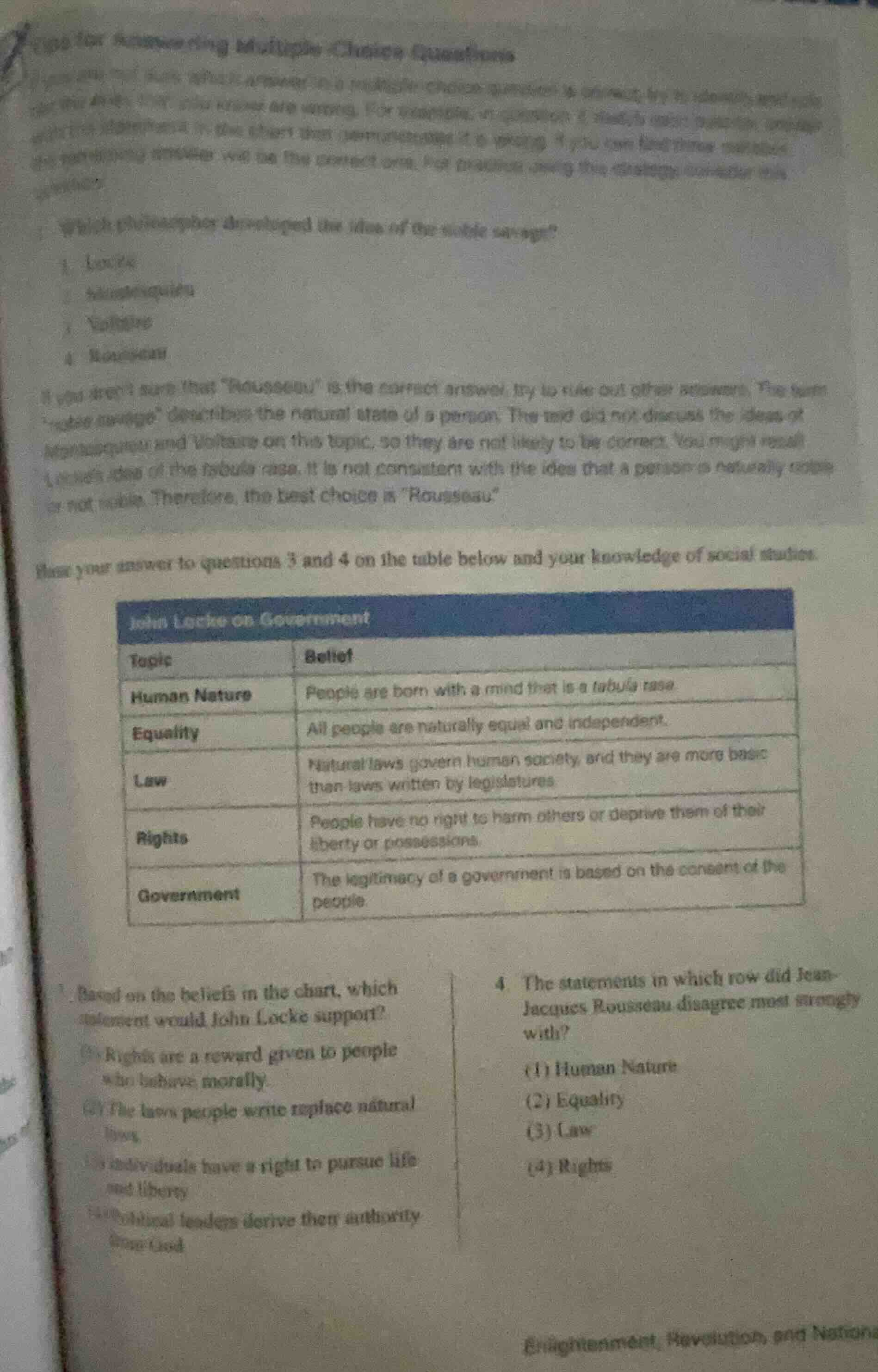
which philosopher developed the idea of the state of nature?
- locke
- montesquieu
- voltaire
- rousseau
if you arent sure that “rousseau” is the correct answer, try to rule out other answers. the term “state of nature” describes the natural state of a person. the text did not discuss the ideas of montesquieu and voltaire on this topic, so they are not likely to be correct. you might recall lockes idea of the tabula rasa. it is not consistent with the idea that a person is naturally cruel or not noble. therefore, the best choice is “rousseau.”
base your answer to questions 3 and 4 on the table below and your knowledge of social studies.
john locke on government
| topic | belief |
|---|---|
| equality | all people are naturally equal and independent. |
| law | natural laws govern human society, and they are more basic than laws written by legislatures. |
| rights | people have no right to harm others or deprive them of their liberty or possessions. |
| government | the legitimacy of a government is based on the consent of the people. |
- based on the beliefs in the chart, which statement would john locke support?
(1) rights are a reward given to people who behave morally.
(2) the laws people write replace natural laws.
(3) individuals have a right to pursue life and liberty.
(4) political leaders derive their authority from god.
- the statements in which row did jean - jacques rousseau disagree most strongly with?
(1) human nature
(2) equality
(3) law
(4) rights
Question 3
To determine which statement John Locke would support, we analyze each option using the chart:
- Option 1: Locke's "Rights" belief states people have natural rights (not rewards for morality), so eliminate.
- Option 2: Locke believed natural laws are more basic than written laws, so he would disagree with this. Eliminate.
- Option 3: Locke's "Rights" belief includes people's right to life and liberty (pursuing life and liberty aligns), so this is consistent.
- Option 4: Locke's "Government" belief is based on people's consent, not God, so eliminate.
To find where Rousseau disagrees most with Locke:
- Human Nature: Locke (tabula rasa) vs. Rousseau (noble savage, natural goodness) – some difference, but check others.
- Equality: Both believed in natural equality – little disagreement.
- Law: Locke: natural laws > written laws; Rousseau: social contract (written laws from general will) – strong disagreement, as Rousseau saw written laws (via social contract) as key, conflicting with Locke’s natural law priority.
- Rights: Both believed in natural rights – little disagreement.

Snap & solve any problem in the app
Get step-by-step solutions on Sovi AI
Photo-based solutions with guided steps
Explore more problems and detailed explanations
(3) Individuals have a right to pursue life and liberty