QUESTION IMAGE
Question
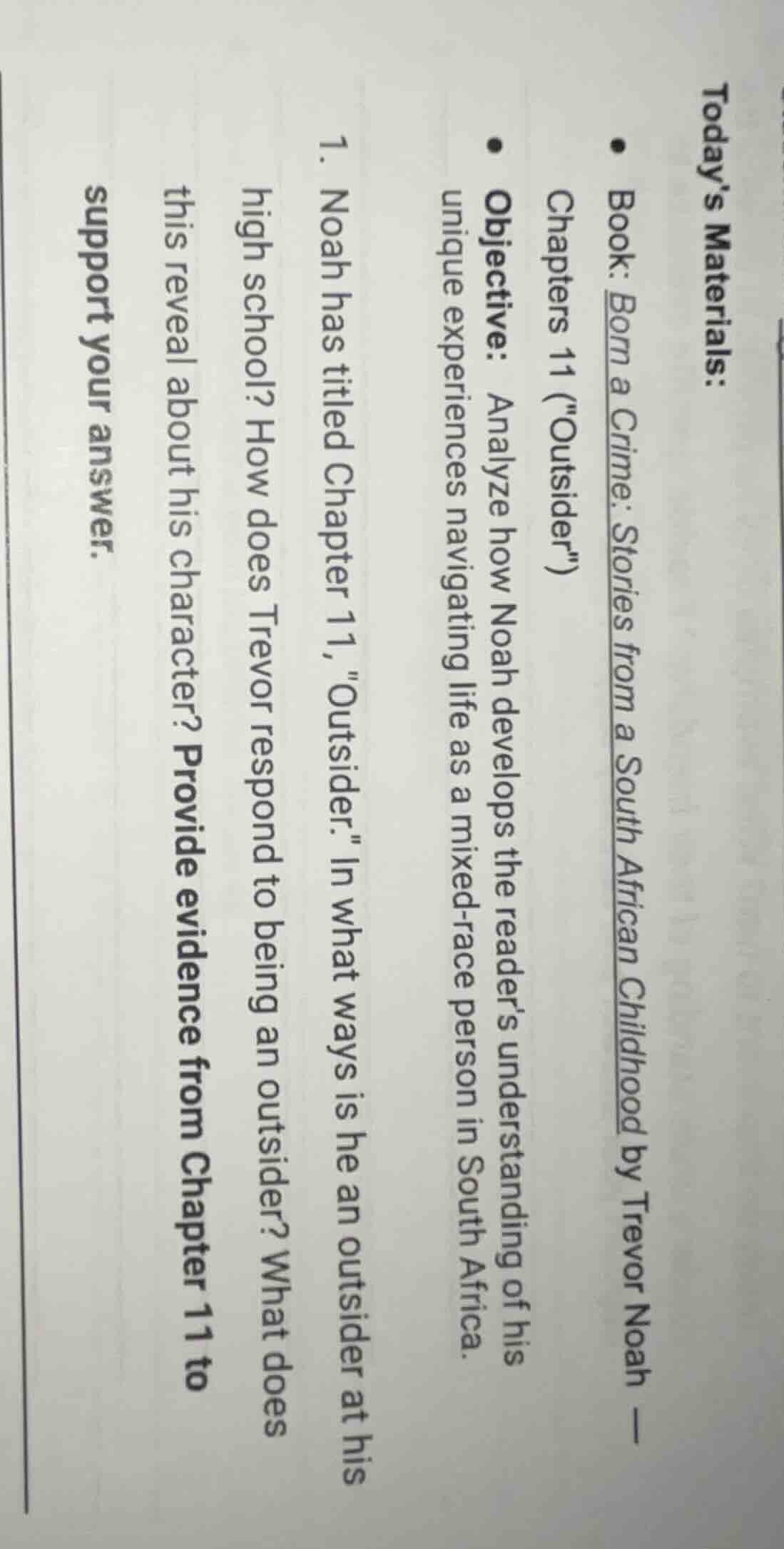
today’s materials: - book: born a crime: stories from a south african childhood by trevor noah — chapters 11 (\outsider\) - objective: analyze how noah develops the reader’s understanding of his unique experiences navigating life as a mixed - race person in south africa. 1. noah has titled chapter 11, \outsider.\ in what ways is he an outsider at his high school? how does trevor respond to being an outsider? what does this reveal about his character? provide evidence from chapter 11 to support your answer.
Brief Explanations
- Outsider status at school: Noah is biracial (white father, Black mother) in apartheid-era South Africa. At his all-Black high school, his lighter skin, fluency in multiple languages (not just the local African languages peers use), and his upbringing in a mixed household make him stand out. He is not fully accepted by the Black peer groups, and he cannot fit in with white students either due to the racial segregation norms of the time.
- Response to being an outsider: Noah leans into his role as an observer and uses humor and adaptability to cope. He becomes a mediator between different social groups at school, leveraging his ability to connect with people from various backgrounds. For example, he helps students from different cliques communicate, using his language skills to bridge gaps.
- Reveal about his character: This shows Noah is resilient, empathetic, and resourceful. His ability to turn his outsider status into a position of utility (connecting others) demonstrates his emotional intelligence. Evidence includes his role as a go-between for students, his willingness to embrace his difference instead of being defeated by it, and his reflection on how this experience taught him to navigate complex social landscapes.

Snap & solve any problem in the app
Get step-by-step solutions on Sovi AI
Photo-based solutions with guided steps
Explore more problems and detailed explanations
- Noah is an outsider at his all-Black high school due to his biracial identity, lighter skin, multilingualism, and non-traditional upbringing, which set him apart from peers who fit into strict racial/social boxes of apartheid South Africa; he is not fully accepted by Black peers and excluded from white circles.
- He responds by acting as a social mediator, using his language skills and adaptability to connect different cliques, and uses humor to cope with his isolation.
- This reveals he is resilient, empathetic, and resourceful—turning his marginalized status into a way to build bridges, as seen in his role connecting students from different groups and his ability to find purpose in his outsider position.