QUESTION IMAGE
Question
topic: graphing systems of linear equations
progress:
the movement of the progress bar may be uneven because questions can be worth more or less (including zero) depending on your answer.
question id: 98628
the sum of sharon’s and john’s ages is 70. john is 4 times as old as sharon.
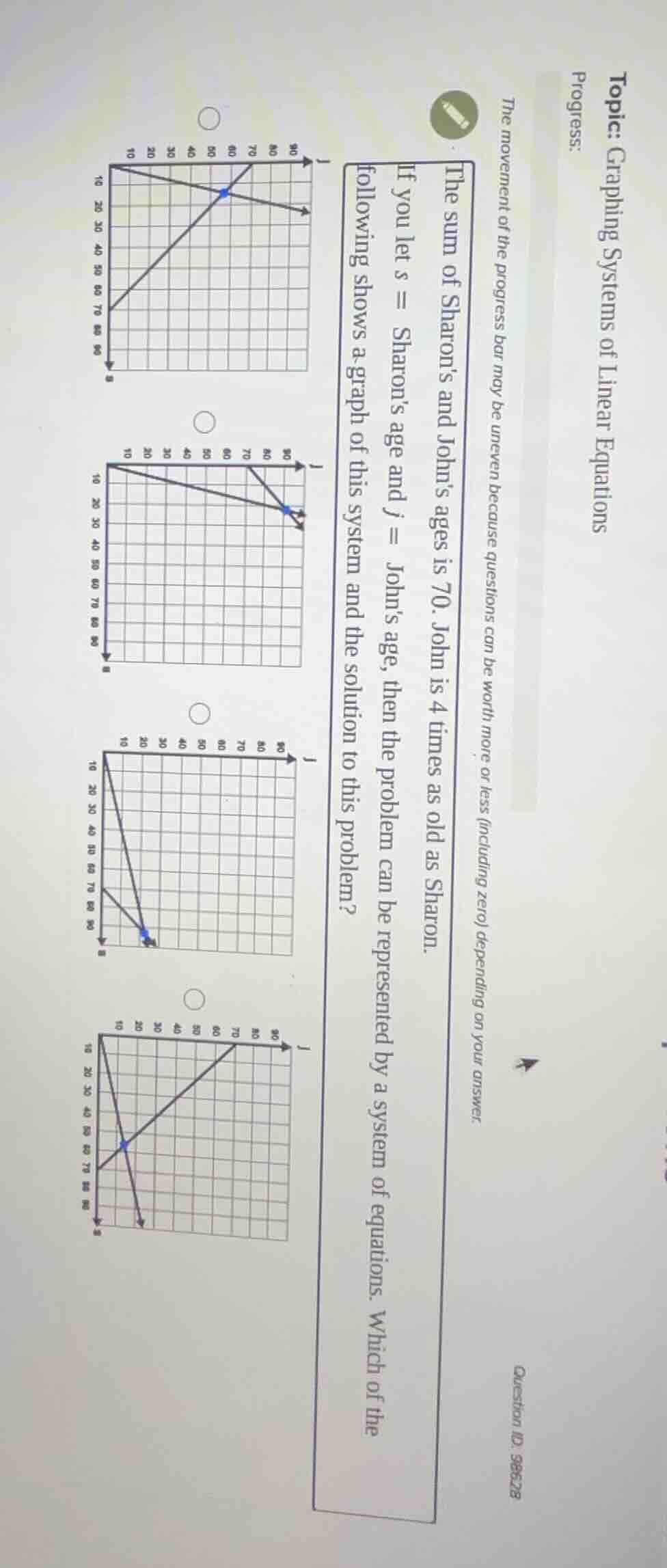
if you let ( s = ) sharon’s age and ( j = ) john’s age, then the problem can be represented by a system of equations. which of the following shows a graph of this system and the solution to this problem?
four graphs are shown, each with a grid and two lines, and a blue dot indicating a point. the x-axis is labeled ( j ) and the y-axis is labeled ( s ).
Step1: Define the equations
We know two conditions: the sum of their ages is 70, so \( s + j = 70 \). John is 4 times as old as Sharon, so \( j = 4s \).
Step2: Analyze the graphs
We need to find the graph where one line represents \( s + j = 70 \) (which can be rewritten as \( j=-s + 70 \), a line with slope -1 and y - intercept 70) and the other line represents \( j = 4s \) (a line with slope 4 and y - intercept 0).
Let's solve the system \(
\) by substitution. Substitute \( j = 4s \) into \( s + j=70 \), we get \( s+4s=70\), \( 5s = 70\), \( s = 14 \), then \( j=4\times14 = 56 \). So the solution is \( (s = 14,j = 56) \) or \( (14,56) \) when \( s \) is on the x - axis and \( j \) is on the y - axis.
Now let's analyze the lines:
- The line \( j=-s + 70 \): when \( s = 0 \), \( j = 70 \); when \( j = 0 \), \( s=70 \).
- The line \( j = 4s \): when \( s = 0 \), \( j = 0 \); when \( s=14 \), \( j = 56 \)
Looking at the graphs, the first graph (top - most) has one line with a negative slope (for \( j=-s + 70 \)) and one line with a positive slope (for \( j = 4s \)) and their intersection point should be at \( (14,56) \). Let's check the coordinates: if \( s = 14 \) (x - coordinate) and \( j = 56 \) (y - coordinate), we can see that in the first graph, the intersection point is at \( (14,56) \) (since when \( s = 14 \), \( j = 56 \) satisfies both lines: for \( j=-s + 70 \), \( 56=- 14 + 70=56 \); for \( j = 4s \), \( 56 = 4\times14\)).

Snap & solve any problem in the app
Get step-by-step solutions on Sovi AI
Photo-based solutions with guided steps
Explore more problems and detailed explanations
The first graph (the top - most graph among the four) is the correct one. To confirm, we can also note that the line \( j=-s + 70 \) has a negative slope and the line \( j = 4s \) has a positive slope, and their intersection is at \( (14,56) \), which matches the solution of the system of equations.