QUESTION IMAGE
Question
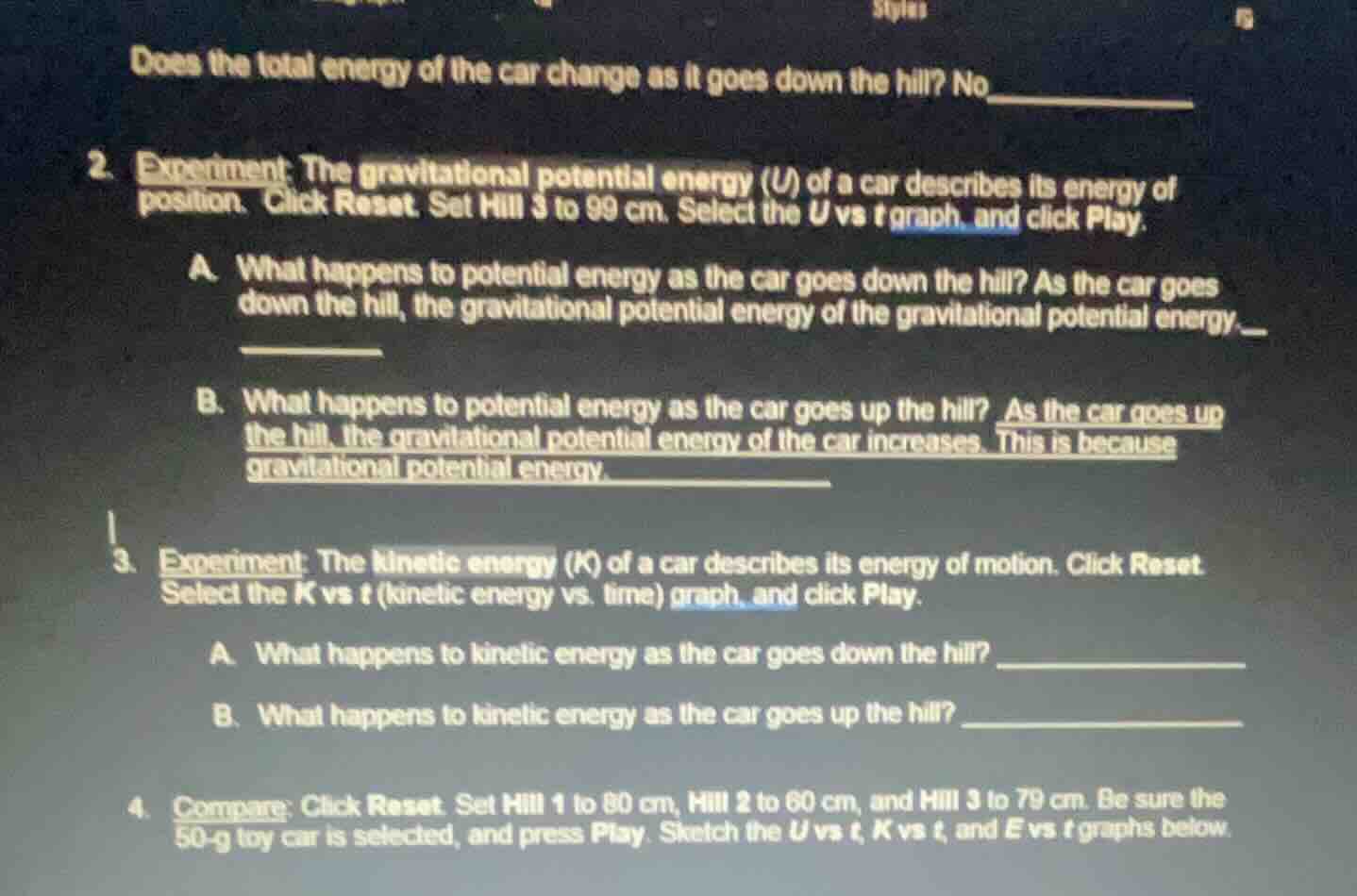
does the total energy of the car change as it goes down the hill? no______
- experiment: the gravitational potential energy (u) of a car describes its energy of position. click reset. set hill 3 to 99 cm. select the u vs t graph, and click play.
a. what happens to potential energy as the car goes down the hill? as the car goes down the hill, the gravitational potential energy of the gravitational potential energy. __
b. what happens to potential energy as the car goes up the hill? as the car goes up the hill, the gravitational potential energy of the car increases. this is because gravitational potential energy. ______
- experiment: the kinetic energy (k) of a car describes its energy of motion. click reset. select the k vs t (kinetic energy vs. time) graph, and click play.
a. what happens to kinetic energy as the car goes down the hill? __________
b. what happens to kinetic energy as the car goes up the hill? __________
- compare: click reset. set hill 1 to 80 cm, hill 2 to 60 cm, and hill 3 to 79 cm. be sure the 50 - g toy car is selected, and press play. sketch the u vs t, k vs t, and e vs t graphs below.
2A
Gravitational potential energy formula is \( U = mgh \), where \( h \) is height. As car goes down hill, height \( h \) decreases. So \( U \) decreases.
From \( U = mgh \), as car goes up hill, height \( h \) increases. So \( U \) increases (since mass \( m \) and gravity \( g \) are constant, increasing \( h \) increases \( U \)).
Kinetic energy \( K=\frac{1}{2}mv^{2} \). As car goes down hill, speed \( v \) increases (due to gravity accelerating it), so \( K \) increases (mass \( m \) is constant, increasing \( v \) increases \( K \)).

Snap & solve any problem in the app
Get step-by-step solutions on Sovi AI
Photo-based solutions with guided steps
Explore more problems and detailed explanations
decreases (because gravitational potential energy \( U = mgh \), and height \( h \) of the car decreases as it moves down the hill)