QUESTION IMAGE
Question
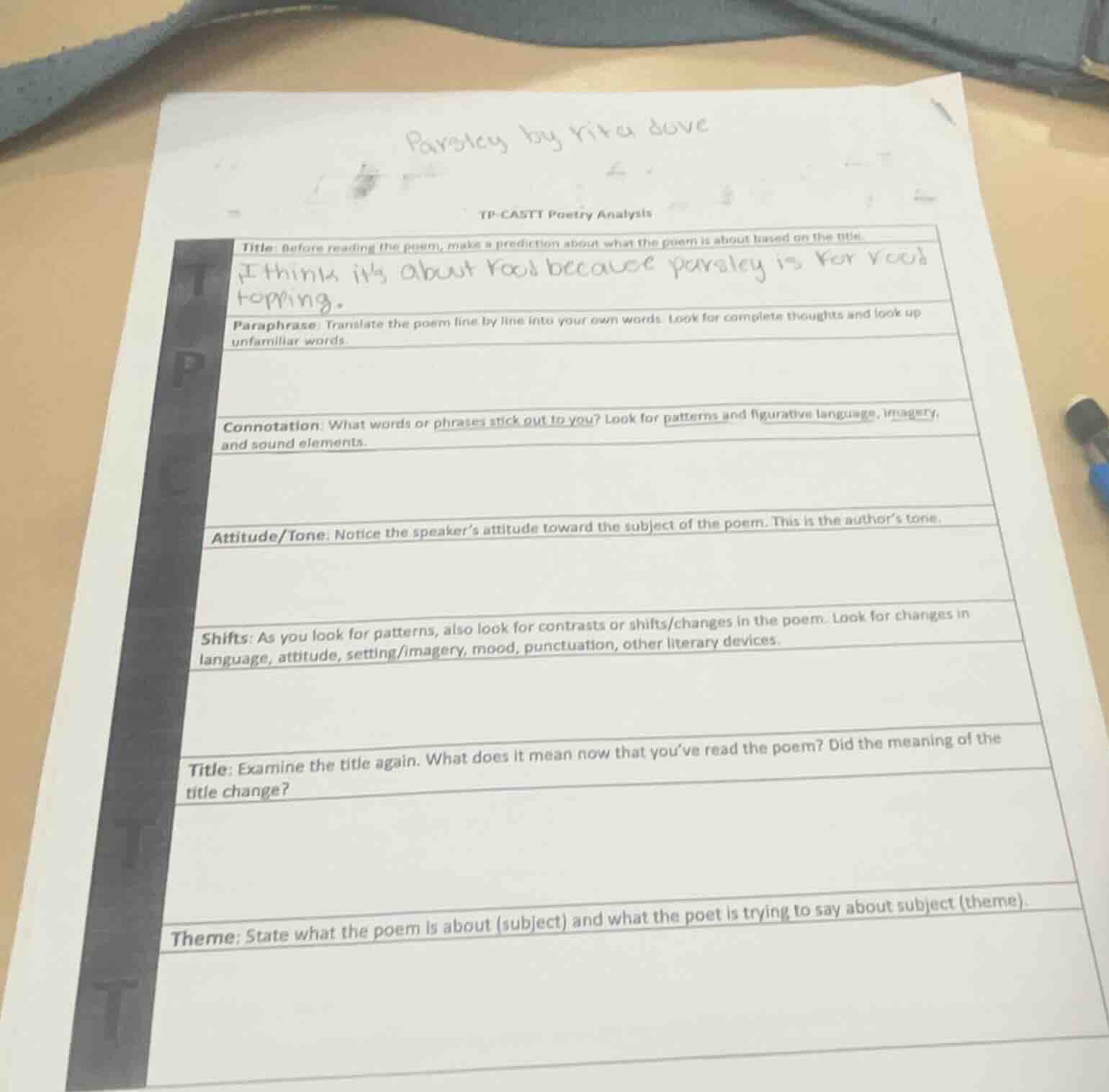
tp - castt poetry analysis
title: before reading the poem, make a prediction about what the poem is about based on the title.
i think its about food because parsley is for food topping.
paraphrase: translate the poem line by line into your own words. look for complete thoughts and look up unfamiliar words.
connotation: what words or phrases stick out to you? look for patterns and figurative language, imagery, and sound elements.
attitude/tone: notice the speaker’s attitude toward the subject of the poem. this is the author’s tone.
shifts: as you look for patterns, also look for contrasts or shifts/changes in the poem. look for changes in language, attitude, setting/imagery, mood, punctuation, other literary devices.
title: examine the title again. what does it mean now that you’ve read the poem? did the meaning of the title change?
theme: state what the poem is about (subject) and what the poet is trying to say about subject (theme).
This is a TP-CASTT analysis for Rita Dove's Parsley. Below is a completed breakdown based on the poem's content:
- Paraphrase: Line-by-line translation:
- Lines 1-4: A general sits counting his medals, while his mother hums a lullaby about parsley, a word he struggles to say.
- Lines 5-10: In the hills, rebels hide; the general orders his men to kill anyone who can't pronounce "perejil" (parsley) correctly.
- Lines 11-16: The dead are thrown into mass graves; the general's mother keeps humming, and the word "parsley" hangs in the air like a death sentence.
- Connotation: Key elements:
- "Parsley" is a symbol of linguistic violence and genocide (tied to the 1937 Haitian Massacre).
- Imagery of mass graves, the general's medals, and the mother's lullaby creates a contrast between cruelty and innocence.
- Repetition of "parsley" emphasizes its deadly power.
- Attitude/Tone: The speaker’s tone is somber, critical, and mournful, condemning the general’s brutal, arbitrary violence while highlighting the tragedy of the victims.
- Shifts: The poem shifts from the general’s arrogant, detached perspective (counting medals) to the visceral horror of the mass killings, then back to the eerie, persistent sound of the mother’s lullaby, amplifying the cycle of violence and trauma.
- Title (Post-Reading): The title no longer refers only to a herb; it is a symbol of linguistic oppression, state violence, and the arbitrary line between life and death for the Haitian victims.
- Theme: The poem’s subject is the 1937 Haitian Massacre, where Dominican forces killed Haitians who mispronounced "parsley." The theme is that linguistic and ethnic prejudice can be weaponized to commit state-sponsored violence, and that trauma persists through cultural and personal memory.

Snap & solve any problem in the app
Get step-by-step solutions on Sovi AI
Photo-based solutions with guided steps
Explore more problems and detailed explanations
Completed TP-CASTT Analysis:
- Paraphrase:
- A general boasts of his medals, his mother hums a lullaby about parsley—a word he cannot say right.
- Rebels hide in the hills; the general orders soldiers to kill anyone who mispronounces "perejil" (parsley).
- Victims are dumped in mass graves; the mother’s lullaby lingers, with "parsley" as a deadly, unspoken threat.
- Connotation:
- "Parsley" = symbol of linguistic genocide and arbitrary death.
- Contrasting imagery: military arrogance vs. civilian suffering; innocent lullaby vs. state violence.
- Repetition of "parsley" reinforces its traumatic weight.
- Attitude/Tone: Somber, condemnatory, and mournful, focusing on the injustice of the violence.
- Shifts: Moves from the general’s detached arrogance to the horror of the killings, then to the eerie, persistent lullaby, emphasizing unresolved trauma.
- Title (Post-Reading): The title now represents a tool of ethnic cleansing, not just a herb; its meaning shifts from mundane to deadly.
- Theme: State violence can be enabled by linguistic and ethnic prejudice, and trauma persists in collective memory long after the violence ends.