QUESTION IMAGE
Question
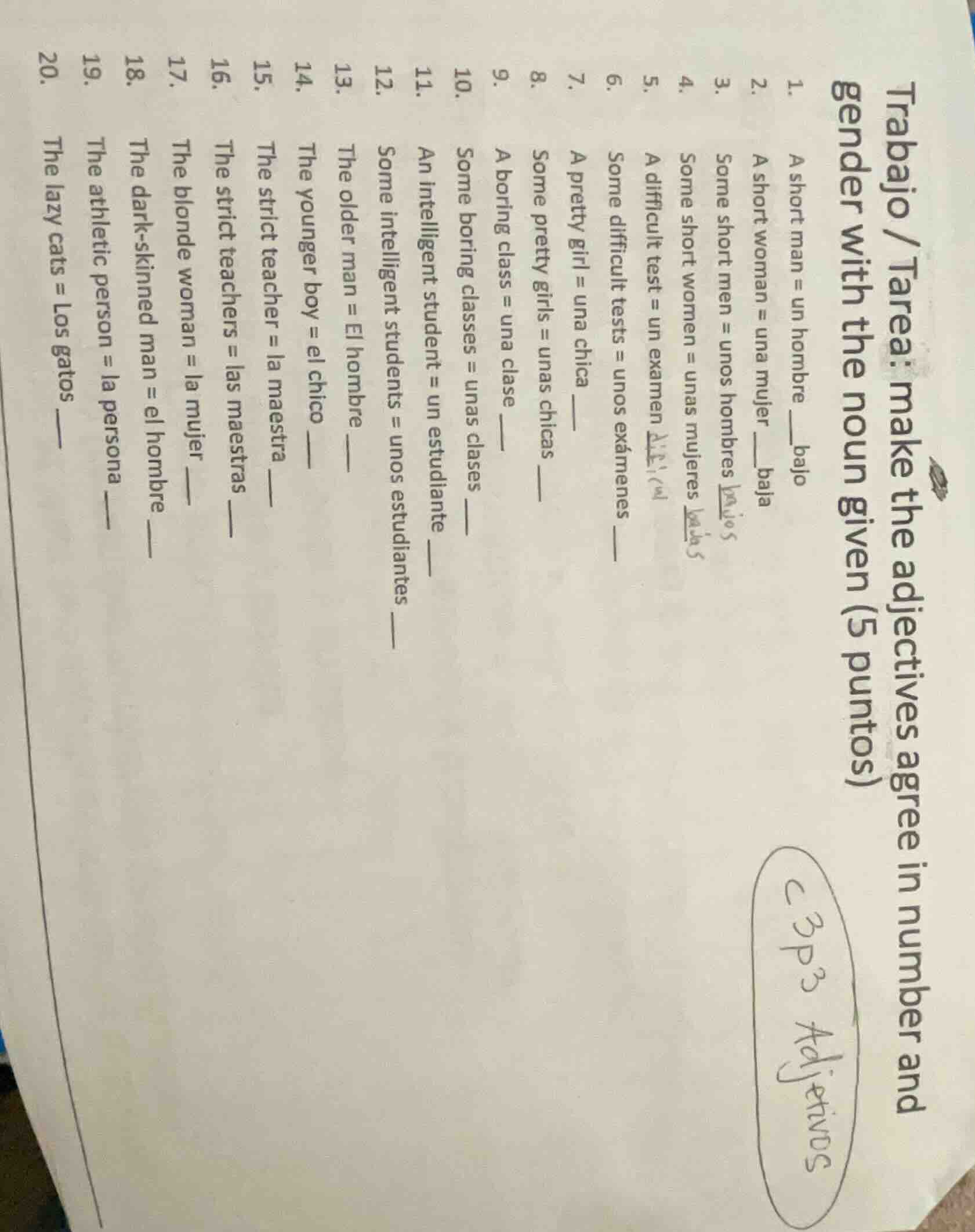
trabajo / tarea: make the adjectives agree in number and gender with the noun given (5 puntos)
- a short man = un hombre ___ bajo
- a short woman = una mujer ___ baja
- some short men = unos hombres ___
- some short women = unas mujeres ___
- a difficult test = un examen ___
- some difficult tests = unos exámenes ___
- a pretty girl = una chica ___
- some pretty girls = unas chicas ___
- a boring class = una clase ___
- some boring classes = unas clases ___
- an intelligent student = un estudiante ___
- some intelligent students = unos estudiantes ___
- the older man = el hombre ___
- the younger boy = el chico ___
- the strict teacher = la maestra ___
- the strict teachers = las maestras ___
- the blonde woman = la mujer ___
- the dark - skinned man = el hombre ___
- the athletic person = la persona ___
- the lazy cats = los gatos ___
To solve these problems, we need to make the adjectives agree in number (and gender, if applicable) with the given nouns in Spanish. Let's go through each one:
1. A short man = un hombre bajo
(No change needed as "hombre" is singular masculine and "bajo" is singular masculine.)
2. A short woman = una mujer baja
(No change needed as "mujer" is singular feminine and "baja" is singular feminine.)
3. Some short men = unos hombres bajos
("hombres" is plural masculine, so "bajos" (plural masculine) is used.)
4. Some short women = unas mujeres bajas
("mujeres" is plural feminine, so "bajas" (plural feminine) is used.)
5. A difficult test = un examen difícil
(No change needed as "examen" is singular masculine and "difícil" is singular masculine (adjectives like "difícil" have the same form for singular masculine and feminine in some cases, but here "examen" is masculine).)
6. Some difficult tests = unos exámenes difíciles
("exámenes" is plural masculine, so "difíciles" (plural) is used.)
7. A pretty girl = una chica bonita
(Assuming the adjective is "bonita" (singular feminine) to match "chica" (singular feminine). The original might have a typo, but the correct adjective for "pretty" here would be "bonita".)
8. Some pretty girls = unas chicas bonitas
("chicas" is plural feminine, so "bonitas" (plural feminine) is used.)
9. A boring class = una clase aburrida
("clase" is singular feminine, so "aburrida" (singular feminine) is used.)
10. Some boring classes = unas clases aburridas
("clases" is plural feminine, so "aburridas" (plural feminine) is used.)
11. An intelligent student = un estudiante inteligente
(No change needed as "estudiante" is singular masculine (or feminine, but here "un" indicates masculine) and "inteligente" is singular masculine (or feminine, as it's invariable in singular for gender in this case).)
12. Some intelligent students = unos estudiantes inteligentes
("estudiantes" is plural, so "inteligentes" (plural) is used.)
13. The older man = El hombre mayor
("hombre" is singular masculine, so "mayor" (singular masculine) is used.)
14. The younger boy = el chico menor
("chico" is singular masculine, so "menor" (singular masculine) is used.)
15. The strict teacher = la maestra estricta
("maestra" is singular feminine, so "estricta" (singular feminine) is used.)
16. The strict teachers = las maestras estrictas
("maestras" is plural feminine, so "estrictas" (plural feminine) is used.)
17. The blonde woman = la mujer rubia
("mujer" is singular feminine, so "rubia" (singular feminine) is used.)
18. The dark - skinned man = el hombre moreno
("hombre" is singular masculine, so "moreno" (singular masculine) is used.)
19. The athletic person = la persona atlética
("persona" is singular feminine, so "atlética" (singular feminine) is used.)
20. The lazy cats = Los gatos perezosos
("gatos" is plural masculine, so "perezosos" (plural masculine) is used.)
If we take question 20 as an example:
Step 1: Identify the noun and its properties
The noun is "gatos", which is plural masculine.
Step 2: Determine the correct adjective form
The adjective "lazy" in Spanish is "perezoso" (singular masculine). For plural masculine, we use "perezosos".

Snap & solve any problem in the app
Get step-by-step solutions on Sovi AI
Photo-based solutions with guided steps
Explore more problems and detailed explanations
Los gatos perezosos