QUESTION IMAGE
Question
translations on the coordinate plane
- a translation moves every point of a figure the same and the same distance__.
- a translation can move a figure and
- translations are also thought of as slides.
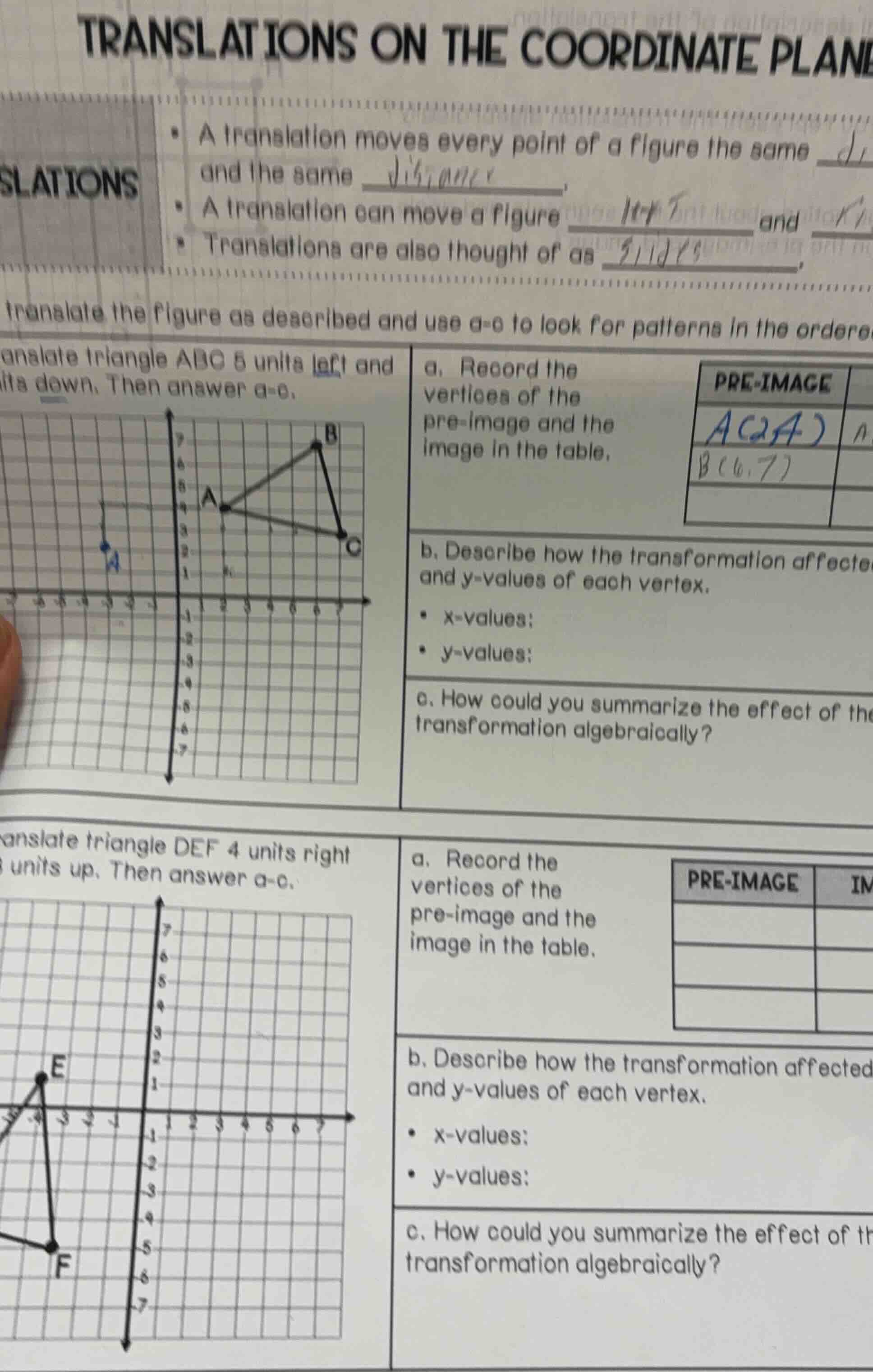
translate the figure as described and use a - c to look for patterns in the order
translate triangle abc 5 units left and 1 unit down. then answer a - c.
a. record the
vertices of the
pre - image and the
image in the table.
b. describe how the transformation affected
the x - values and y - values of each vertex.
- x - values:
- y - values:
c. how could you summarize the effect of the
transformation algebraically?
translate triangle def 4 units right
3 units up. then answer a - c.
a. record the
vertices of the
pre - image and the
image in the table.
b. describe how the transformation affected
the x - values and y - values of each vertex.
- x - values:
- y - values:
c. how could you summarize the effect of the
transformation algebraically?
Part 1: Translating Triangle ABC (5 units left and 3 units down)
a. Finding Pre - Image and Image Vertices
First, we identify the coordinates of the pre - image (triangle ABC) from the graph.
- Vertex A: From the graph, we can see that the coordinates of A are \((2, 4)\).
- Vertex B: The coordinates of B are \((6, 7)\).
- Vertex C: The coordinates of C are \((7, 3)\).
To find the image after translating 5 units left and 3 units down, we use the translation rules: for a translation of \(h\) units left (subtract \(h\) from the \(x\) - coordinate) and \(k\) units down (subtract \(k\) from the \(y\) - coordinate). Here, \(h = 5\) and \(k=3\).
- For vertex A \((x,y)=(2,4)\):
- New \(x\) - coordinate: \(x'=2 - 5=-3\)
- New \(y\) - coordinate: \(y'=4 - 3 = 1\)
- So, the image of A, \(A'\) has coordinates \((-3,1)\).
- For vertex B \((x,y)=(6,7)\):
- New \(x\) - coordinate: \(x'=6 - 5 = 1\)
- New \(y\) - coordinate: \(y'=7 - 3=4\)
- So, the image of B, \(B'\) has coordinates \((1,4)\).
- For vertex C \((x,y)=(7,3)\):
- New \(x\) - coordinate: \(x'=7 - 5 = 2\)
- New \(y\) - coordinate: \(y'=3 - 3=0\)
- So, the image of C, \(C'\) has coordinates \((2,0)\).
The table of pre - image and image vertices is:
| Pre - Image | Image |
|---|---|
| \(B(6,7)\) | \(B'(1,4)\) |
| \(C(7,3)\) | \(C'(2,0)\) |
b. Effect on \(x\) - values and \(y\) - values
- \(x\) - values: For each vertex, the \(x\) - coordinate is decreased by 5 (because we are moving 5 units to the left).
- \(y\) - values: For each vertex, the \(y\) - coordinate is decreased by 3 (because we are moving 3 units down).
c. Algebraic Summary
If a point \((x,y)\) in the pre - image is translated 5 units left and 3 units down, the coordinates of the image \((x',y')\) are given by the transformation:
\(x'=x - 5\) and \(y'=y - 3\)
In vector form, the translation can be written as \((x,y)\to(x - 5,y - 3)\)
Part 2: Translating Triangle DEF (4 units right and 3 units up)
a. Finding Pre - Image and Image Vertices (assuming we identify the pre - image coordinates from the graph)
Let's assume the coordinates of D, E, F from the graph:
- Let's say \(D(-5,1)\), \(E(-4,1)\), \(F(-3,-5)\) (we need to confirm from the graph, but for the sake of the process, we proceed with these assumed values).
To find the image after translating 4 units right and 3 units up, we use the translation rules: for a translation of \(h\) units right (add \(h\) to the \(x\) - coordinate) and \(k\) units up (add \(k\) to the \(y\) - coordinate). Here, \(h = 4\) and \(k = 3\).
- For vertex D \((x,y)=(-5,1)\):
- New \(x\) - coordinate: \(x'=-5 + 4=-1\)
- New \(y\) - coordinate: \(y'=1+3 = 4\)
- So, the image of D, \(D'\) has coordinates \((-1,4)\).
- For vertex E \((x,y)=(-4,1)\):
- New \(x\) - coordinate: \(x'=-4 + 4=0\)
- New \(y\) - coordinate: \(y'=1 + 3=4\)
- So, the image of E, \(E'\) has coordinates \((0,4)\).
- For vertex F \((x,y)=(-3,-5)\):
- New \(x\) - coordinate: \(x'=-3 + 4 = 1\)
- New \(y\) - coordinate: \(y'=-5+3=-2\)
- So, the image of F, \(F'\) has coordinates \((1,-2)\).
The table of pre - image and image vertices is:
| Pre - Image | Image |
|---|---|
| \(E(-4,1)\) | \(E'(0,4)\) |
| \(F(-3,-5)\) | \(F'(1,-2)\) |
b. Effect on \(x\) - values and \(y\) - values
- \(x\) - values: For each vertex, the \(x\) - coordinate is increased by 4 (because we are moving 4 units to the right).
- \(y\) - values: For each vertex, the \(y\) - coordinate is increased…

Snap & solve any problem in the app
Get step-by-step solutions on Sovi AI
Photo-based solutions with guided steps
Explore more problems and detailed explanations
Part 1: Translating Triangle ABC (5 units left and 3 units down)
a. Finding Pre - Image and Image Vertices
First, we identify the coordinates of the pre - image (triangle ABC) from the graph.
- Vertex A: From the graph, we can see that the coordinates of A are \((2, 4)\).
- Vertex B: The coordinates of B are \((6, 7)\).
- Vertex C: The coordinates of C are \((7, 3)\).
To find the image after translating 5 units left and 3 units down, we use the translation rules: for a translation of \(h\) units left (subtract \(h\) from the \(x\) - coordinate) and \(k\) units down (subtract \(k\) from the \(y\) - coordinate). Here, \(h = 5\) and \(k=3\).
- For vertex A \((x,y)=(2,4)\):
- New \(x\) - coordinate: \(x'=2 - 5=-3\)
- New \(y\) - coordinate: \(y'=4 - 3 = 1\)
- So, the image of A, \(A'\) has coordinates \((-3,1)\).
- For vertex B \((x,y)=(6,7)\):
- New \(x\) - coordinate: \(x'=6 - 5 = 1\)
- New \(y\) - coordinate: \(y'=7 - 3=4\)
- So, the image of B, \(B'\) has coordinates \((1,4)\).
- For vertex C \((x,y)=(7,3)\):
- New \(x\) - coordinate: \(x'=7 - 5 = 2\)
- New \(y\) - coordinate: \(y'=3 - 3=0\)
- So, the image of C, \(C'\) has coordinates \((2,0)\).
The table of pre - image and image vertices is:
| Pre - Image | Image |
|---|---|
| \(B(6,7)\) | \(B'(1,4)\) |
| \(C(7,3)\) | \(C'(2,0)\) |
b. Effect on \(x\) - values and \(y\) - values
- \(x\) - values: For each vertex, the \(x\) - coordinate is decreased by 5 (because we are moving 5 units to the left).
- \(y\) - values: For each vertex, the \(y\) - coordinate is decreased by 3 (because we are moving 3 units down).
c. Algebraic Summary
If a point \((x,y)\) in the pre - image is translated 5 units left and 3 units down, the coordinates of the image \((x',y')\) are given by the transformation:
\(x'=x - 5\) and \(y'=y - 3\)
In vector form, the translation can be written as \((x,y)\to(x - 5,y - 3)\)
Part 2: Translating Triangle DEF (4 units right and 3 units up)
a. Finding Pre - Image and Image Vertices (assuming we identify the pre - image coordinates from the graph)
Let's assume the coordinates of D, E, F from the graph:
- Let's say \(D(-5,1)\), \(E(-4,1)\), \(F(-3,-5)\) (we need to confirm from the graph, but for the sake of the process, we proceed with these assumed values).
To find the image after translating 4 units right and 3 units up, we use the translation rules: for a translation of \(h\) units right (add \(h\) to the \(x\) - coordinate) and \(k\) units up (add \(k\) to the \(y\) - coordinate). Here, \(h = 4\) and \(k = 3\).
- For vertex D \((x,y)=(-5,1)\):
- New \(x\) - coordinate: \(x'=-5 + 4=-1\)
- New \(y\) - coordinate: \(y'=1+3 = 4\)
- So, the image of D, \(D'\) has coordinates \((-1,4)\).
- For vertex E \((x,y)=(-4,1)\):
- New \(x\) - coordinate: \(x'=-4 + 4=0\)
- New \(y\) - coordinate: \(y'=1 + 3=4\)
- So, the image of E, \(E'\) has coordinates \((0,4)\).
- For vertex F \((x,y)=(-3,-5)\):
- New \(x\) - coordinate: \(x'=-3 + 4 = 1\)
- New \(y\) - coordinate: \(y'=-5+3=-2\)
- So, the image of F, \(F'\) has coordinates \((1,-2)\).
The table of pre - image and image vertices is:
| Pre - Image | Image |
|---|---|
| \(E(-4,1)\) | \(E'(0,4)\) |
| \(F(-3,-5)\) | \(F'(1,-2)\) |
b. Effect on \(x\) - values and \(y\) - values
- \(x\) - values: For each vertex, the \(x\) - coordinate is increased by 4 (because we are moving 4 units to the right).
- \(y\) - values: For each vertex, the \(y\) - coordinate is increased by 3 (because we are moving 3 units up).
c. Algebraic Summary
If a point \((x,y)\) in the pre - image is translated 4 units right and 3 units up, the coordinates of the image \((x',y')\) are given by the transformation:
\(x'=x + 4\) and \(y'=y + 3\)
In vector form, the translation can be written as \((x,y)\to(x + 4,y + 3)\)
Final Answers (for the first part - Triangle ABC)
a. Table
| Pre - Image | Image |
|---|---|
| \(B(6,7)\) | \(B'(1,4)\) |
| \(C(7,3)\) | \(C'(2,0)\) |
b.
- \(x\) - values: Decreased by 5.
- \(y\) - values: Decreased by 3.
c.
The algebraic transformation is \((x,y)\to(x - 5,y - 3)\)
Final Answers (for the second part - Triangle DEF)
a. Table (assuming pre - image coordinates as above)
| Pre - Image | Image |
|---|---|
| \(E(-4,1)\) | \(E'(0,4)\) |
| \(F(-3,-5)\) | \(F'(1,-2)\) |
b.
- \(x\) - values: Increased by 4.
- \(y\) - values: Increased by 3.
c.
The algebraic transformation is \((x,y)\to(x + 4,y + 3)\)