QUESTION IMAGE
Question
transverse and longitudinal waves
read and answer the questions to assess your prior knowledge of the content.
- how is energy transferred through longitudinal waves?
a) particles move side to side, away from the starting point.
b. particles move perpendicular to the wave motion.
c. particles must be transmitted through a vacuum.
d. particles move parallel to the wave motion.
- energy travels through objects in a predictable pattern. a transverse wave has a pattern that is similar to which of the following objects?
i. waves in water
ii. radio waves
iii. visible light waves
iv. waves created by the motion of tectonic plate movement
a. i only
b. i and ii only
c. i and iii only
d. i, ii, iii, and iv
- how is energy transferred through transverse waves?
a. movement of particles perpendicular to the direction of the wave
b. giving off light in the direction of the wave
c. giving off sound in the direction of the wave
d. movement of particles parallel to the direction of the wave
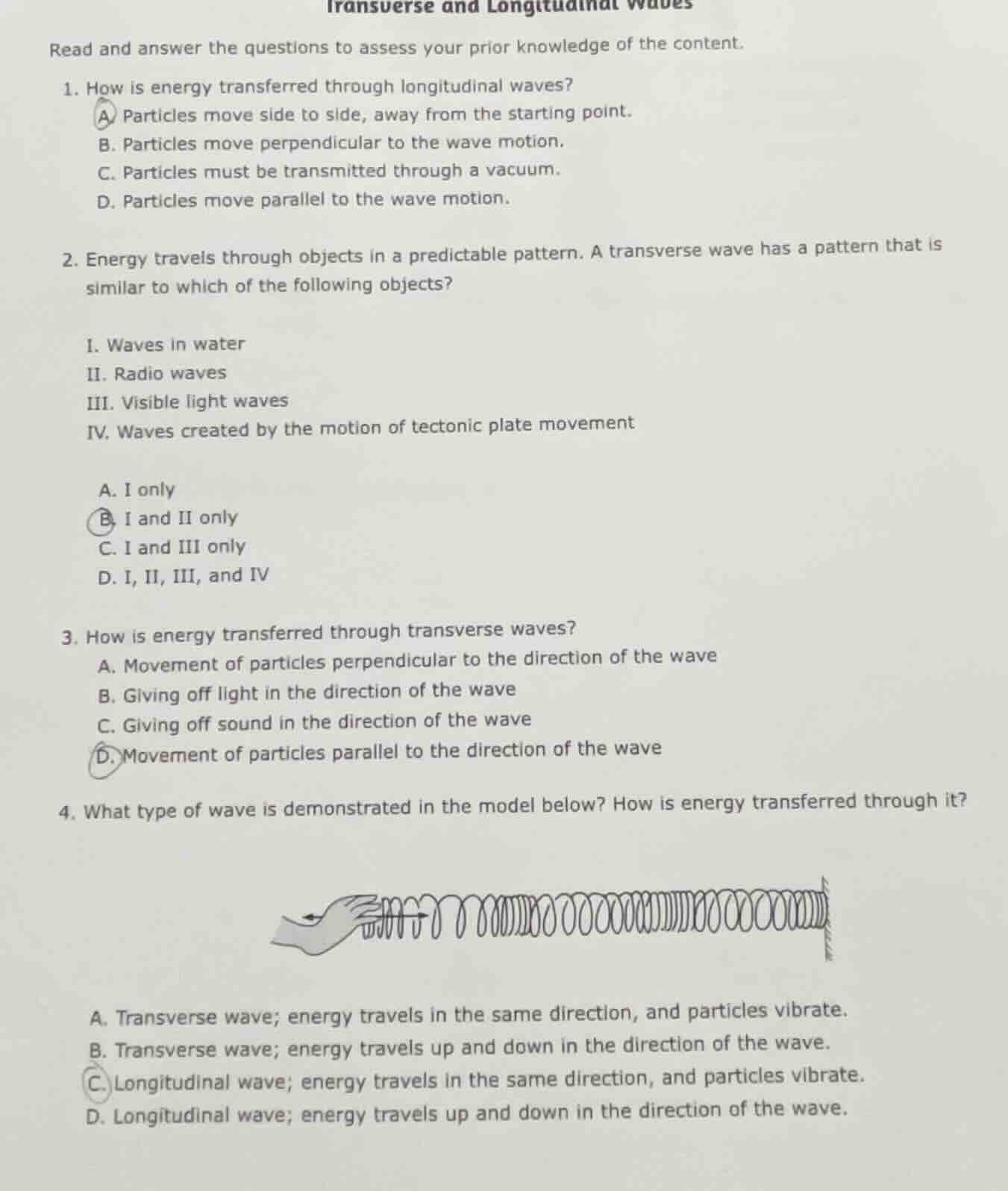
- what type of wave is demonstrated in the model below? how is energy transferred through it?
image of a hand moving a slinky
a. transverse wave; energy travels in the same direction, and particles vibrate.
b. transverse wave; energy travels up and down in the direction of the wave.
c. longitudinal wave; energy travels in the same direction, and particles vibrate.
d. longitudinal wave; energy travels up and down in the direction of the wave.
- For longitudinal waves, particle motion is parallel to wave direction, which transfers energy.
- Radio waves and visible light are transverse; water surface waves are a mix, tectonic plate waves include longitudinal (P-waves), so only II and III are transverse.
- Transverse waves transfer energy via particles moving perpendicular to wave direction.
- The slinky model shows compressions/rarefactions, a longitudinal wave, with energy and particle vibration in the same direction.

Snap & solve any problem in the app
Get step-by-step solutions on Sovi AI
Photo-based solutions with guided steps
Explore more problems and detailed explanations
- D. Particles move parallel to the wave motion.
- C. I and III only
- A. Movement of particles perpendicular to the direction of the wave
- C. Longitudinal wave; energy travels in the same direction, and particles vibrate.