QUESTION IMAGE
Question
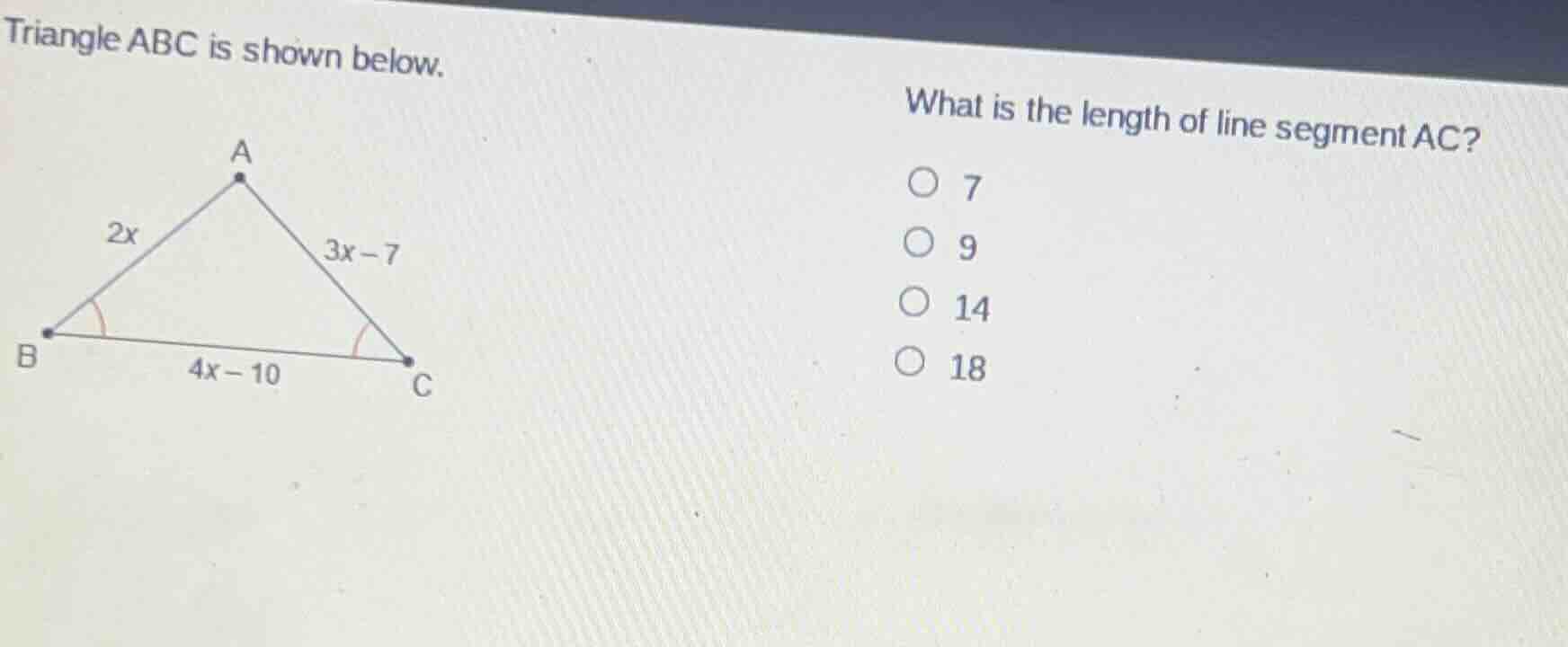
triangle abc is shown below. what is the length of line segment ac? 7 9 14 18
Step1: Identify triangle type
Since angles at B and C are equal, triangle ABC is isosceles with \( AB = AC \)? Wait, no, wait—wait, in an isosceles triangle, sides opposite equal angles are equal. Wait, angle at B and angle at C are equal, so sides opposite them: side opposite angle B is AC, side opposite angle C is AB. Wait, no: angle at B is at vertex B, so side opposite is AC; angle at C is at vertex C, side opposite is AB. Wait, but in the diagram, AB is \( 2x \), AC is \( 3x - 7 \), and BC is \( 4x - 10 \). Wait, no, maybe I got the sides wrong. Wait, angle at B and angle at C are equal, so the sides adjacent? Wait, no—wait, in a triangle, equal angles imply equal opposite sides. So angle B = angle C, so side AC (opposite angle B) and side AB (opposite angle C) should be equal? Wait, no: angle B is at vertex B, so the side opposite angle B is AC; angle C is at vertex C, so the side opposite angle C is AB. So if angle B = angle C, then AC = AB? Wait, but AB is \( 2x \), AC is \( 3x - 7 \). Wait, that can't be. Wait, maybe I mixed up the sides. Wait, maybe AB and AC are not the opposite sides. Wait, no—wait, let's look at the labels: vertex A, B, C. So side AB is between A and B, length \( 2x \); side AC is between A and C, length \( 3x - 7 \); side BC is between B and C, length \( 4x - 10 \). Angles at B and C are equal, so triangle ABC is isosceles with AB = AC? Wait, no, if angles at B and C are equal, then the sides opposite them are equal. So side opposite angle B is AC, side opposite angle C is AB. So AC = AB? Wait, but AB is \( 2x \), AC is \( 3x - 7 \). So set \( 2x = 3x - 7 \)? Wait, that would give \( x = 7 \), but then let's check BC: \( 4x - 10 = 4*7 -10 = 18 \), AB = 14, AC = 14. But wait, the options are 7,9,14,18. Wait, but maybe I made a mistake. Wait, maybe the equal angles imply that AB = BC? No, that doesn't make sense. Wait, no—wait, maybe the sides adjacent to the equal angles? Wait, no, the correct property is that in a triangle, equal angles have equal opposite sides. So angle B = angle C, so side AC (opposite angle B) = side AB (opposite angle C). Wait, but AB is \( 2x \), AC is \( 3x -7 \). So \( 2x = 3x -7 \) → \( x =7 \). Then AC is \( 3*7 -7 = 14 \). Wait, but let's check BC: \( 4*7 -10 = 18 \). Then AB is \( 2*7 =14 \), AC is 14, BC is 18. That works. Alternatively, maybe the equal angles imply AB = BC? Let's check: \( 2x = 4x -10 \) → \( 2x =10 \) → \( x=5 \). Then AC is \( 3*5 -7 =8 \), which is not an option. Or AC = BC: \( 3x -7 =4x -10 \) → \( x=3 \). Then AB is \( 2*3=6 \), not an option. So the correct approach is angle B = angle C, so AB = AC (opposite sides). So \( 2x = 3x -7 \) → \( x=7 \). Then AC is \( 3*7 -7 =14 \).
Step2: Solve for x
Set \( AB = AC \) (since angle B = angle C, so opposite sides equal):
\( 2x = 3x - 7 \)
Subtract \( 2x \) from both sides:
\( 0 = x - 7 \)
Add 7 to both sides:
\( x = 7 \)
Step3: Calculate AC length
Substitute \( x = 7 \) into \( AC = 3x - 7 \):
\( AC = 3(7) - 7 = 21 - 7 = 14 \)

Snap & solve any problem in the app
Get step-by-step solutions on Sovi AI
Photo-based solutions with guided steps
Explore more problems and detailed explanations
14