QUESTION IMAGE
Question
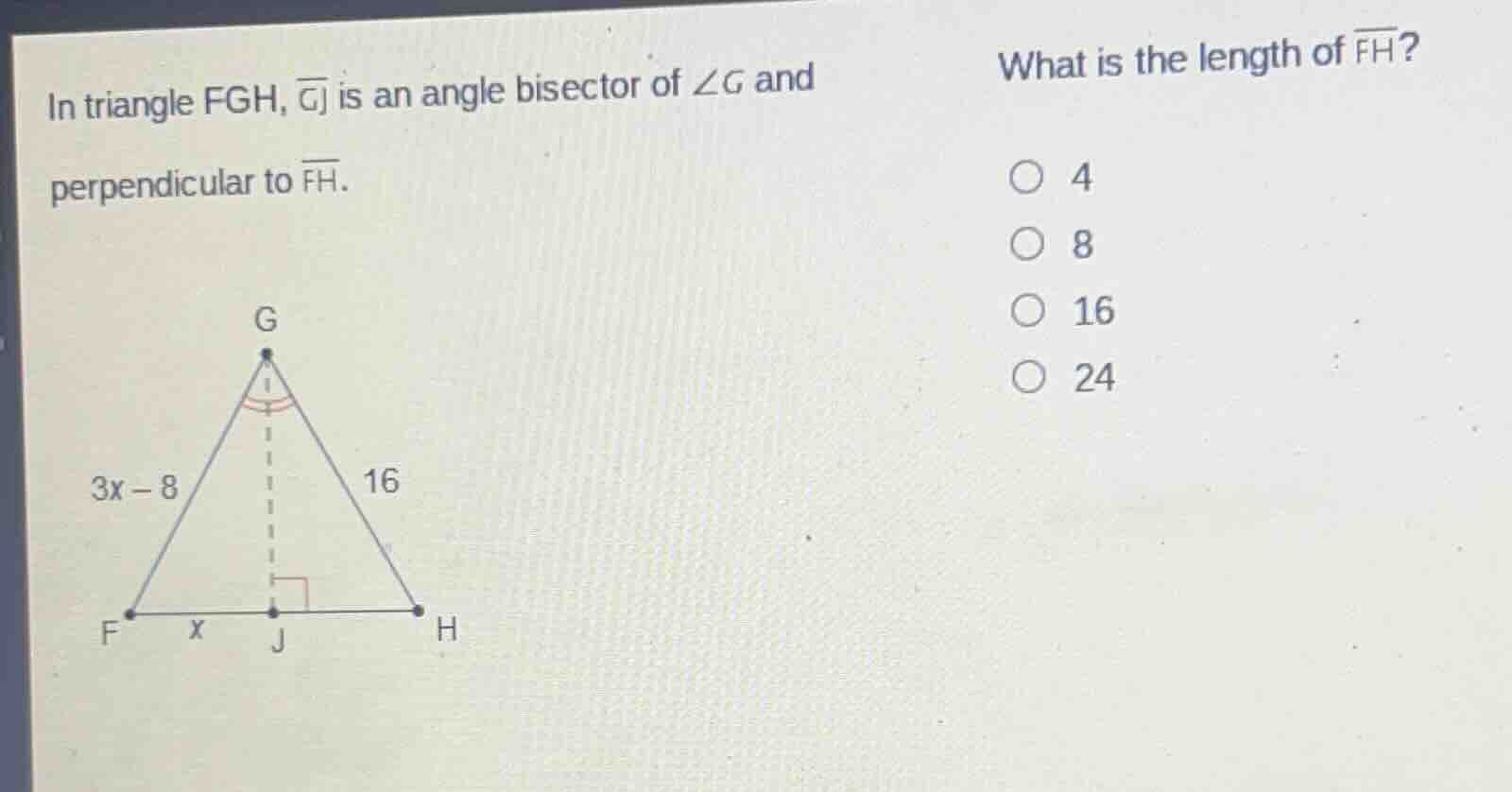
in triangle fgh, gj is an angle bisector of ∠g and perpendicular to fh. what is the length of fh? 4 8 16 24 3x - 8 16 f x j h
Step1: Identify triangle properties
Since \( GJ \) is an angle bisector and perpendicular to \( FH \), triangle \( FGH \) is isosceles with \( FG = GH \). So, set \( 3x - 8 = 16 \).
\[ 3x - 8 = 16 \]
Step2: Solve for \( x \)
Add 8 to both sides:
\[ 3x = 16 + 8 \]
\[ 3x = 24 \]
Divide by 3:
\[ x = \frac{24}{3} = 8 \]
Step3: Analyze \( FH \)
In an isosceles triangle with \( GJ \) as perpendicular bisector, \( FJ = JH = x \), but wait, actually, since \( FG = GH = 16 \) (from \( 3x - 8 = 16 \), \( x = 8 \)), and \( FJ = x = 8 \), \( JH \) should also be equal? Wait, no, wait: Wait, \( FG = 3x - 8 \), \( GH = 16 \), so \( 3x - 8 = 16 \) gives \( x = 8 \). Then \( FH = FJ + JH \), but since \( GJ \) is angle bisector and perpendicular, triangle \( FGJ \cong HGJ \) (ASA: \( \angle FGJ = \angle HGJ \), \( GJ = GJ \), \( \angle GJF = \angle GJH = 90^\circ \)), so \( FJ = JH \), and \( FG = GH \). Wait, \( FG = 3x - 8 = 3*8 - 8 = 16 \), so \( FG = GH = 16 \), so triangle \( FGH \) is isosceles with \( FG = GH \), so \( FJ = JH = x \), but \( FH = FJ + JH = x + x = 2x \)? Wait, no, in the diagram, \( FJ = x \), \( JH \) is... Wait, maybe I made a mistake. Wait, the length of \( FG \) is \( 3x - 8 \), \( GH \) is 16. Since \( GJ \) is angle bisector and perpendicular, triangle \( FGJ \) and \( HGJ \) are congruent (by ASA: angle bisector gives \( \angle FGJ = \angle HGJ \), right angle \( \angle GJF = \angle GJH \), and common side \( GJ \)). Therefore, \( FG = GH \), so \( 3x - 8 = 16 \), so \( x = 8 \). Then, since \( GJ \) is perpendicular bisector, \( FJ = JH \), and \( FH = FJ + JH = x + x = 2x \)? Wait, no, in the diagram, \( FJ = x \), and \( JH \) is equal to \( FJ \) because of congruence? Wait, no, actually, in the diagram, \( FH \) is split into \( FJ = x \) and \( JH \), but since triangles \( FGJ \) and \( HGJ \) are congruent, \( FJ = JH \), so \( JH = x \), so \( FH = x + x = 2x \). But wait, \( FG = 3x - 8 = 16 \), so \( x = 8 \), so \( FH = 2x = 16 \)? Wait, no, that can't be. Wait, maybe \( FH \) is \( 2x \), but let's check again. Wait, the options are 4, 8, 16, 24. Wait, if \( x = 8 \), then \( FJ = 8 \), and \( JH \) is equal to \( FJ \) because of the congruent triangles (since \( GJ \) is angle bisector and perpendicular, so it's a perpendicular bisector, so \( FJ = JH \)), so \( FH = FJ + JH = 8 + 8 = 16 \). Wait, but let's confirm: \( FG = 3x - 8 = 3*8 - 8 = 16 \), \( GH = 16 \), so triangle \( FGH \) is isosceles with \( FG = GH \), and \( GJ \) is the altitude, so it bisects \( FH \), so \( FJ = JH \), and \( FH = 2*FJ = 2*8 = 16 \). So the length of \( FH \) is 16.

Snap & solve any problem in the app
Get step-by-step solutions on Sovi AI
Photo-based solutions with guided steps
Explore more problems and detailed explanations
16