QUESTION IMAGE
Question
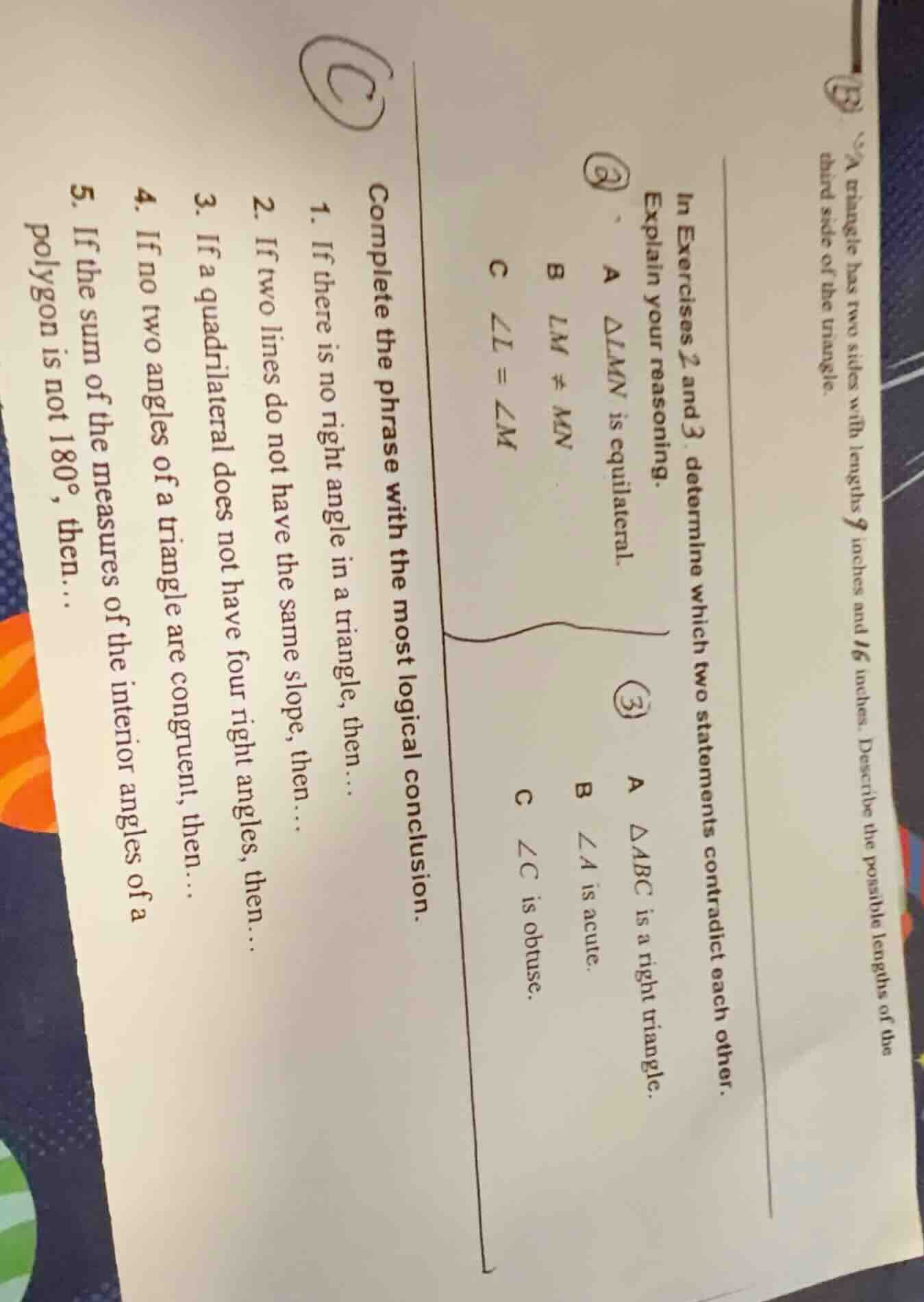
b a triangle has two sides with lengths 9 inches and 16 inches. describe the possible lengths of the third side of the triangle.
in exercises 2 and 3, determine which two statements contradict each other. explain your reasoning.
②
a $\triangle lmn$ is equilateral.
b $lm \
eq mn$
c $\angle l = \angle m$
③
a $\triangle abc$ is a right triangle.
b $\angle a$ is acute.
c $\angle c$ is obtuse.
c complete the phrase with the most logical conclusion.
- if there is no right angle in a triangle, then...
- if two lines do not have the same slope, then...
- if a quadrilateral does not have four right angles, then...
- if no two angles of a triangle are congruent, then...
- if the sum of the measures of the interior angles of a polygon is not $180^\circ$, then...
Part B
Step1: Apply triangle inequality theorem
For a triangle with sides $a$, $b$, $c$, the inequalities are:
$a + b > c$, $a + c > b$, $b + c > a$
Let the known sides be $9$ and $16$, unknown side be $x$.
Step2: Set up first inequality
$9 + 16 > x$
$\implies 25 > x$
Step3: Set up second inequality
$9 + x > 16$
$\implies x > 16 - 9$
$\implies x > 7$
Step4: Set up third inequality
$16 + x > 9$
$\implies x > 9 - 16$
$\implies x > -7$ (irrelevant, side length positive)
For Exercise 2:
Step1: Recall equilateral triangle properties
An equilateral triangle has all sides equal ($LM = MN = NL$) and all angles equal ($\angle L = \angle M = \angle N$).
Step2: Contradict with given statements
Statement A says $\triangle LMN$ is equilateral, which requires $LM = MN$ and $\angle L = \angle M$. Statements B ($LM
eq MN$) and C ($\angle L = \angle M$) contradict A: B directly violates side equality, and A requires equal angles so C aligns with A, but B and A cannot both be true.
For Exercise 3:
Step1: Recall right triangle angle properties
A right triangle has one right angle ($90^\circ$), so the other two angles are acute (sum to $90^\circ$).
Step2: Contradict with given statements
Statement A says $\triangle ABC$ is a right triangle (has one right angle). Statement C says $\angle C$ is obtuse (greater than $90^\circ$). A triangle cannot have both a right angle and an obtuse angle (sum of angles would exceed $180^\circ$), so A and C contradict each other.
- A triangle with no right angle cannot be a right triangle, so it is an oblique triangle (acute or obtuse).
- Lines with different slopes are not parallel, so they intersect at exactly one point.
- A quadrilateral without four right angles is not a rectangle or square, so it does not have all angles equal to $90^\circ$.
- If no two angles of a triangle are congruent, no two sides opposite those angles are congruent, so it is a scalene triangle.
- The sum of interior angles of a triangle is $180^\circ$, so if the sum is not $180^\circ$, the polygon is not a triangle.

Snap & solve any problem in the app
Get step-by-step solutions on Sovi AI
Photo-based solutions with guided steps
Explore more problems and detailed explanations
The length of the third side must be greater than 7 inches and less than 25 inches, or $7 < x < 25$.
---