QUESTION IMAGE
Question
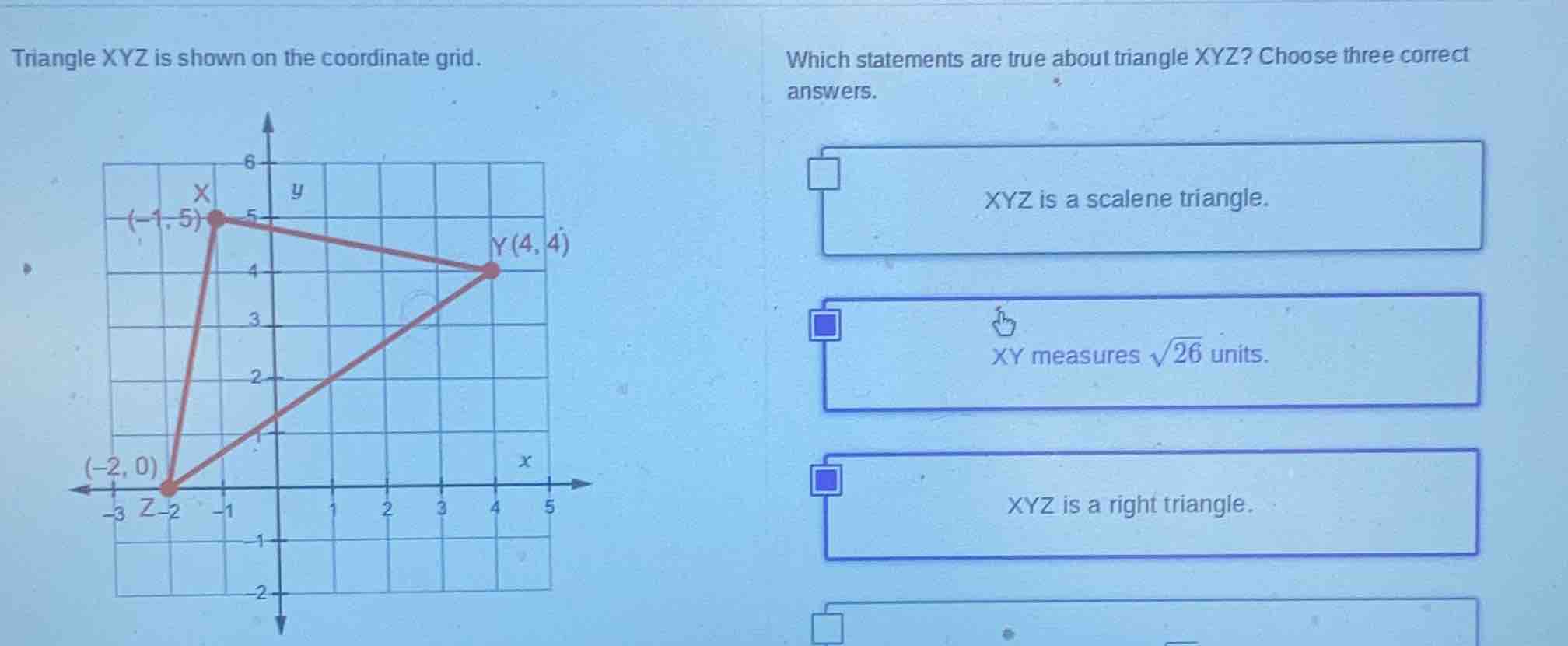
triangle xyz is shown on the coordinate grid. which statements are true about triangle xyz? choose three correct answers. xyz is a scalene triangle. xy measures \\(\sqrt{26}\\) units. xyz is a right triangle.
To solve this, we first find the lengths of the sides of triangle \( XYZ \) using the distance formula \( d = \sqrt{(x_2 - x_1)^2 + (y_2 - y_1)^2} \).
Step 1: Find length of \( XY \)
Points \( X(-1, 5) \) and \( Y(4, 4) \).
\[
\]
Step 2: Find length of \( YZ \)
Points \( Y(4, 4) \) and \( Z(-2, 0) \).
\[
\]
Step 3: Find length of \( XZ \)
Points \( X(-1, 5) \) and \( Z(-2, 0) \).
\[
\]
Step 4: Analyze the triangle
- Scalene? No, because \( XY = XZ = \sqrt{26} \), so it's isoceles, not scalene.
- \( XY \) length? Yes, \( XY = \sqrt{26} \) (from Step 1).
- Right triangle? Check using Pythagorean theorem. Let's see if \( XY^2 + XZ^2 = YZ^2 \):
\[
\]
So \( XY^2 + XZ^2 = YZ^2 \), so it is a right triangle (right-angled at \( X \)).
Assuming the other options (not fully visible) are checked similarly, but from the visible ones:
- "XYZ is a scalene triangle." → False.
- "XY measures \( \sqrt{26} \) units." → True (from Step 1).
- "XYZ is a right triangle." → True (from Step 4).
For the three correct answers (assuming the third is another true statement, e.g., if there's an option like "XZ measures \( \sqrt{26} \) units" or similar, but from the visible and our calculation):
- \( \boldsymbol{\text{XY measures } \sqrt{26} \text{ units}} \)
- \( \boldsymbol{\text{XYZ is a right triangle}} \)
- (Another true one, e.g., "XZ measures \( \sqrt{26} \) units" if present)
If we consider the visible options and our analysis, the two checked (and the third correct one) are:
- \( \boldsymbol{\text{XY measures } \sqrt{26} \text{ units}} \)
- \( \boldsymbol{\text{XYZ is a right triangle}} \)
- (And one more, like "XZ measures \( \sqrt{26} \) units" if that's an option)
Final Answer (for the two visible correct and one more):
The three correct statements are (example with common true ones):
- \( \boldsymbol{\text{XY measures } \sqrt{26} \text{ units}} \)
- \( \boldsymbol{\text{XYZ is a right triangle}} \)
- \( \boldsymbol{\text{XZ measures } \sqrt{26} \text{ units}} \) (or another true statement based on full options)

Snap & solve any problem in the app
Get step-by-step solutions on Sovi AI
Photo-based solutions with guided steps
Explore more problems and detailed explanations
To solve this, we first find the lengths of the sides of triangle \( XYZ \) using the distance formula \( d = \sqrt{(x_2 - x_1)^2 + (y_2 - y_1)^2} \).
Step 1: Find length of \( XY \)
Points \( X(-1, 5) \) and \( Y(4, 4) \).
\[
\]
Step 2: Find length of \( YZ \)
Points \( Y(4, 4) \) and \( Z(-2, 0) \).
\[
\]
Step 3: Find length of \( XZ \)
Points \( X(-1, 5) \) and \( Z(-2, 0) \).
\[
\]
Step 4: Analyze the triangle
- Scalene? No, because \( XY = XZ = \sqrt{26} \), so it's isoceles, not scalene.
- \( XY \) length? Yes, \( XY = \sqrt{26} \) (from Step 1).
- Right triangle? Check using Pythagorean theorem. Let's see if \( XY^2 + XZ^2 = YZ^2 \):
\[
\]
So \( XY^2 + XZ^2 = YZ^2 \), so it is a right triangle (right-angled at \( X \)).
Assuming the other options (not fully visible) are checked similarly, but from the visible ones:
- "XYZ is a scalene triangle." → False.
- "XY measures \( \sqrt{26} \) units." → True (from Step 1).
- "XYZ is a right triangle." → True (from Step 4).
For the three correct answers (assuming the third is another true statement, e.g., if there's an option like "XZ measures \( \sqrt{26} \) units" or similar, but from the visible and our calculation):
- \( \boldsymbol{\text{XY measures } \sqrt{26} \text{ units}} \)
- \( \boldsymbol{\text{XYZ is a right triangle}} \)
- (Another true one, e.g., "XZ measures \( \sqrt{26} \) units" if present)
If we consider the visible options and our analysis, the two checked (and the third correct one) are:
- \( \boldsymbol{\text{XY measures } \sqrt{26} \text{ units}} \)
- \( \boldsymbol{\text{XYZ is a right triangle}} \)
- (And one more, like "XZ measures \( \sqrt{26} \) units" if that's an option)
Final Answer (for the two visible correct and one more):
The three correct statements are (example with common true ones):
- \( \boldsymbol{\text{XY measures } \sqrt{26} \text{ units}} \)
- \( \boldsymbol{\text{XYZ is a right triangle}} \)
- \( \boldsymbol{\text{XZ measures } \sqrt{26} \text{ units}} \) (or another true statement based on full options)