QUESTION IMAGE
Question
tue jan 27 hw, due wednesday jan 28
project check in: check each item that is complete.
__ pre - image reflection translation rotation __ coloring
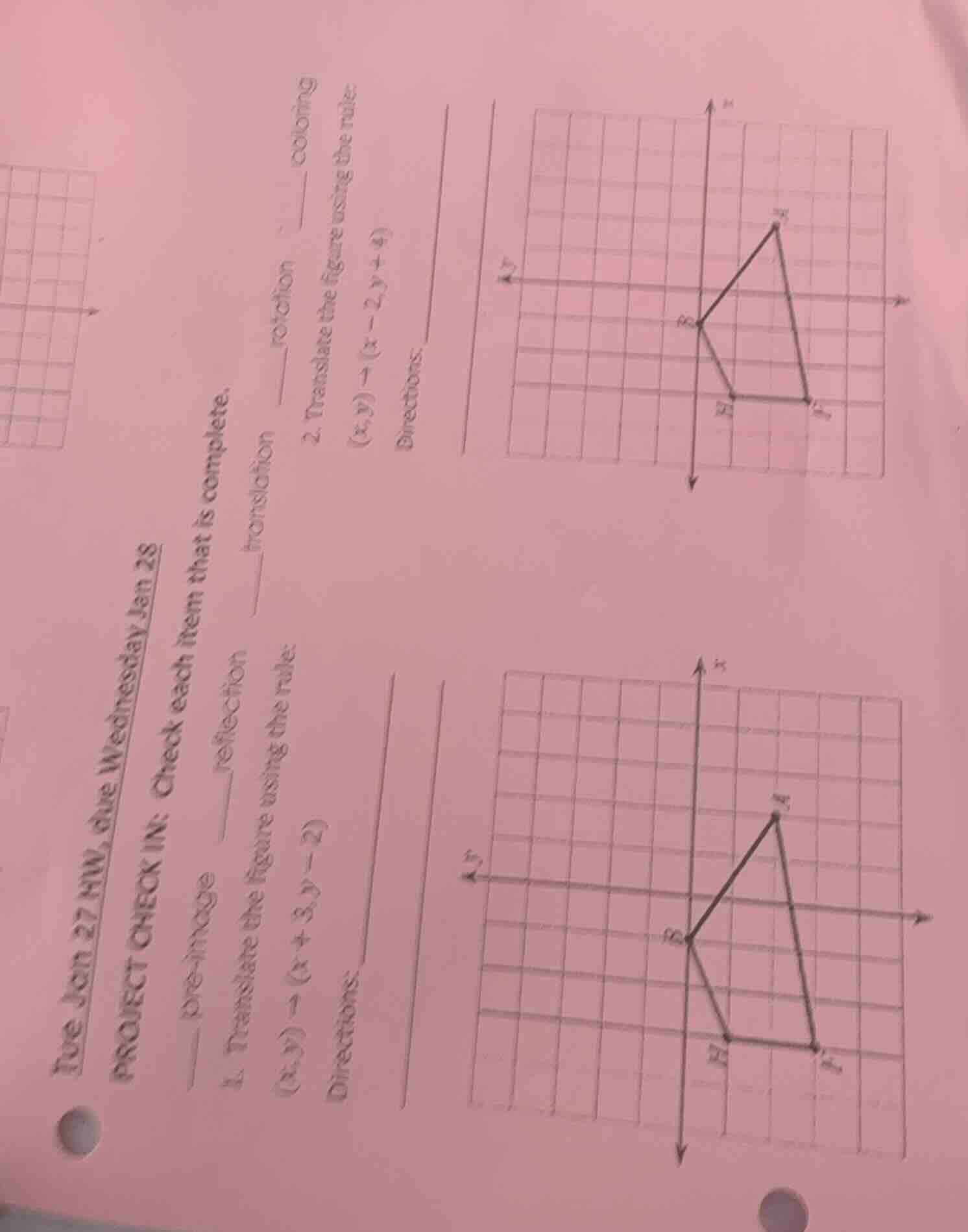
- translate the figure using the rule:
$(x,y)\to(x + 3,y - 2)$
directions:
- translate the figure using the rule:
$(x,y)\to(x - 2,y + 4)$
directions:
To solve the translation problems, we first identify the coordinates of the pre - image vertices and then apply the translation rule to find the coordinates of the image vertices.
Problem 1: Translation rule \((x,y)\to(x + 3,y - 2)\)
- Identify pre - image coordinates:
- Let's assume the pre - image vertices are \(H(x_1,y_1)\), \(B(x_2,y_2)\), and \(A(x_3,y_3)\) from the graph. From the lower graph (pre - image for problem 1), we can see that if we consider the grid, let's say \(H=(0, - 1)\), \(B=(0,0)\), \(A=(2,1)\) (we can find these coordinates by looking at the position of the points on the \(x\) and \(y\) axes of the coordinate plane. For a point \((x,y)\), \(x\) is the horizontal distance from the origin and \(y\) is the vertical distance).
- Apply the translation rule \((x,y)\to(x + 3,y - 2)\):
- For point \(H=(0,-1)\):
- New \(x\) - coordinate: \(x+3=0 + 3=3\)
- New \(y\) - coordinate: \(y - 2=-1-2=-3\)
- So the image of \(H\) is \(H'=(3,-3)\)
- For point \(B=(0,0)\):
- New \(x\) - coordinate: \(x + 3=0+3 = 3\)
- New \(y\) - coordinate: \(y-2=0 - 2=-2\)
- So the image of \(B\) is \(B'=(3,-2)\)
- For point \(A=(2,1)\):
- New \(x\) - coordinate: \(x + 3=2+3=5\)
- New \(y\) - coordinate: \(y - 2=1-2=-1\)
- So the image of \(A\) is \(A'=(5,-1)\)
- Then we can plot these new points \(H'\), \(B'\), and \(A'\) on the coordinate plane to get the translated figure.
Problem 2: Translation rule \((x,y)\to(x - 2,y + 4)\)
- Identify pre - image coordinates:
- From the upper graph (pre - image for problem 2), let's assume the pre - image vertices are \(H(x_1,y_1)\), \(B(x_2,y_2)\), and \(A(x_3,y_3)\). Looking at the grid, if \(H=(1,-1)\), \(B=(1,0)\), \(A=(3,1)\)
- Apply the translation rule \((x,y)\to(x - 2,y + 4)\):
- For point \(H=(1,-1)\):
- New \(x\) - coordinate: \(x-2=1-2=-1\)
- New \(y\) - coordinate: \(y + 4=-1 + 4=3\)
- So the image of \(H\) is \(H'=(-1,3)\)
- For point \(B=(1,0)\):
- New \(x\) - coordinate: \(x-2=1-2=-1\)
- New \(y\) - coordinate: \(y + 4=0 + 4=4\)
- So the image of \(B\) is \(B'=(-1,4)\)
- For point \(A=(3,1)\):
- New \(x\) - coordinate: \(x-2=3-2 = 1\)
- New \(y\) - coordinate: \(y + 4=1+4=5\)
- So the image of \(A\) is \(A'=(1,5)\)
- Then we can plot these new points \(H'\), \(B'\), and \(A'\) on the coordinate plane to get the translated figure.
Final Answer (for the coordinates of the image after translation)
For problem 1 (rule \((x,y)\to(x + 3,y - 2)\)):
- If pre - image \(H=(0,-1)\), \(B=(0,0)\), \(A=(2,1)\)
- Image: \(H'=(3,-3)\), \(B'=(3,-2)\), \(A'=(5,-1)\)
For problem 2 (rule \((x,y)\to(x - 2,y + 4)\)):
- If pre - image \(H=(1,-1)\), \(B=(1,0)\), \(A=(3,1)\)
- Image: \(H'=(-1,3)\), \(B'=(-1,4)\), \(A'=(1,5)\)
(After finding the image coordinates, we can draw the translated figures by connecting the image vertices in the same order as the pre - image vertices.)

Snap & solve any problem in the app
Get step-by-step solutions on Sovi AI
Photo-based solutions with guided steps
Explore more problems and detailed explanations
To solve the translation problems, we first identify the coordinates of the pre - image vertices and then apply the translation rule to find the coordinates of the image vertices.
Problem 1: Translation rule \((x,y)\to(x + 3,y - 2)\)
- Identify pre - image coordinates:
- Let's assume the pre - image vertices are \(H(x_1,y_1)\), \(B(x_2,y_2)\), and \(A(x_3,y_3)\) from the graph. From the lower graph (pre - image for problem 1), we can see that if we consider the grid, let's say \(H=(0, - 1)\), \(B=(0,0)\), \(A=(2,1)\) (we can find these coordinates by looking at the position of the points on the \(x\) and \(y\) axes of the coordinate plane. For a point \((x,y)\), \(x\) is the horizontal distance from the origin and \(y\) is the vertical distance).
- Apply the translation rule \((x,y)\to(x + 3,y - 2)\):
- For point \(H=(0,-1)\):
- New \(x\) - coordinate: \(x+3=0 + 3=3\)
- New \(y\) - coordinate: \(y - 2=-1-2=-3\)
- So the image of \(H\) is \(H'=(3,-3)\)
- For point \(B=(0,0)\):
- New \(x\) - coordinate: \(x + 3=0+3 = 3\)
- New \(y\) - coordinate: \(y-2=0 - 2=-2\)
- So the image of \(B\) is \(B'=(3,-2)\)
- For point \(A=(2,1)\):
- New \(x\) - coordinate: \(x + 3=2+3=5\)
- New \(y\) - coordinate: \(y - 2=1-2=-1\)
- So the image of \(A\) is \(A'=(5,-1)\)
- Then we can plot these new points \(H'\), \(B'\), and \(A'\) on the coordinate plane to get the translated figure.
Problem 2: Translation rule \((x,y)\to(x - 2,y + 4)\)
- Identify pre - image coordinates:
- From the upper graph (pre - image for problem 2), let's assume the pre - image vertices are \(H(x_1,y_1)\), \(B(x_2,y_2)\), and \(A(x_3,y_3)\). Looking at the grid, if \(H=(1,-1)\), \(B=(1,0)\), \(A=(3,1)\)
- Apply the translation rule \((x,y)\to(x - 2,y + 4)\):
- For point \(H=(1,-1)\):
- New \(x\) - coordinate: \(x-2=1-2=-1\)
- New \(y\) - coordinate: \(y + 4=-1 + 4=3\)
- So the image of \(H\) is \(H'=(-1,3)\)
- For point \(B=(1,0)\):
- New \(x\) - coordinate: \(x-2=1-2=-1\)
- New \(y\) - coordinate: \(y + 4=0 + 4=4\)
- So the image of \(B\) is \(B'=(-1,4)\)
- For point \(A=(3,1)\):
- New \(x\) - coordinate: \(x-2=3-2 = 1\)
- New \(y\) - coordinate: \(y + 4=1+4=5\)
- So the image of \(A\) is \(A'=(1,5)\)
- Then we can plot these new points \(H'\), \(B'\), and \(A'\) on the coordinate plane to get the translated figure.
Final Answer (for the coordinates of the image after translation)
For problem 1 (rule \((x,y)\to(x + 3,y - 2)\)):
- If pre - image \(H=(0,-1)\), \(B=(0,0)\), \(A=(2,1)\)
- Image: \(H'=(3,-3)\), \(B'=(3,-2)\), \(A'=(5,-1)\)
For problem 2 (rule \((x,y)\to(x - 2,y + 4)\)):
- If pre - image \(H=(1,-1)\), \(B=(1,0)\), \(A=(3,1)\)
- Image: \(H'=(-1,3)\), \(B'=(-1,4)\), \(A'=(1,5)\)
(After finding the image coordinates, we can draw the translated figures by connecting the image vertices in the same order as the pre - image vertices.)