QUESTION IMAGE
Question
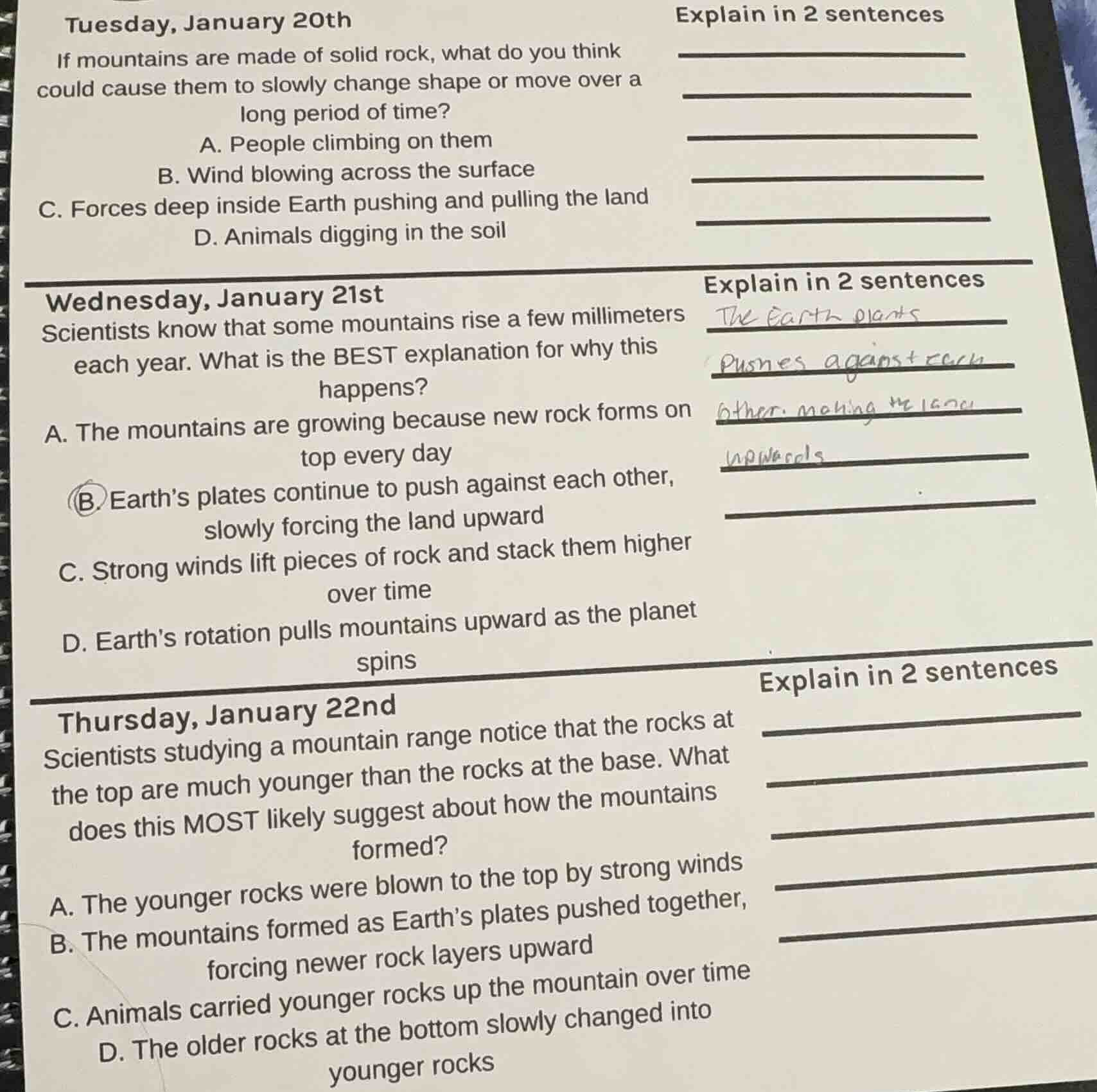
tuesday, january 20th
if mountains are made of solid rock, what do you think could cause them to slowly change shape or move over a long period of time?
a. people climbing on them
b. wind blowing across the surface
c. forces deep inside earth pushing and pulling the land
d. animals digging in the soil
explain in 2 sentences
wednesday, january 21st
scientists know that some mountains rise a few millimeters each year. what is the best explanation for why this happens?
a. the mountains are growing because new rock forms on top every day
b. earth’s plates continue to push against each other, slowly forcing the land upward
c. strong winds lift pieces of rock and stack them higher over time
d. earth’s rotation pulls mountains upward as the planet spins
explain in 2 sentences
thursday, january 22nd
scientists studying a mountain range notice that the rocks at the top are much younger than the rocks at the base. what does this most likely suggest about how the mountains formed?
a. the younger rocks were blown to the top by strong winds
b. the mountains formed as earth’s plates pushed together, forcing newer rock layers upward
c. animals carried younger rocks up the mountain over time
d. the older rocks at the bottom slowly changed into younger rocks
explain in 2 sentences
Tuesday, January 20th
People climbing (A) or animals digging (D) have minimal long - term impact on mountain shape. Wind erosion (B) changes shape but not movement. Internal Earth forces (C), like plate tectonics, drive mountain movement/shape change over time.
New rock formation (A) is not a major cause of mountain rise. Wind (C) erodes, not builds up mountains. Earth's rotation (D) doesn't pull mountains up. Plate tectonics (B) causes plates to push, lifting mountains slowly.
Wind (A) and animals (C) can't transport rocks to form mountain layers. Rock transformation (D) doesn't explain layer age difference. Plate collision (B) pushes newer rock layers upward, resulting in younger rocks at the top.

Snap & solve any problem in the app
Get step-by-step solutions on Sovi AI
Photo-based solutions with guided steps
Explore more problems and detailed explanations
C. Forces deep inside Earth pushing and pulling the land