QUESTION IMAGE
Question
tutorial exercise
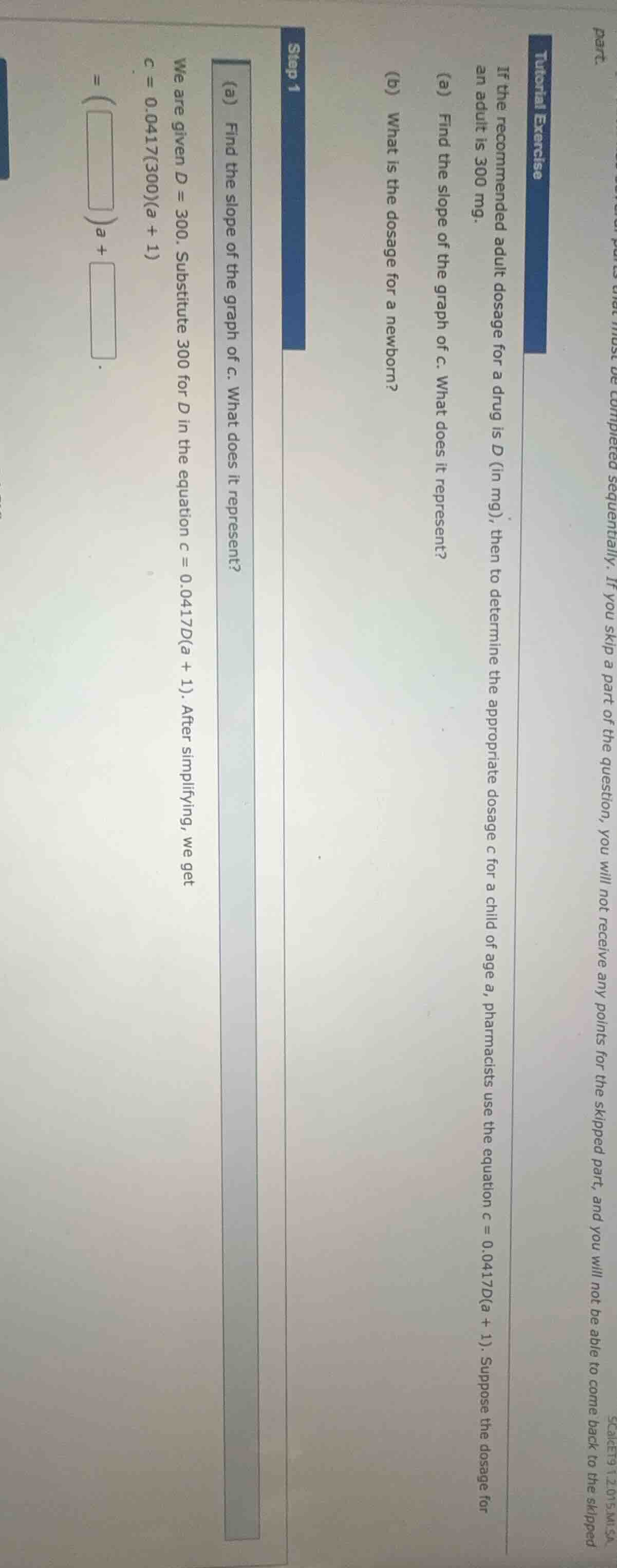
if the recommended adult dosage for a drug is ( d ) (in mg), then to determine the appropriate dosage ( c ) for a child of age ( a ), pharmacists use the equation ( c = 0.0417d(a + 1) ). suppose the dosage for an adult is 300 mg.
(a) find the slope of the graph of ( c ). what does it represent?
(b) what is the dosage for a newborn?
step 1
(a) find the slope of the graph of ( c ). what does it represent?
we are given ( d = 300 ). substitute 300 for ( d ) in the equation ( c = 0.0417d(a + 1) ). after simplifying, we get
( c = 0.0417(300)(a + 1) )
( = left( square
ight)a + square ).
Step1: Substitute D=300 into formula
$c = 0.0417(300)(a + 1)$
Step2: Calculate coefficient of a
$0.0417\times300 = 12.51$
Step3: Expand to slope-intercept form
$c = 12.51a + 12.51$
Step4: Identify slope and meaning
Slope = 12.51, it represents the rate of increase in child dosage per year of age.
Step5: Calculate newborn dosage (a=0)
$c = 12.51(0) + 12.51 = 12.51$

Snap & solve any problem in the app
Get step-by-step solutions on Sovi AI
Photo-based solutions with guided steps
Explore more problems and detailed explanations
(a) The slope is 12.51, representing the increase in child dosage (in mg) per additional year of age.
(b) The dosage for a newborn is 12.51 mg.
The simplified equation is $\boldsymbol{(12.51)a + 12.51}$