QUESTION IMAGE
Question
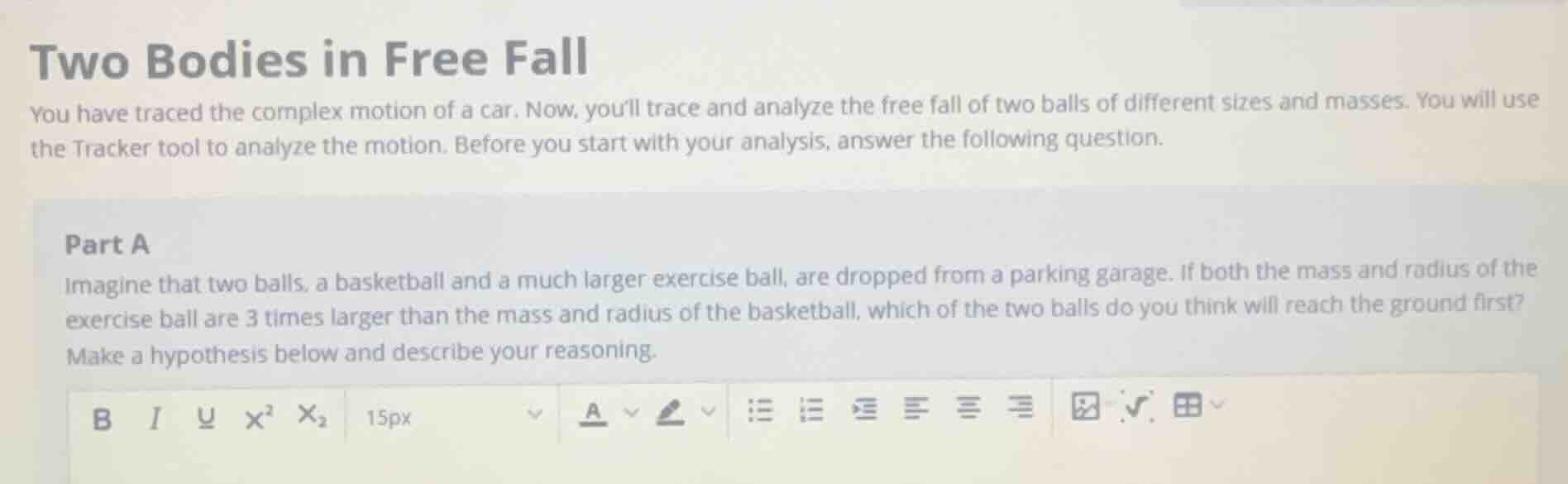
two bodies in free fall
you have traced the complex motion of a car. now, youll trace and analyze the free fall of two balls of different sizes and masses. you will use the tracker tool to analyze the motion. before you start with your analysis, answer the following question.
part a
imagine that two balls, a basketball and a much larger exercise ball, are dropped from a parking garage. if both the mass and radius of the exercise ball are 3 times larger than the mass and radius of the basketball, which of the two balls do you think will reach the ground first?
make a hypothesis below and describe your reasoning.
In free fall (ignoring air resistance), the acceleration due to gravity \( g \) is independent of the mass and size (radius) of the object. The formula for the time taken to fall a height \( h \) is \( t=\sqrt{\frac{2h}{g}} \), which does not involve mass or radius. So both balls should reach the ground at the same time. If air resistance is considered, the larger exercise ball (with more surface area relative to its mass? Wait, no—actually, for spheres, the terminal velocity depends on mass and radius, but in the context of a parking garage fall (relatively short distance), air resistance might not be significant enough to change the result much, or if we assume ideal free fall (no air resistance), they fall together. So the hypothesis is both balls reach the ground simultaneously because free - fall acceleration is independent of mass and size (in ideal conditions without air resistance).

Snap & solve any problem in the app
Get step-by-step solutions on Sovi AI
Photo-based solutions with guided steps
Explore more problems and detailed explanations
Hypothesis: Both the basketball and the exercise ball will reach the ground at the same time.
Reasoning: In the ideal case of free fall (neglecting air resistance), the acceleration due to gravity (\( g \)) acting on an object in free fall is independent of the object's mass and size. The time taken for an object to fall from a height \( h \) is given by the formula \( t = \sqrt{\frac{2h}{g}} \), which does not include the mass or radius of the object. So, regardless of the differences in their mass and radius, both balls will accelerate towards the ground at the same rate (\( g \)) and thus reach the ground simultaneously. If air resistance is considered, for the short distance of a parking garage fall, the effect of air resistance on the time of fall is likely to be negligible, and the dominant factor (gravity) still causes them to fall at nearly the same rate.