QUESTION IMAGE
Question
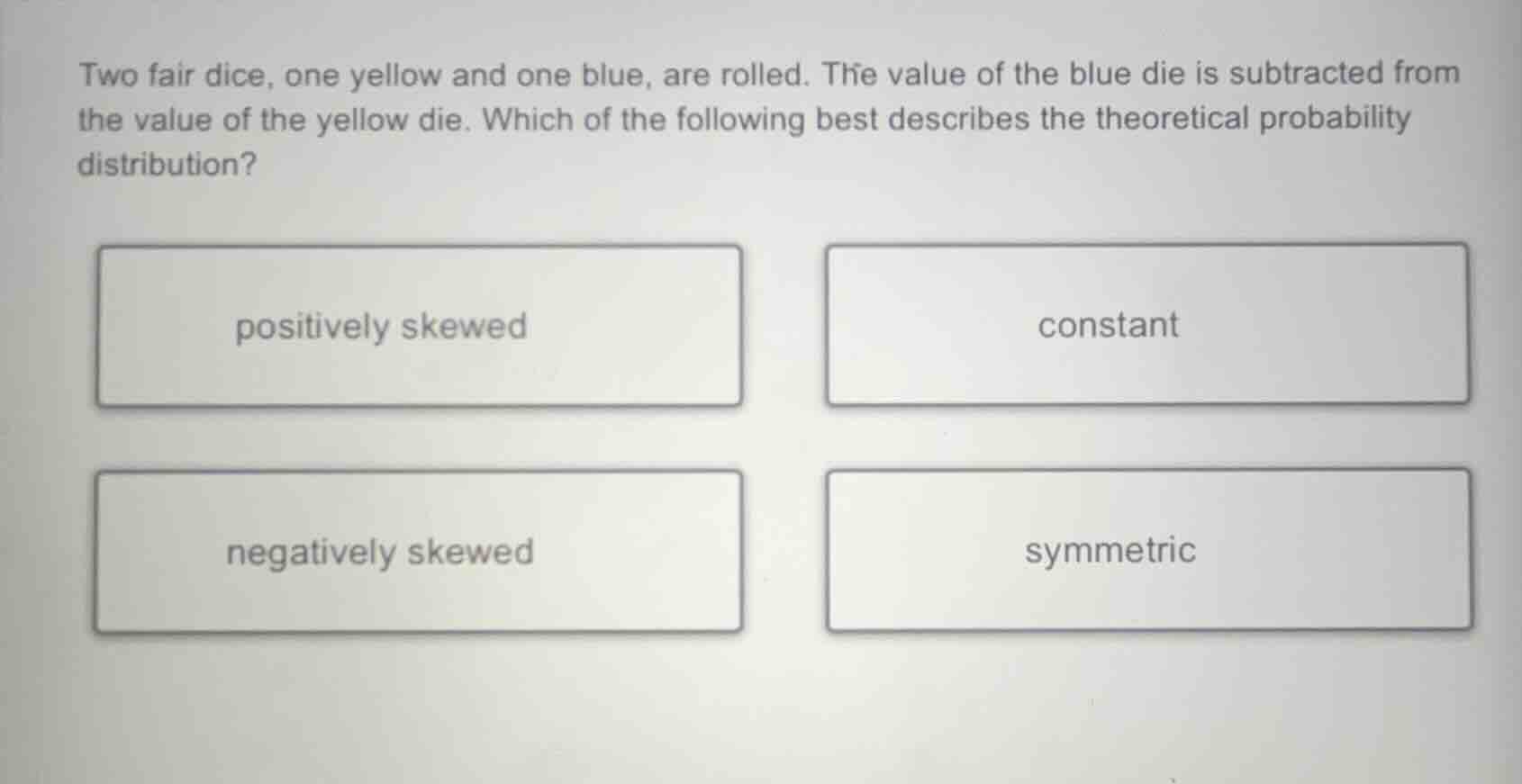
two fair dice, one yellow and one blue, are rolled. the value of the blue die is subtracted from the value of the yellow die. which of the following best describes the theoretical probability distribution?
positively skewed
constant
negatively skewed
symmetric
When rolling two fair dice (yellow and blue) and calculating \( Y - B \) (where \( Y \) is the yellow die value and \( B \) is the blue die value), the possible differences range from \( - 5\) (when \( Y = 1, B = 6\)) to \(5\) (when \( Y = 6, B = 1\)). For each positive difference \( d \), there is a corresponding negative difference \( -d \) with the same probability. For example, the probability of \( Y - B=1\) (e.g., \( Y = 2,B = 1\); \( Y = 3,B = 2\); \( Y = 4,B = 3\); \( Y = 5,B = 4\); \( Y = 6,B = 5\)) is \( \frac{5}{36}\), and the probability of \( Y - B=- 1\) (e.g., \( Y = 1,B = 2\); \( Y = 2,B = 3\); \( Y = 3,B = 4\); \( Y = 4,B = 5\); \( Y = 5,B = 6\)) is also \( \frac{5}{36}\). This symmetry around 0 means the distribution of \( Y - B \) is symmetric. A positively skewed distribution has a longer tail on the positive side, a negatively skewed on the negative side, and a constant distribution would have all probabilities equal (which is not the case here, as differences like 0 have a different probability than 1 or - 1). So the distribution is symmetric.

Snap & solve any problem in the app
Get step-by-step solutions on Sovi AI
Photo-based solutions with guided steps
Explore more problems and detailed explanations
symmetric