QUESTION IMAGE
Question
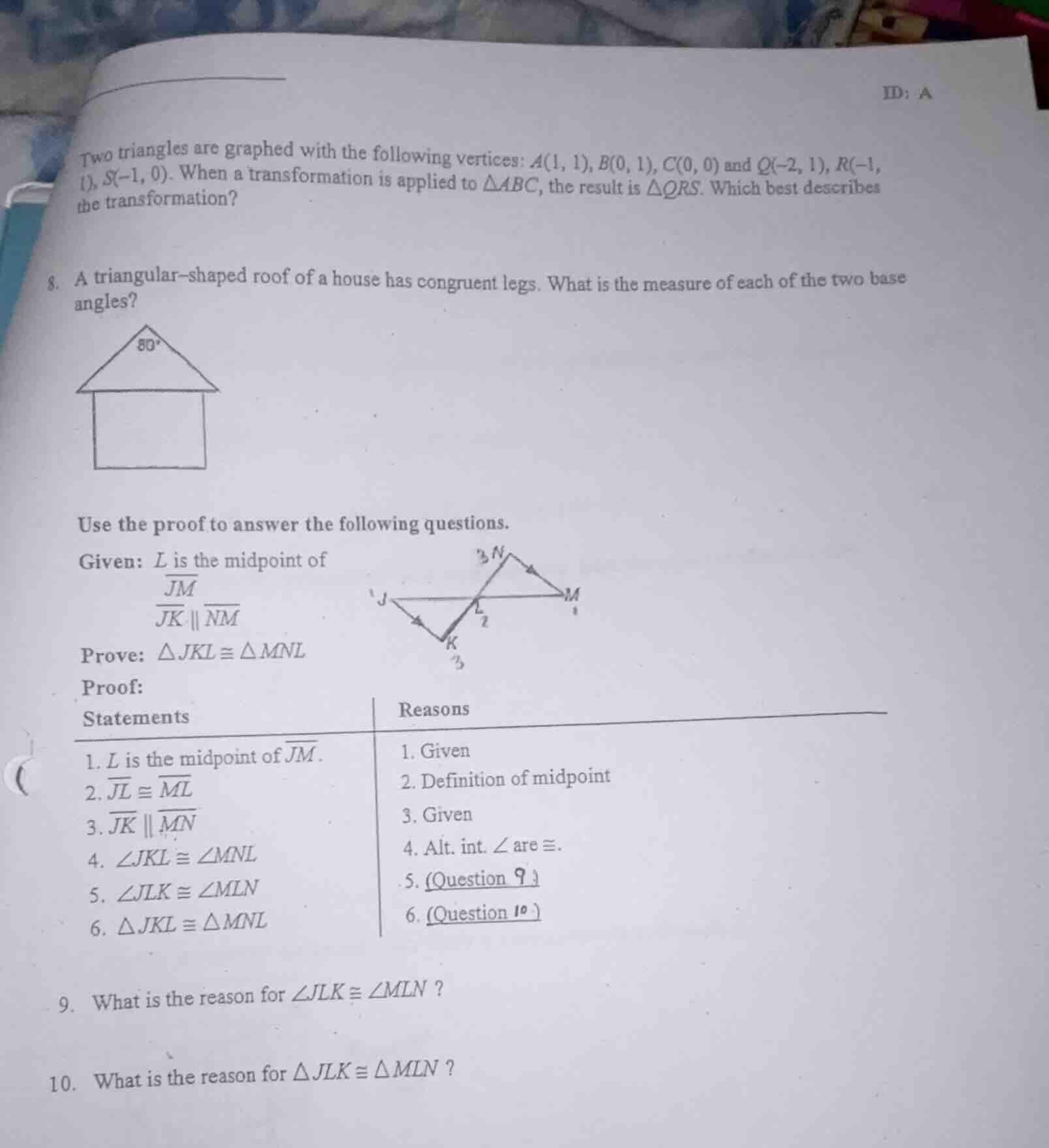
two triangles are graphed with the following vertices: a(1, 1), b(0, 1), c(0, 0) and q(-2, 1), r(-1, 1), s(-1, 0). when a transformation is applied to $\triangle abc$, the result is $\triangle qrs$. which best describes the transformation?
- a triangular - shaped roof of a house has congruent legs. what is the measure of each of the two base angles?
use the proof to answer the following questions.
given: l is the midpoint of $\overline{jm}$
$\overline{jk} \parallel \overline{nm}$
prove: $\triangle jkl \cong \triangle mnl$
proof:
| statements | reasons |
|---|---|
| 2. $\overline{jl} \cong \overline{ml}$ | 2. definition of midpoint |
| 3. $\overline{jk} \parallel \overline{mn}$ | 3. given |
| 4. $\angle jkl \cong \angle mnl$ | 4. alt. int. $\angle$ are $\cong$. |
| 5. $\angle jlk \cong \angle mln$ | 5. (question 9) |
| 6. $\triangle jkl \cong \triangle mnl$ | 6. (question 10) |
- what is the reason for $\angle jlk \cong \angle mln$?
- what is the reason for $\triangle jlk \cong \triangle mln$?
Question 8
Step1: Identify triangle type
The triangular roof has congruent legs, so it's an isosceles triangle. The given angle is the vertex angle ($50^\circ$).
Step2: Use triangle angle sum
The sum of angles in a triangle is $180^\circ$. Let each base angle be $x$. So, $50 + 2x = 180$.
Step3: Solve for x
Subtract $50$ from both sides: $2x = 180 - 50 = 130$. Divide by $2$: $x = \frac{130}{2} = 65$.
$\angle JLK$ and $\angle MLN$ are vertical angles. By the Vertical Angles Theorem, vertical angles are congruent. So the reason is "Vertical angles are congruent".
We have $\overline{JL} \cong \overline{ML}$ (from midpoint), $\angle JKL \cong \angle MNL$ (alternate interior angles), and $\angle JLK \cong \angle MLN$ (vertical angles). This satisfies the AAS (Angle - Angle - Side) congruence criterion for triangles. So the reason is "AAS (Angle - Angle - Side) Congruence Postulate".

Snap & solve any problem in the app
Get step-by-step solutions on Sovi AI
Photo-based solutions with guided steps
Explore more problems and detailed explanations
Each base angle measures $65^\circ$.