QUESTION IMAGE
Question
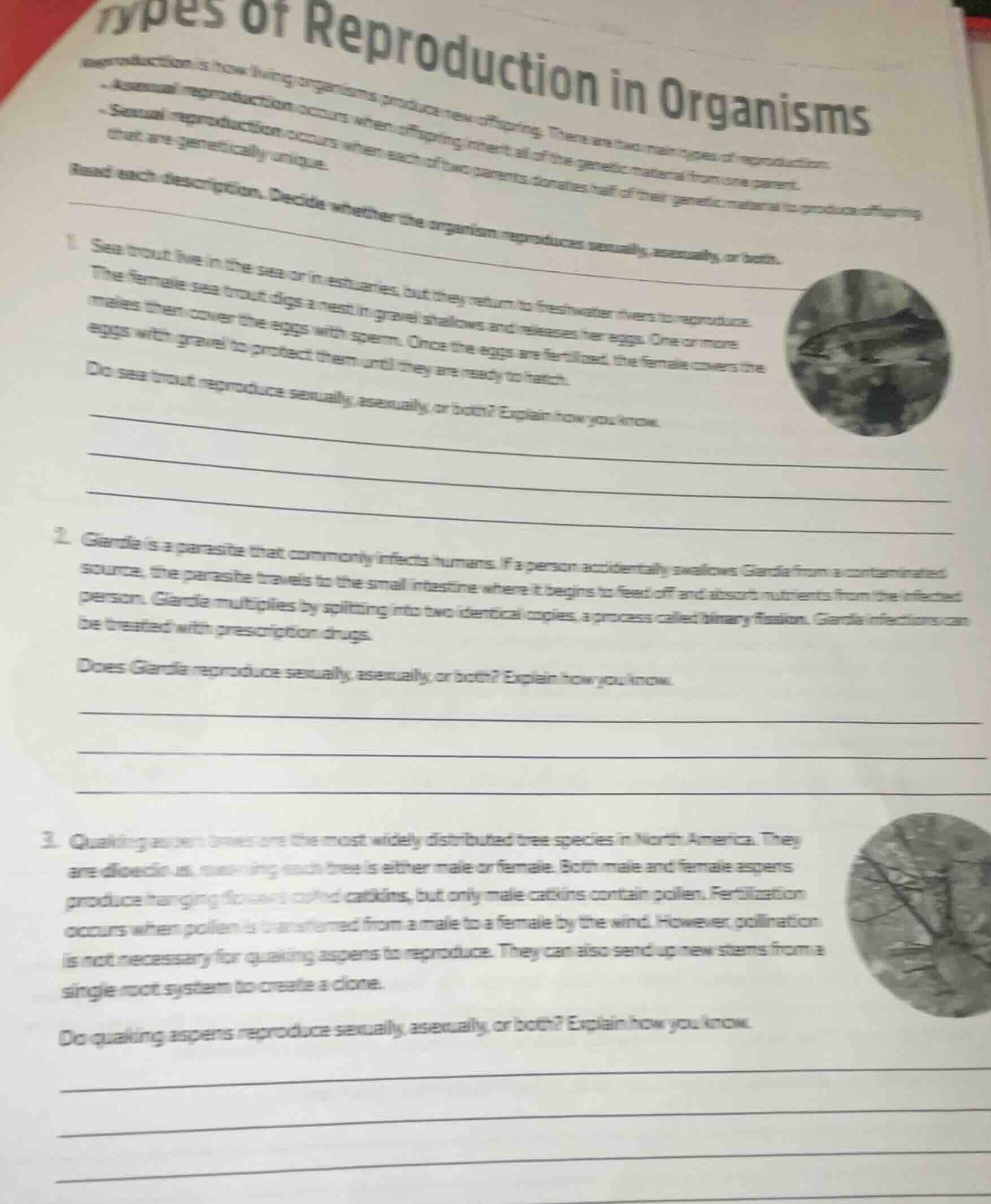
types of reproduction in organisms
reproduction is how living organisms produce new offspring. there are two main types of reproduction:
- asexual reproduction occurs when offspring inherit all of the genetic material from one parent.
- sexual reproduction occurs when each of two parents donates half of their genetic material to produce offspring that are genetically unique.
read each description. decide whether the organism reproduces sexually, asexually, or both.
- sea trout live in the sea or in estuaries, but they return to freshwater rivers to reproduce. the female sea trout digs a nest in gravel shallows and releases her eggs. one or more males then cover the eggs with sperm. once the eggs are fertilized, the female covers the eggs with gravel to protect them until they are ready to hatch.
do sea trout reproduce sexually, asexually, or both? explain how you know.
- giardia is a parasite that commonly infects humans. if a person accidentally swallows giardia from a contaminated source, the parasite travels to the small intestine where it begins to feed off and absorb nutrients from the infected person. giardia multiplies by splitting into two identical copies, a process called binary fission. giardia infections can be treated with prescription drugs.
does giardia reproduce sexually, asexually, or both? explain how you know.
- quaking aspen trees are the most widely distributed tree species in north america. they are dioecious, meaning each tree is either male or female. both male and female aspens produce hanging flowers called catkins, but only male catkins contain pollen. fertilization occurs when pollen is transferred from a male to a female by the wind. however, pollination is not necessary for quaking aspens to reproduce. they can also send up new stems from a single root system to create a clone.
do quaking aspens reproduce sexually, asexually, or both? explain how you know.
Sub - question 1: Sea trout reproduction
Sexual reproduction requires genetic material from two parents (a male and a female). In the case of sea trout, the female releases eggs and the male releases sperm to fertilize the eggs. This means the offspring will inherit genetic material from both the male and female parents, which is characteristic of sexual reproduction. There is no indication of asexual reproduction (where offspring come from a single parent) in the description.
Asexual reproduction involves the production of offspring from a single parent, and the offspring are genetically identical to the parent. Giardia multiplies by splitting into two identical copies through binary fission. This process only involves one parent (the original Giardia organism) and results in offspring that are identical to the parent. There is no mention of the involvement of two parents or the combination of genetic material from two sources, so there is no sexual reproduction.
Sexual reproduction in plants often involves pollination (transfer of pollen from male to female) for fertilization, which requires genetic material from two parents (male and female). Quaking aspens have male and female trees, and fertilization occurs when pollen is transferred from male to female catkins, so this is sexual reproduction. Asexual reproduction in plants can involve methods like producing new stems from a root system (cloning). Quaking aspens can send up new stems from a single root system to create a clone, which is a form of asexual reproduction. So they can reproduce both sexually and asexually.

Snap & solve any problem in the app
Get step-by-step solutions on Sovi AI
Photo-based solutions with guided steps
Explore more problems and detailed explanations
Sea trout reproduce sexually. This is because the female sea trout releases eggs and one or more males cover the eggs with sperm, indicating that the offspring will inherit genetic material from two parents (male and female), which is the process of sexual reproduction. There is no evidence of asexual reproduction (offspring from one parent) in the given description.