QUESTION IMAGE
Question
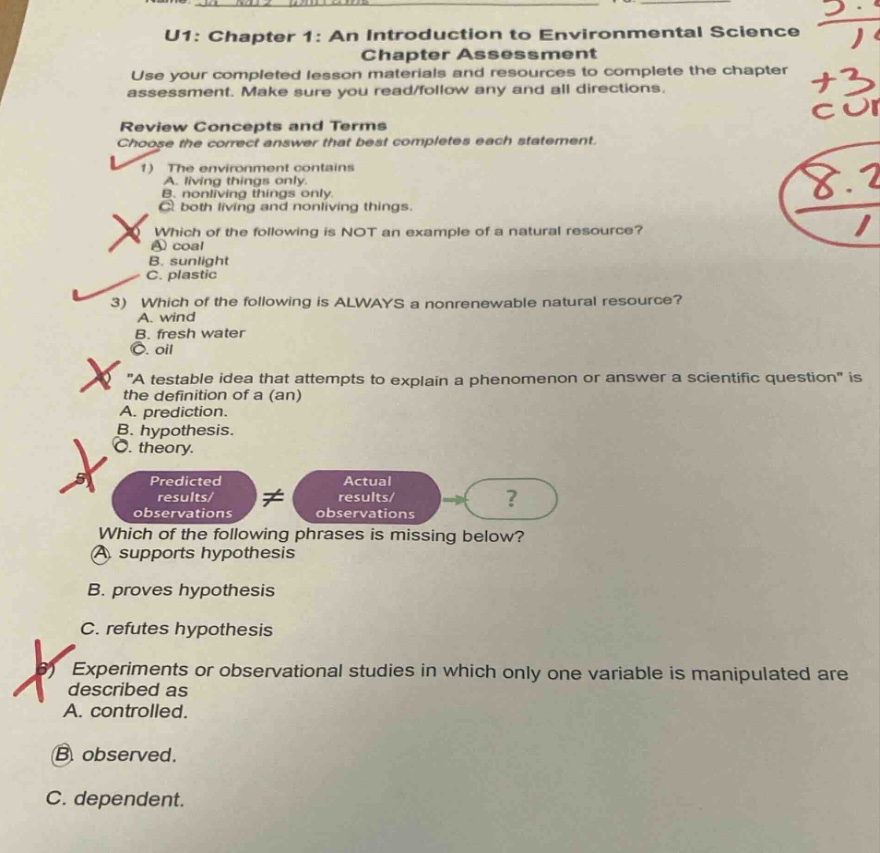
u1: chapter 1: an introduction to environmental science
chapter assessment
use your completed lesson materials and resources to complete the chapter
assessment. make sure you read/follow any and all directions.
review concepts and terms
choose the correct answer that best completes each statement.
- the environment contains
a. living things only.
b. nonliving things only.
c. both living and nonliving things.
- which of the following is not an example of a natural resource?
a. coal
b. sunlight
c. plastic
- which of the following is always a nonrenewable natural resource?
a. wind
b. fresh water
c. oil
- \a testable idea that attempts to explain a phenomenon or answer a scientific question\ is
the definition of a (an)
a. prediction.
b. hypothesis.
c. theory.
5)
predicted
results/
observations
≠
actual
results/
observations
→?
which of the following phrases is missing below?
a. supports hypothesis
b. proves hypothesis
c. refutes hypothesis
- experiments or observational studies in which only one variable is manipulated are
described as
a. controlled.
b. observed.
c. dependent.
Question 1
The environment includes all components of an ecosystem, which has both biotic (living) and abiotic (non - living) factors. So the environment contains both living and non - living things.
Natural resources are materials that occur in nature. Coal is a fossil fuel from nature, sunlight is a natural energy source. Plastic is a man - made material, not a natural resource.
Renewable resources can be replenished, non - renewable cannot be replenished quickly. Wind is renewable, fresh water can be renewed (through cycles), oil is a fossil fuel and is non - renewable as it takes millions of years to form.

Snap & solve any problem in the app
Get step-by-step solutions on Sovi AI
Photo-based solutions with guided steps
Explore more problems and detailed explanations
C. both living and nonliving things.