QUESTION IMAGE
Question
unit 26
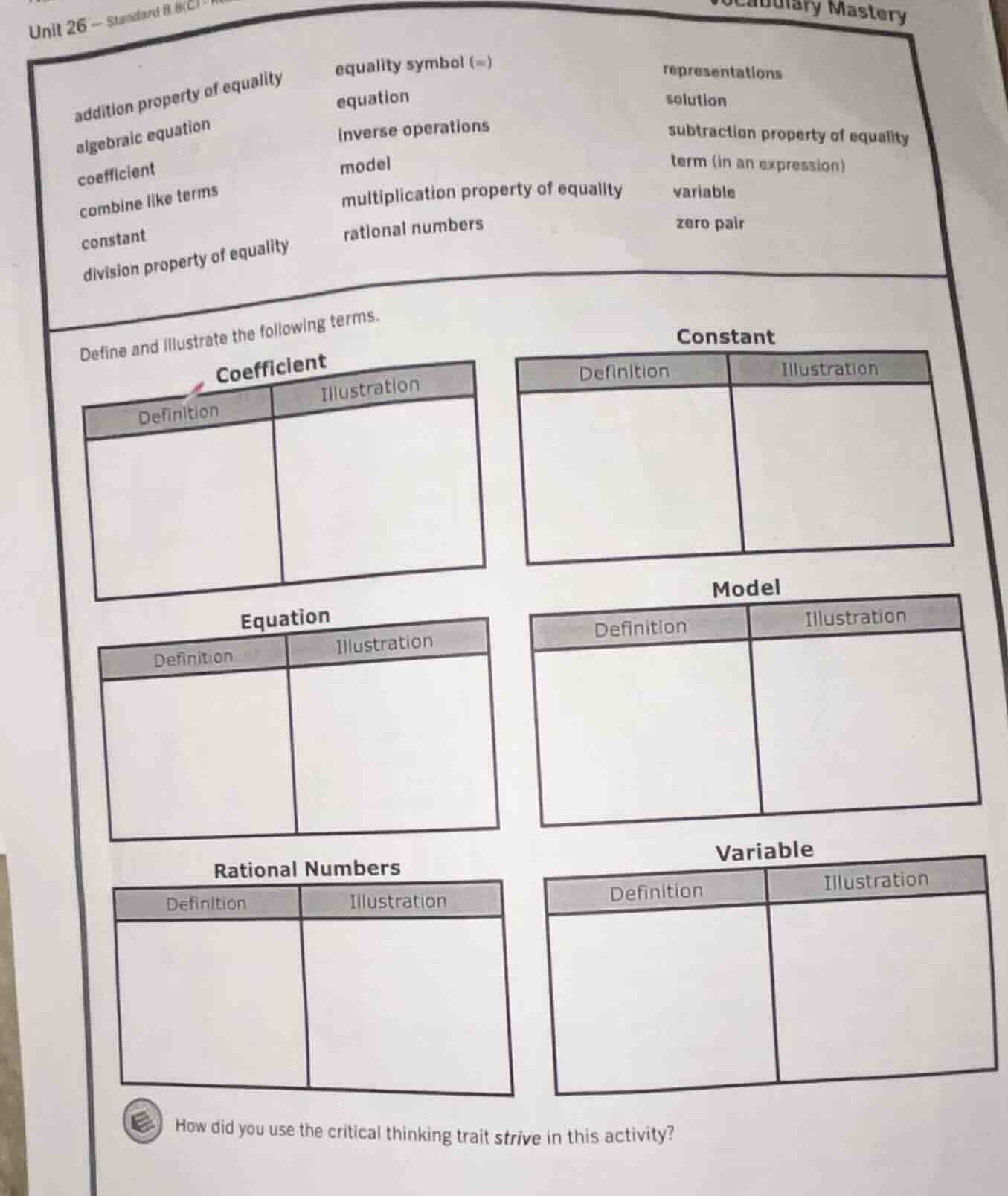
vocabulary mastery
addition property of equality
equality symbol (=)
representations
algebraic equation
equation
solution
coefficient
inverse operations
subtraction property of equality
combine like terms
model
term (in an expression)
constant
multiplication property of equality
variable
division property of equality
rational numbers
zero pair
define and illustrate the following terms.
coefficient
definition
illustration
constant
definition
illustration
equation
definition
illustration
model
definition
illustration
rational numbers
definition
illustration
variable
definition
illustration
how did you use the critical thinking trait strive in this activity?
To solve this, we'll define and illustrate each term:
Coefficient
Definition:
A numerical factor of a term with a variable.
Illustration:
In the term \( 5x \), the coefficient is \( 5 \).
Constant
Definition:
A fixed value (a number without a variable).
Illustration:
In the expression \( 3x + 7 \), \( 7 \) is a constant.
Equation
Definition:
A mathematical statement with an equality symbol (\(=\)) showing two expressions are equal.
Illustration:
\( 2x + 3 = 7 \) (shows \( 2x + 3 \) and \( 7 \) are equal).
Model
Definition:
A representation (like an equation) of a real - world situation.
Illustration:
If a car travels at 60 mph, the distance \( d \) in \( t \) hours is modeled by \( d = 60t \).
Rational Numbers
Definition:
Numbers that can be written as \( \frac{a}{b} \), where \( a,b \) are integers and \( b
eq0 \).
Illustration:
\( \frac{3}{4} \), \( - 2\) (since \( - 2=\frac{-2}{1}\)), and \( 0.5=\frac{1}{2} \) are rational numbers.
Variable
Definition:
A symbol (usually a letter) representing an unknown or changing quantity.
Illustration:
In \( y = 3x + 2 \), \( x \) and \( y \) are variables.
For the critical thinking part: To "strive" in this activity, we analyzed each term's meaning, connected definitions to examples (like relating the coefficient's definition to a term with a variable), and verified the accuracy of illustrations by checking if they matched the definitions (e.g., ensuring the equation illustration has an equality sign). This involved careful reasoning, checking for consistency between definitions and examples, and applying mathematical concepts accurately.

Snap & solve any problem in the app
Get step-by-step solutions on Sovi AI
Photo-based solutions with guided steps
Explore more problems and detailed explanations
To solve this, we'll define and illustrate each term:
Coefficient
Definition:
A numerical factor of a term with a variable.
Illustration:
In the term \( 5x \), the coefficient is \( 5 \).
Constant
Definition:
A fixed value (a number without a variable).
Illustration:
In the expression \( 3x + 7 \), \( 7 \) is a constant.
Equation
Definition:
A mathematical statement with an equality symbol (\(=\)) showing two expressions are equal.
Illustration:
\( 2x + 3 = 7 \) (shows \( 2x + 3 \) and \( 7 \) are equal).
Model
Definition:
A representation (like an equation) of a real - world situation.
Illustration:
If a car travels at 60 mph, the distance \( d \) in \( t \) hours is modeled by \( d = 60t \).
Rational Numbers
Definition:
Numbers that can be written as \( \frac{a}{b} \), where \( a,b \) are integers and \( b
eq0 \).
Illustration:
\( \frac{3}{4} \), \( - 2\) (since \( - 2=\frac{-2}{1}\)), and \( 0.5=\frac{1}{2} \) are rational numbers.
Variable
Definition:
A symbol (usually a letter) representing an unknown or changing quantity.
Illustration:
In \( y = 3x + 2 \), \( x \) and \( y \) are variables.
For the critical thinking part: To "strive" in this activity, we analyzed each term's meaning, connected definitions to examples (like relating the coefficient's definition to a term with a variable), and verified the accuracy of illustrations by checking if they matched the definitions (e.g., ensuring the equation illustration has an equality sign). This involved careful reasoning, checking for consistency between definitions and examples, and applying mathematical concepts accurately.