QUESTION IMAGE
Question
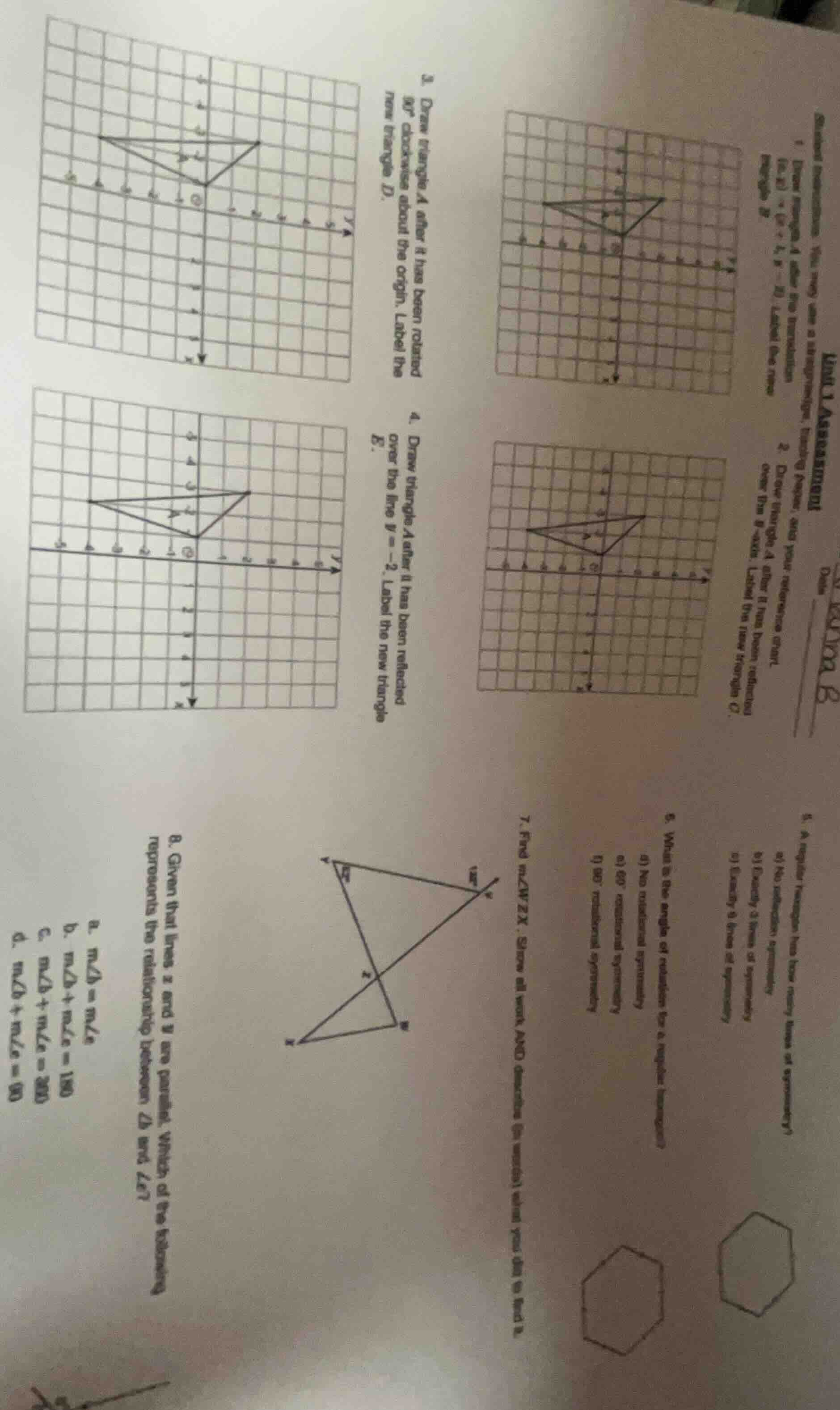
unit 1 assessmentstudent instructions: you may use a straightedge, tracing paper, and your reference chart.1. draw triangle a after the translation $(x,y)\to(x + 1, y - 3)$. label the new triangle b.2. draw triangle a after it has been reflected over the y-axis. label the new triangle c.3. draw triangle a after it has been rotated $90^\circ$ clockwise about the origin. label the new triangle d.4. draw triangle a after it has been reflected over the line $y=-2$. label the new triangle e.5. a regular hexagon has how many lines of symmetry?a) no reflection symmetryb) exactly 3 lines of symmetryc) exactly 6 lines of symmetry6. what is the angle of rotation for a regular hexagon?d) no rotational symmetrye) $60^\circ$ rotational symmetryf) $90^\circ$ rotational symmetry7. find $m\angle wzx$. show all work, and describe (in words) what you did to find it.8. given that lines x and y are parallel. which of the following represents the relationship between $\angle b$ and $\angle e$?a. $m\angle b=m\angle e$b. $m\angle b+m\angle e=180$c. $m\angle b+m\angle e=90$d. $m\angle b+m\angle e=60$
Questions 1-4 (Transformations)
First, identify the vertices of Triangle A from the grid:
- Vertex 1: $(0, 1)$
- Vertex 2: $(2, 3)$
- Vertex 3: $(-4, 1)$
---
1. Translation $(x,y)\to(x+4, y-3)$
Step1: Translate each vertex
New Vertex 1: $(0+4, 1-3)=(4, -2)$
New Vertex 2: $(2+4, 3-3)=(6, 0)$
New Vertex 3: $(-4+4, 1-3)=(0, -2)$
Step2: Plot & label Triangle B
Connect $(4,-2)$, $(6,0)$, $(0,-2)$ on the grid.
Step1: Reflect each vertex
Rule: $(x,y)\to(-x,y)$
New Vertex 1: $(0, 1)$ (unchanged, on y-axis)
New Vertex 2: $(-2, 3)$
New Vertex 3: $(4, 1)$
Step2: Plot & label Triangle C
Connect $(0,1)$, $(-2,3)$, $(4,1)$ on the grid.
Step1: Rotate each vertex
Rule: $(x,y)\to(y,-x)$
New Vertex 1: $(1, 0)$
New Vertex 2: $(3, -2)$
New Vertex 3: $(1, 4)$
Step2: Plot & label Triangle D
Connect $(1,0)$, $(3,-2)$, $(1,4)$ on the grid.

Snap & solve any problem in the app
Get step-by-step solutions on Sovi AI
Photo-based solutions with guided steps
Explore more problems and detailed explanations
Triangle B has vertices $(4, -2)$, $(6, 0)$, $(0, -2)$ (plot these points and connect to form the triangle).
---