QUESTION IMAGE
Question
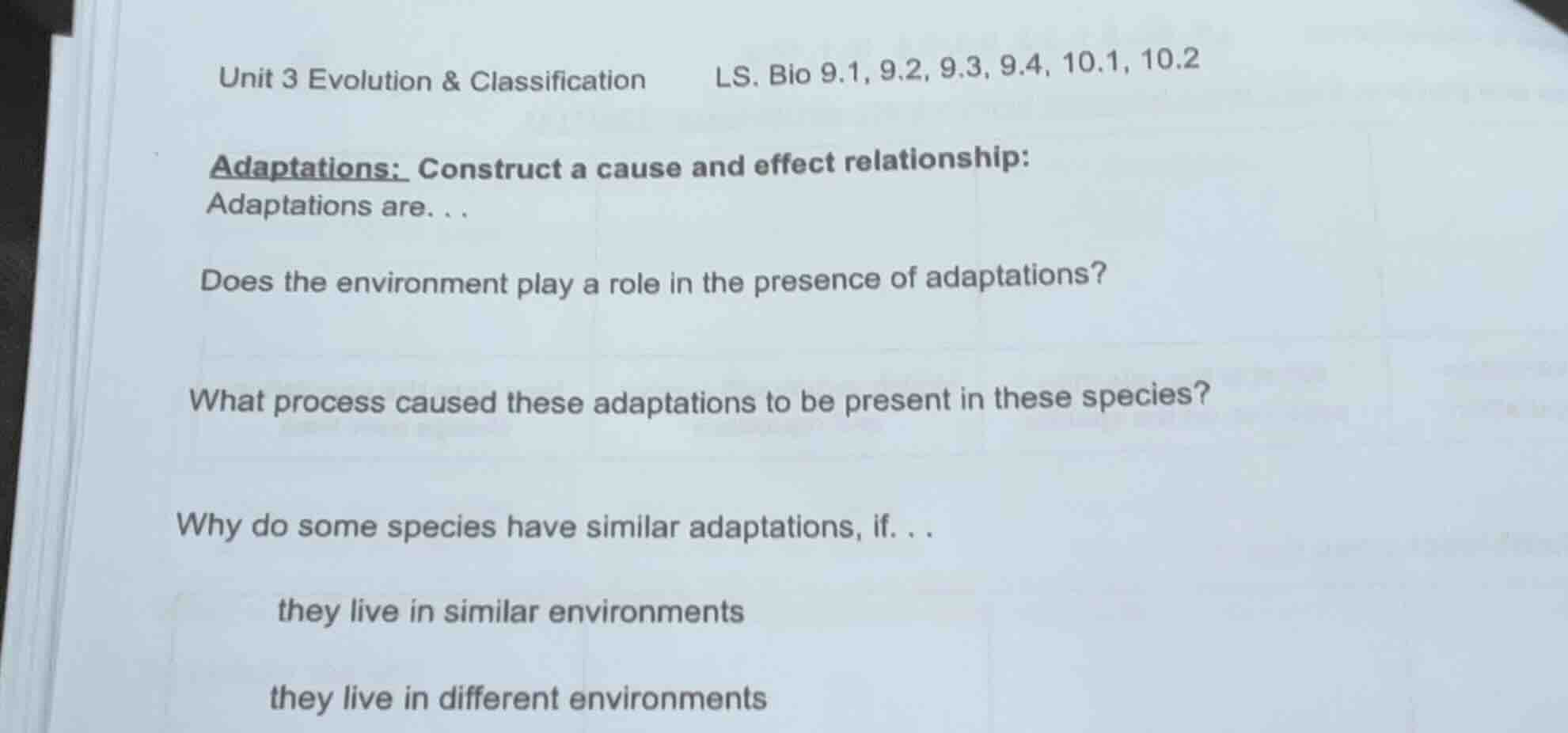
unit 3 evolution & classification ls. bio 9.1, 9.2, 9.3, 9.4, 10.1, 10.2
adaptations: construct a cause and effect relationship:
adaptations are. . .
does the environment play a role in the presence of adaptations?
what process caused these adaptations to be present in these species?
why do some species have similar adaptations, if. . .
they live in similar environments
they live in different environments
- Adaptations definition: Adaptations are heritable traits that improve an organism's survival and reproductive success in its environment. The cause is genetic variation and environmental pressure; the effect is enhanced fitness for the organism.
- Environment's role: Environmental conditions create selective pressures. Traits that improve survival in a specific environment are more likely to be passed to offspring, so the environment directly shapes which adaptations persist.
- Process for adaptations: Natural selection is the core process. Organisms with beneficial heritable traits survive longer, reproduce more, and pass those traits to subsequent generations, leading to widespread adaptations in a population over time.
- Similar adaptations in similar environments: This is convergent evolution. Unrelated species independently evolve similar traits because they face the same environmental selective pressures (e.g., streamlined bodies in dolphins and sharks for aquatic movement).
- Similar adaptations in different environments: This is often due to shared ancestry (divergent evolution from a common ancestor). The similar traits are homologous structures, inherited from a common ancestor, even if the species now live in different environments (e.g., forelimbs of humans, bats, and whales).

Snap & solve any problem in the app
Get step-by-step solutions on Sovi AI
Photo-based solutions with guided steps
Explore more problems and detailed explanations
- Adaptations are heritable, fitness-enhancing traits. Cause: Genetic variation + environmental pressure; Effect: Improved survival/reproduction in a habitat.
- Yes, the environment plays a critical role: it creates selective pressures that determine which heritable traits (adaptations) are favored and passed to offspring.
- Natural selection is the primary process: organisms with beneficial, heritable adaptations survive and reproduce at higher rates, leading to the trait becoming common in the population over generations.
- When they live in similar environments: This is convergent evolution—unrelated species independently evolve similar adaptations to cope with identical environmental selective pressures.
When they live in different environments: This typically stems from shared ancestry (divergent evolution); the similar traits are homologous structures inherited from a common ancestor, even as the species adapted to new, distinct habitats.