QUESTION IMAGE
Question
unit 3 evolution & classification ls. bio 9.1, 9.2, 9.3, 9.4, 10.1, 10.2
station 5: embryos
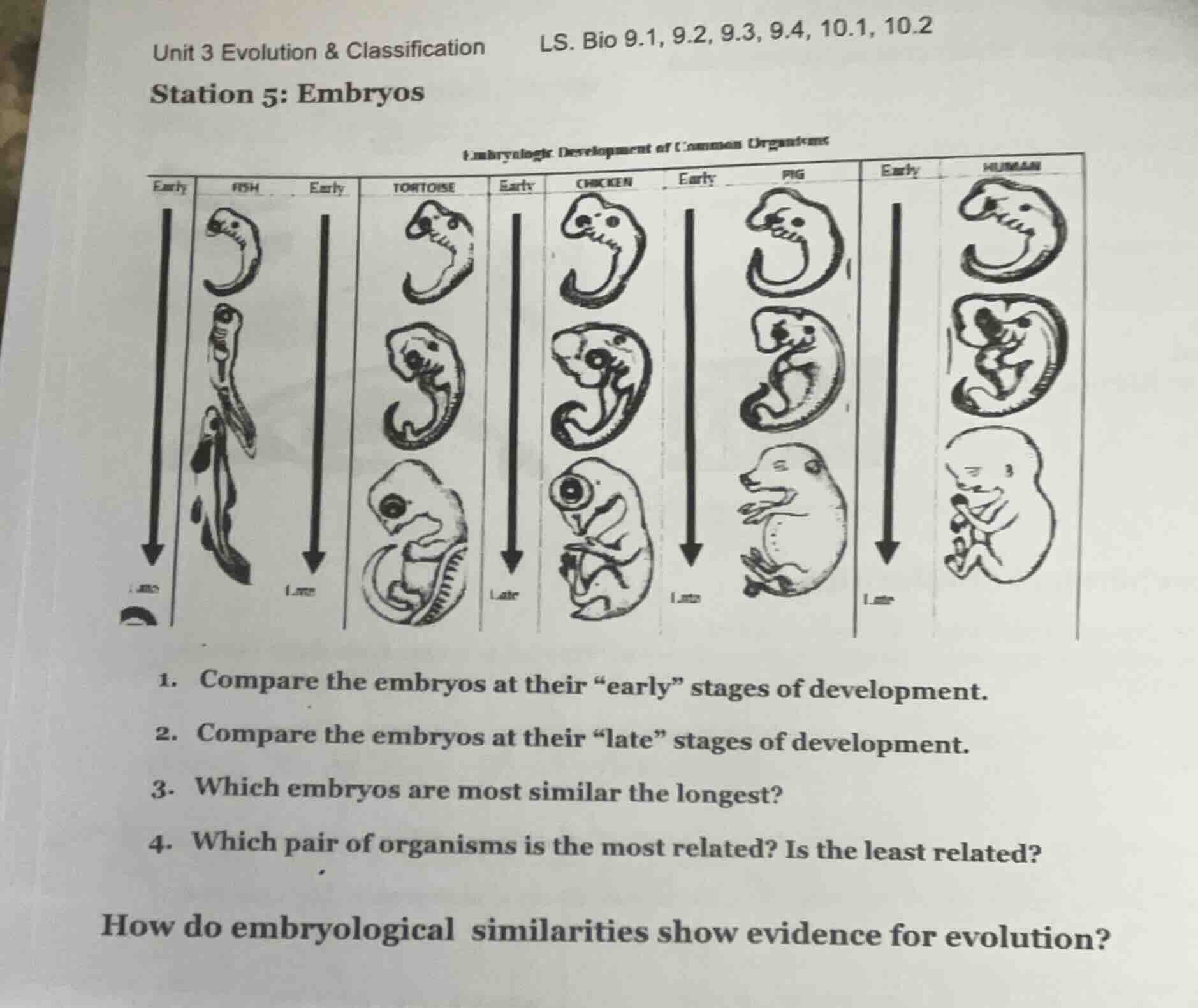
embryologic development of common organisms
- compare the embryos at their \early\ stages of development.
- compare the embryos at their \late\ stages of development.
- which embryos are most similar the longest?
- which pair of organisms is the most related? is the least related?
how do embryological similarities show evidence for evolution?
Brief Explanations
- For early stages: All embryos share key physical traits like curved bodies, gill slits, and similar head/limb bud structures, making them nearly indistinguishable.
- For late stages: Each embryo develops species-specific features (fish: fins, gills; tortoise: shell, reptilian limbs; chicken: beak, wings; pig: snout, hooved limbs; human: rounded skull, grasping hands) that make them easily distinguishable.
- Observe developmental progression: Pig and human embryos retain similar structures (e.g., limb shape, body form) through more stages than other pairs before diverging into species-specific traits.
- Relatedness is tied to shared development: Pig and human are most related (closest evolutionary lineage, shared mammalian traits longest); fish is least related to all others (diverges earliest into aquatic-specific traits).
- Evolution evidence: Shared early embryonic structures indicate all these organisms inherit a common developmental blueprint from a distant common ancestor, with divergence in later stages reflecting adaptive evolutionary changes over time.

Snap & solve any problem in the app
Get step-by-step solutions on Sovi AI
Photo-based solutions with guided steps
Explore more problems and detailed explanations
- All early-stage embryos are highly similar, with shared features like gill slits, curved bodies, and undifferentiated limb buds.
- Late-stage embryos are distinct, each having unique species-specific traits (e.g., fish fins, human hands, chicken beaks) that match their adult forms.
- Pig and human embryos are most similar the longest.
- Most related: Pig and human; Least related: Fish and all other organisms (fish and human, fish and pig, fish and chicken, fish and tortoise).
- Shared early embryonic development shows that these organisms descend from a common ancestor, as they inherit a common genetic/developmental framework. As development proceeds, species-specific adaptations emerge, reflecting evolutionary divergence from that shared ancestor.