QUESTION IMAGE
Question
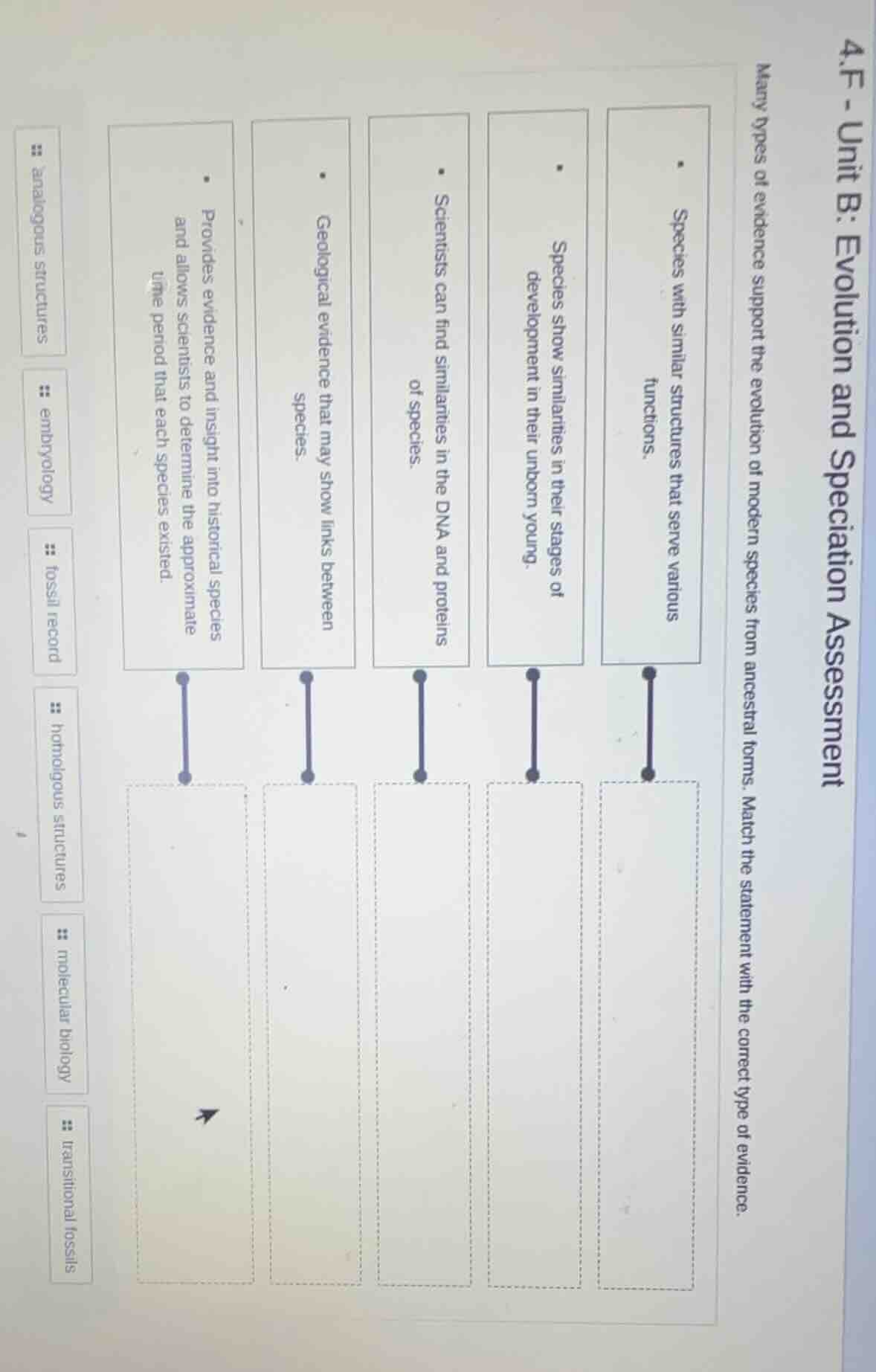
4.f - unit b: evolution and speciation assessment many types of evidence support the evolution of modern species from ancestral forms. match the statement with the correct type of evidence. - species with similar structures that serve various functions. - species show similarities in their stages of development in their unborn young. - scientists can find similarities in the dna and proteins of species. - geological evidence that may show links between species. - provides evidence and insight into historical species and allows scientists to determine the approximate time period that each species existed. :: analogous structures :: embryology :: fossil record :: homologous structures :: molecular biology :: transitional fossils
To solve this matching problem, we analyze each statement and match it with the corresponding evidence type:
1. "Species with similar structures that serve various functions."
This describes analogous structures (structures with similar form/function but different evolutionary origins).
2. "Species show similarities in their stages of development in their unborn young."
This refers to embryology (comparing embryonic development across species).
3. "Scientists can find similarities in the DNA and proteins of species."
This is molecular biology (analyzing molecular-level similarities like DNA/proteins).
4. "Geological evidence that may show links between species."
This relates to transitional fossils (fossils showing intermediate forms between species, found in geological layers).
5. "Provides evidence and insight into historical species and allows scientists to determine the approximate time period that each species existed."
This is the fossil record (fossils document species over time and their existence periods).
Final Matches:
- "Species with similar structures that serve various functions." → analogous structures
- "Species show similarities in their stages of development in their unborn young." → embryology
- "Scientists can find similarities in the DNA and proteins of species." → molecular biology
- "Geological evidence that may show links between species." → transitional fossils
- "Provides evidence and insight into historical species and allows scientists to determine the approximate time period that each species existed." → fossil record
(Note: For the "similar structures with different evolutionary origins" (homologous structures have similar origin but different function), the first statement’s "similar structures, various functions" matches analogous structures. If a statement about "similar structures, same origin, different functions" were present, it would match homologous structures, but the given first statement specifies "various functions," so analogous structures is correct.)

Snap & solve any problem in the app
Get step-by-step solutions on Sovi AI
Photo-based solutions with guided steps
Explore more problems and detailed explanations
To solve this matching problem, we analyze each statement and match it with the corresponding evidence type:
1. "Species with similar structures that serve various functions."
This describes analogous structures (structures with similar form/function but different evolutionary origins).
2. "Species show similarities in their stages of development in their unborn young."
This refers to embryology (comparing embryonic development across species).
3. "Scientists can find similarities in the DNA and proteins of species."
This is molecular biology (analyzing molecular-level similarities like DNA/proteins).
4. "Geological evidence that may show links between species."
This relates to transitional fossils (fossils showing intermediate forms between species, found in geological layers).
5. "Provides evidence and insight into historical species and allows scientists to determine the approximate time period that each species existed."
This is the fossil record (fossils document species over time and their existence periods).
Final Matches:
- "Species with similar structures that serve various functions." → analogous structures
- "Species show similarities in their stages of development in their unborn young." → embryology
- "Scientists can find similarities in the DNA and proteins of species." → molecular biology
- "Geological evidence that may show links between species." → transitional fossils
- "Provides evidence and insight into historical species and allows scientists to determine the approximate time period that each species existed." → fossil record
(Note: For the "similar structures with different evolutionary origins" (homologous structures have similar origin but different function), the first statement’s "similar structures, various functions" matches analogous structures. If a statement about "similar structures, same origin, different functions" were present, it would match homologous structures, but the given first statement specifies "various functions," so analogous structures is correct.)