QUESTION IMAGE
Question
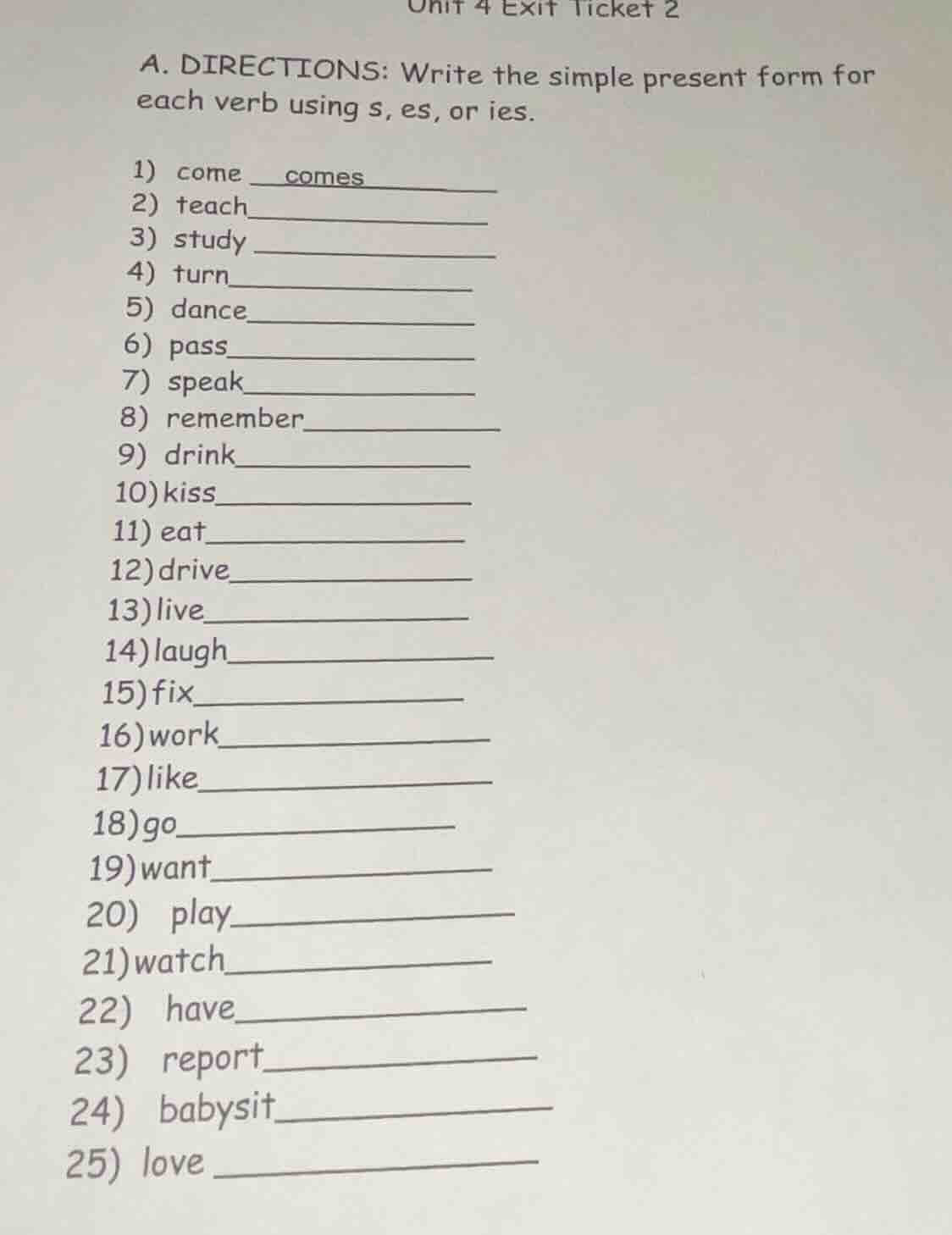
unit 4 exit ticket 2
a. directions: write the simple present form for
each verb using s, es, or ies.
- come ____comes____
- teach__________
- study __________
- turn__________
- dance__________
- pass__________
- speak__________
- remember__________
- drink__________
10)kiss__________
- eat__________
12)drive__________
13)live__________
14)laugh__________
15)fix__________
16)work__________
17)like__________
18)go__________
19)want__________
- play__________
21)watch__________
- have__________
- report__________
- babysit__________
- love __________
Response
To solve this, we apply the rules for forming the simple present tense of verbs with third - person singular (he/she/it) subjects:
Rule 1: For most regular verbs, add "s" to the base form.
- Verbs like "turn", "speak", "remember", "drink", "eat", "drive", "live", "laugh", "work", "like", "want", "play", "report", "love" follow this rule.
- "turn" becomes "turns"
- "speak" becomes "speaks"
- "remember" becomes "remembers"
- "drink" becomes "drinks"
- "eat" becomes "eats"
- "drive" becomes "drives"
- "live" becomes "lives"
- "laugh" becomes "laughs"
- "work" becomes "works"
- "like" becomes "likes"
- "want" becomes "wants"
- "play" becomes "plays"
- "report" becomes "reports"
- "love" becomes "loves"
Rule 2: If the verb ends in "ch", "sh", "s", "x", or "z", add "es".
- Verbs "teach" (ends with "ch"), "dance" (ends with "ce" which is like "se" in terms of the rule - since "dance" ends with "e" + "ce", but the base rule for "ch", "sh", "s", "x", "z" or "o" (for some verbs) applies here. Wait, "teach" ends with "ch", so we add "es" → "teaches". "dance" ends with "ce" (which is a s - like sound - producing ending), so we add "es" → "dances". "pass" (ends with "ss") → "passes". "kiss" (ends with "ss") → "kisses". "fix" (ends with "x") → "fixes". "go" (ends with "o") → "goes" (this is a special case for "o" - ending verbs, we add "es"). "watch" (ends with "ch") → "watches".
Rule 3: If the verb ends in a consonant + "y", change the "y" to "i" and add "es".
- The verb "study" ends with "y" after a consonant "d", so we change "y" to "i" and add "es" → "studies". "babysit" ends with "y" after a consonant "t", so we change "y" to "i" and add "es" → "babysits".
Now let's list all the answers:
- teaches
- studies
- turns
- dances
- passes
- speaks
- remembers
- drinks
- kisses
- eats
- drives
- lives
- laughs
- fixes
- works
- likes
- goes
- wants
- plays
- watches
- has (Note: "have" is an irregular verb, and its third - person singular form is "has")
- reports
- babysits
- loves

Snap & solve any problem in the app
Get step-by-step solutions on Sovi AI
Photo-based solutions with guided steps
Explore more problems and detailed explanations
To solve this, we apply the rules for forming the simple present tense of verbs with third - person singular (he/she/it) subjects:
Rule 1: For most regular verbs, add "s" to the base form.
- Verbs like "turn", "speak", "remember", "drink", "eat", "drive", "live", "laugh", "work", "like", "want", "play", "report", "love" follow this rule.
- "turn" becomes "turns"
- "speak" becomes "speaks"
- "remember" becomes "remembers"
- "drink" becomes "drinks"
- "eat" becomes "eats"
- "drive" becomes "drives"
- "live" becomes "lives"
- "laugh" becomes "laughs"
- "work" becomes "works"
- "like" becomes "likes"
- "want" becomes "wants"
- "play" becomes "plays"
- "report" becomes "reports"
- "love" becomes "loves"
Rule 2: If the verb ends in "ch", "sh", "s", "x", or "z", add "es".
- Verbs "teach" (ends with "ch"), "dance" (ends with "ce" which is like "se" in terms of the rule - since "dance" ends with "e" + "ce", but the base rule for "ch", "sh", "s", "x", "z" or "o" (for some verbs) applies here. Wait, "teach" ends with "ch", so we add "es" → "teaches". "dance" ends with "ce" (which is a s - like sound - producing ending), so we add "es" → "dances". "pass" (ends with "ss") → "passes". "kiss" (ends with "ss") → "kisses". "fix" (ends with "x") → "fixes". "go" (ends with "o") → "goes" (this is a special case for "o" - ending verbs, we add "es"). "watch" (ends with "ch") → "watches".
Rule 3: If the verb ends in a consonant + "y", change the "y" to "i" and add "es".
- The verb "study" ends with "y" after a consonant "d", so we change "y" to "i" and add "es" → "studies". "babysit" ends with "y" after a consonant "t", so we change "y" to "i" and add "es" → "babysits".
Now let's list all the answers:
- teaches
- studies
- turns
- dances
- passes
- speaks
- remembers
- drinks
- kisses
- eats
- drives
- lives
- laughs
- fixes
- works
- likes
- goes
- wants
- plays
- watches
- has (Note: "have" is an irregular verb, and its third - person singular form is "has")
- reports
- babysits
- loves