QUESTION IMAGE
Question
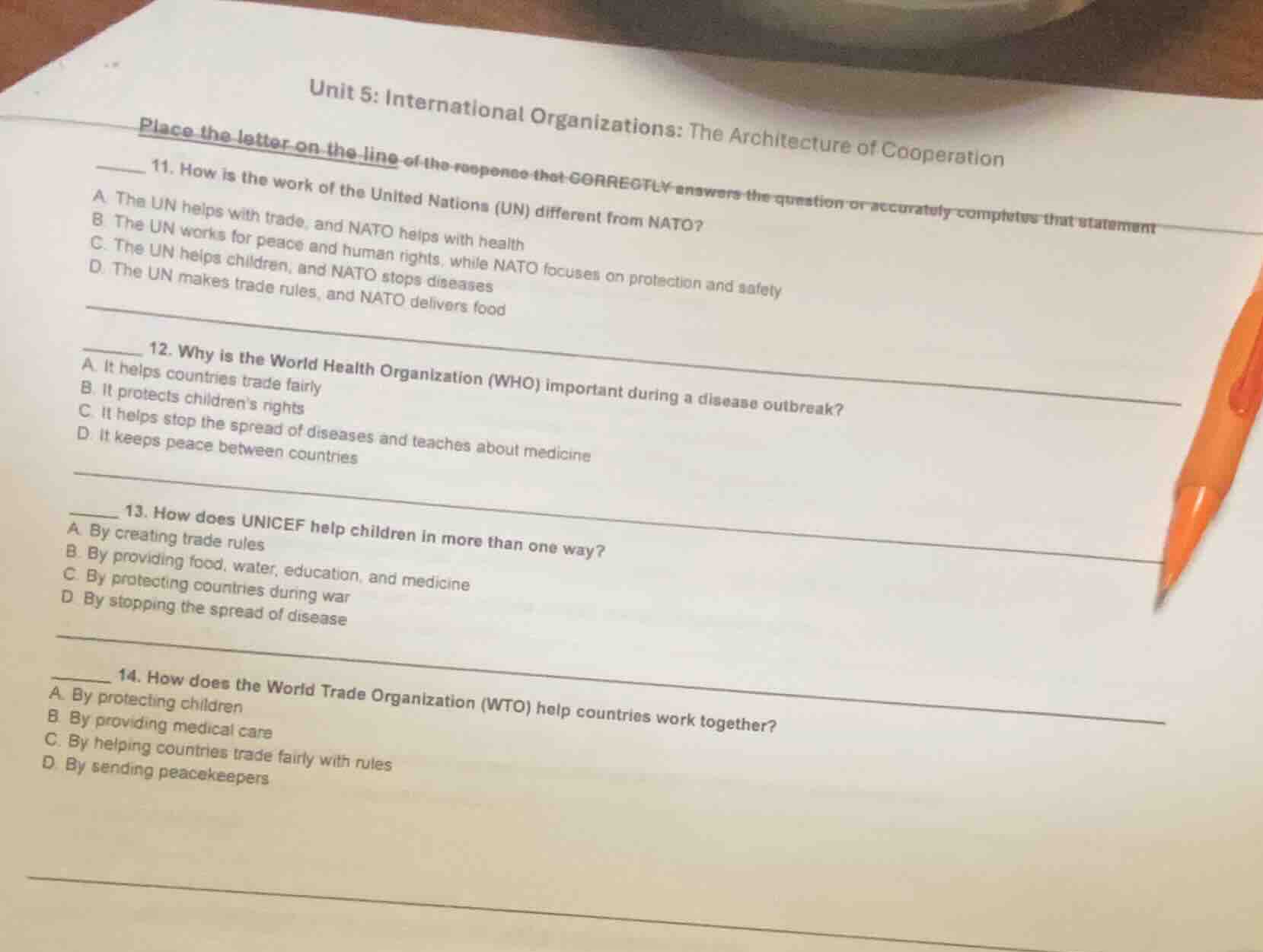
unit 5: international organizations: the architecture of cooperation
place the letter on the line of the response that correctly answers the question or accurately completes the statement
____ 11. how is the work of the united nations (un) different from nato?
a. the un helps with trade, and nato helps with health
b. the un works for peace and human rights, while nato focuses on protection and safety
c. the un helps children, and nato stops diseases
d. the un makes trade rules, and nato delivers food
____ 12. why is the world health organization (who) important during a disease outbreak?
a. it helps countries trade fairly
b. it protects children’s rights
c. it helps stop the spread of diseases and teaches about medicine
d. it keeps peace between countries
____ 13. how does unicef help children in more than one way?
a. by creating trade rules
b. by providing food, water, education, and medicine
c. by protecting countries during war
d. by stopping the spread of disease
____ 14. how does the world trade organization (wto) help countries work together?
a. by protecting children
b. by providing medical care
c. by helping countries trade fairly with rules
d. by sending peacekeepers
- The UN has a broad mandate including peace, human rights, and global welfare, while NATO is a military alliance focused on collective defense and safety.
- WHO's core role during disease outbreaks is coordinating disease control, stopping spread, and sharing medical knowledge.
- UNICEF's mission centers on holistic support for children, including basic needs, education, and healthcare.
- WTO's primary function is establishing and enforcing rules to ensure fair international trade between countries.

Snap & solve any problem in the app
Get step-by-step solutions on Sovi AI
Photo-based solutions with guided steps
Explore more problems and detailed explanations
- B. The UN works for peace and human rights, while NATO focuses on protection and safety
- C. It helps stop the spread of diseases and teaches about medicine
- B. By providing food, water, education, and medicine
- C. By helping countries trade fairly with rules