QUESTION IMAGE
Question
unit 1, lesson 2
activity 2
are people treating scarce resources as
scarce?
directions: mark an “s” at the end of the statement if
you think the item is scarce. mark a “ns” if the item is
not scarce.
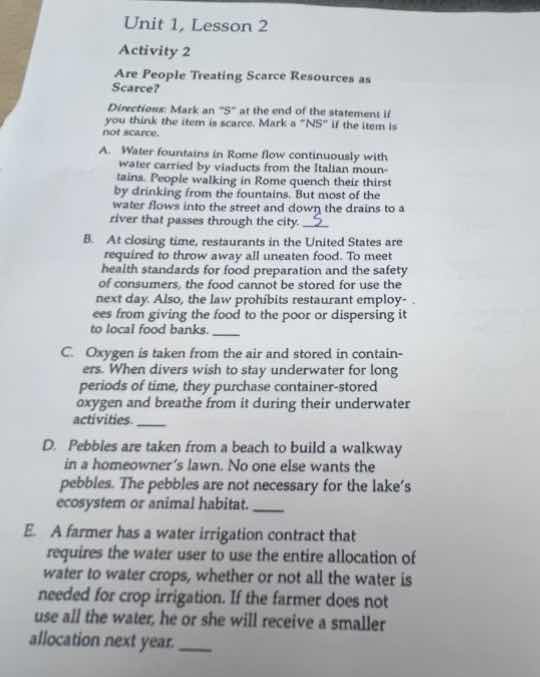
a. water fountains in rome flow continuously with
water carried by viaducts from the italian country-
tains. people walking in rome quench their thirst
by drinking from the fountains. but most of the
water flows into the street and down the drains to a
river that passes through the city.
b. at closing time, restaurants in the united states are
required to throw away all uneaten food. to meet
health standards for food preparation and the safety
of consumers, the food cannot be stored for use the
next day. also, the law prohibits restaurant employ-
ees from giving the food to the poor or dispersing it
to local food banks.
c. oxygen is taken from the air and stored in contain-
ers. when divers wish to stay underwater for long
periods of time, they purchase container - stored
oxygen and breathe from it during their underwater
activities.
d. pebbles are taken from a beach to build a walkway
in a homeowner’s lawn. no one else wants the
pebbles are not all necessary for the lake’s
ecosystem or animal habitat.
e. a farmer has a water irrigation contract that
requires the water user to use the entire allocation of
water to water crops, whether or not all the water is
needed for crop irrigation. if the farmer does not
use all the water, he or she will receive a smaller
allocation next year.
To solve this, we analyze each statement to determine if the resource is scarce (S) or not scarce (NS) by checking if it's limited or has alternative uses/availability:
Part A
- Explanation: Rome’s water fountains have continuous water (via aqueducts), and excess flows away. Water here is abundant, not limited.
- Answer: NS
Part B
- Explanation: Unsold restaurant food must be thrown away (can’t reuse or donate due to health laws). The food is not available for other uses, so it’s not scarce (since it’s wasted, not limited in a way that creates competition).
- Answer: NS
Part C
- Explanation: Divers need to purchase stored oxygen for long dives, meaning oxygen in containers is limited (not freely available). This creates competition (need to buy), so it’s scarce.
- Answer: S
Part D
- Explanation: Beach pebbles used for a walkway are unwanted by others and not vital for the ecosystem. They are abundant (no competition for use), so not scarce.
- Answer: NS
Part E
- Explanation: The farmer must use all water or get less next year, meaning water allocation is limited (scarcity forces use to avoid loss).
- Answer: S
Final Answers:
A. NS
B. NS
C. S
D. NS
E. S

Snap & solve any problem in the app
Get step-by-step solutions on Sovi AI
Photo-based solutions with guided steps
Explore more problems and detailed explanations
To solve this, we analyze each statement to determine if the resource is scarce (S) or not scarce (NS) by checking if it's limited or has alternative uses/availability:
Part A
- Explanation: Rome’s water fountains have continuous water (via aqueducts), and excess flows away. Water here is abundant, not limited.
- Answer: NS
Part B
- Explanation: Unsold restaurant food must be thrown away (can’t reuse or donate due to health laws). The food is not available for other uses, so it’s not scarce (since it’s wasted, not limited in a way that creates competition).
- Answer: NS
Part C
- Explanation: Divers need to purchase stored oxygen for long dives, meaning oxygen in containers is limited (not freely available). This creates competition (need to buy), so it’s scarce.
- Answer: S
Part D
- Explanation: Beach pebbles used for a walkway are unwanted by others and not vital for the ecosystem. They are abundant (no competition for use), so not scarce.
- Answer: NS
Part E
- Explanation: The farmer must use all water or get less next year, meaning water allocation is limited (scarcity forces use to avoid loss).
- Answer: S
Final Answers:
A. NS
B. NS
C. S
D. NS
E. S