QUESTION IMAGE
Question
unit 0.6: old world governments
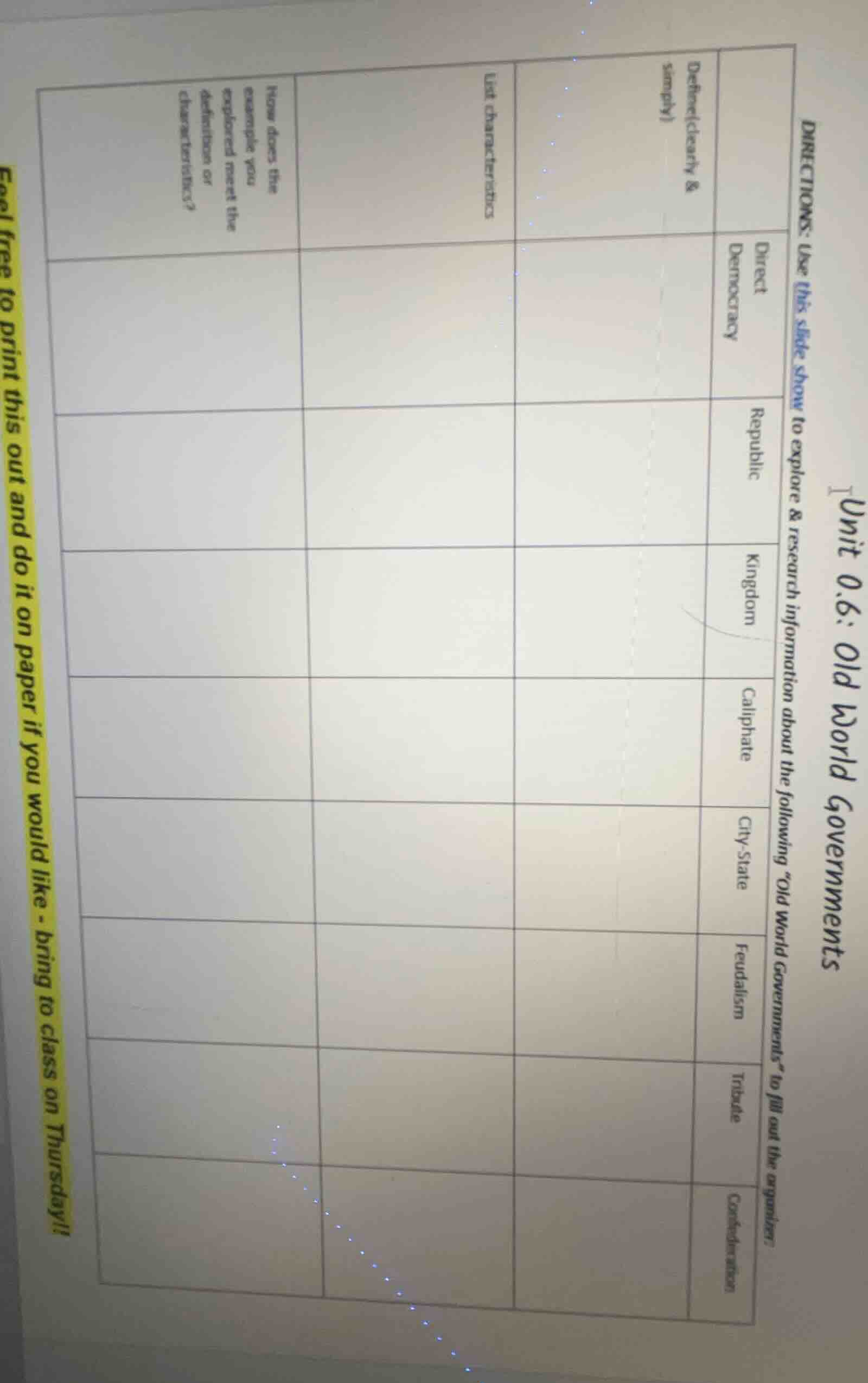
directions: use this slide show to explore & research information about the following \old world governments\ to fill out the organizer.
\t\t\tdefine(clearly & simply)
\t\t\tlist characteristics
\t\t\thow does the example you explored meet the definition or characteristic?
direct democracy
republic
kingdom
caliphate
city - state
feudalism
tribute
confederation
feel free to print this out and do it on paper if you would like - bring to class on thursday!!
Each row is completed with a clear definition, key characteristics, and a verification of how the example aligns with the system's traits, based on core political history concepts:
- Direct Democracy: A system where citizens directly vote on policies, no elected representatives.
- Republic: Citizens elect representatives to make laws on their behalf.
- Kingdom: Ruled by a monarch (king/queen), power usually hereditary.
- Caliphate: Islamic state led by a caliph, a successor to the Prophet Muhammad, combining religious and political authority.
- City-State: Independent self-governing city that controls surrounding small territories.
- Feudalism: A hierarchical system based on land ownership, loyalty, and military service.
- Tribute: A system where a weaker state/group pays goods/resources to a stronger power to avoid conflict.
- Confederation: A union of sovereign states that delegate limited power to a central body.

Snap & solve any problem in the app
Get step-by-step solutions on Sovi AI
Photo-based solutions with guided steps
Explore more problems and detailed explanations
| Government Type | Define(clearly & simply) | List characteristics | How does the example you explored meet the definition or characteristics? |
|---|---|---|---|
| Republic | Citizens elect reps to make laws | Elected officials; rule of law; citizen eligibility for office | Roman Republic: Citizens elected consuls and senators to govern, aligning with representative rule and legal framework. |
| Kingdom | Ruled by a hereditary monarch | Hereditary power; monarch as head of state; varying autocracy levels | Ancient Egypt: Pharaohs inherited power, served as state/religious head, fitting hereditary monarchical rule. |
| Caliphate | Islamic state led by a caliph (Muhammad's successor) | Religious-political unity; caliph as leader; Sharia law influence | Rashidun Caliphate: Led by caliphs succeeding Muhammad, merged religious and political authority, matching caliphate traits. |
| City-State | Independent self-governing city with surrounding lands | Sovereign territory; urban center; unique governance system | Ancient Sparta: Independent city with its own military-focused government, controlling surrounding Peloponnesian lands. |
| Feudalism | Hierarchical system based on land, loyalty, service | Lord-vassal relationships; land for military service; serf labor | Medieval Europe: Lords granted fiefs to vassals in exchange for military support, serfs worked land, fitting the hierarchical land-based structure. |
| Tribute | Weaker group pays goods/resources to a stronger power | Asymmetrical power dynamic; payment for protection/peace; forced or voluntary | Aztec Empire: Conquered city-states paid food, gold, and slaves to the Aztec ruler, matching the tribute-based subjugation system. |
| Confederation | Union of sovereign states with limited central power | State sovereignty; weak central government; shared limited functions | Ancient Greek Delian League: Independent city-states joined under a weak central council, retaining most sovereignty, fitting confederation traits. |