QUESTION IMAGE
Question
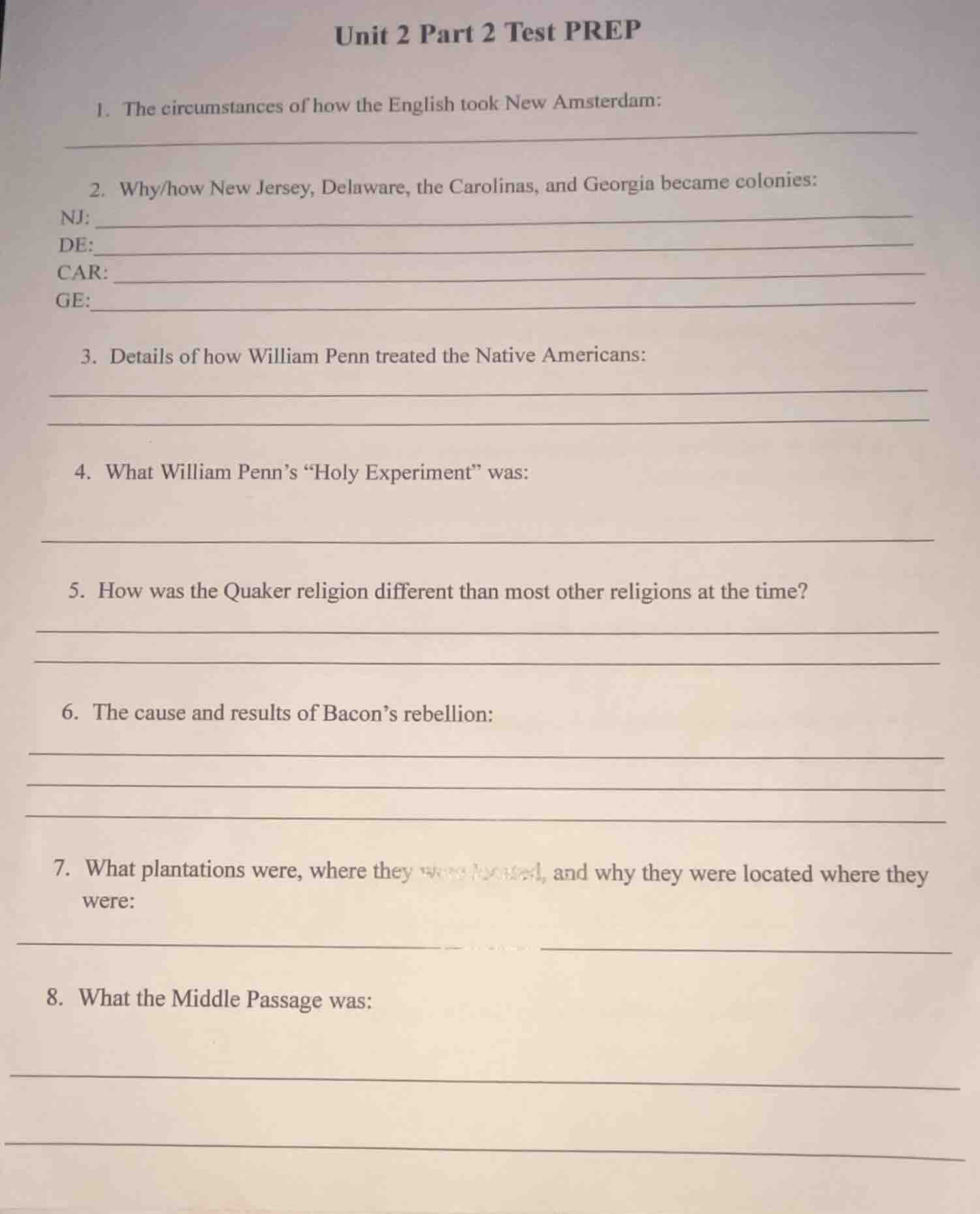
unit 2 part 2 test prep
- the circumstances of how the english took new amsterdam:
- why/how new jersey, delaware, the carolinas, and georgia became colonies:
nj:
de:
car:
ge:
- details of how william penn treated the native americans:
- what william penn’s “holy experiment” was:
- how was the quaker religion different than most other religions at the time?
- the cause and results of bacon’s rebellion:
- what plantations were, where they were located, and why they were located where they were:
- what the middle passage was:
To answer these questions, we'll address each one with a brief explanation:
1. The circumstances of how the English took New Amsterdam:
The Dutch colony of New Amsterdam (later New York) was taken by the English in 1664. The English fleet arrived, and Peter Stuyvesant, the Dutch governor, had little military support. The Dutch surrendered without a fight, and the colony was renamed New York in honor of the Duke of York.
2. Why/how New Jersey, Delaware, the Carolinas, and Georgia became colonies:
- NJ (New Jersey): Originally part of New Netherland and then New York, it was split off and given to Sir George Carteret and Lord Berkeley as a proprietary colony. Later, it became a royal colony.
- DE (Delaware): Initially part of Pennsylvania, it was granted its own assembly by William Penn. It later became a separate colony, first proprietary and then royal.
- CAR (Carolinas): Founded by the Lords Proprietors (eight English nobles) as a proprietary colony. It was later split into North and South Carolina. The southern part had large plantations, while the northern part had smaller farms.
- GE (Georgia): Founded by James Oglethorpe as a proprietary colony to serve as a buffer between the English colonies and Spanish Florida. It was also a place for debtors to start fresh. Later, it became a royal colony.
3. Details of how William Penn treated the Native Americans:
William Penn, the founder of Pennsylvania, had a peaceful approach. He made treaties with Native American tribes (like the Lenape) based on fairness and respect. He paid for land (instead of taking it by force) and established a policy of peaceful coexistence. This led to relatively good relations, though these were later strained by incoming settlers.
4. What William Penn’s “Holy Experiment” was:
Penn’s “Holy Experiment” was his vision for Pennsylvania. It was a colony founded on Quaker principles of religious freedom, equality, and democracy. He wanted to create a place where people of all religions (especially Quakers, who faced persecution in England) could live peacefully, and where the government would be based on consent and justice.
5. How was the Quaker religion different than most other religions at the time?
Quakers (Society of Friends) differed in several ways:
- They believed in the “Inner Light” (a direct connection to God, without needing clergy).
- They opposed formal rituals, sacraments, and elaborate churches.
- They advocated for equality (including women’s rights and against slavery), pacifism (opposing war), and simplicity in life and worship.
- They refused to take oaths or fight in wars, which was controversial.
6. The cause and results of Bacon’s rebellion:
- Cause: Nathaniel Bacon led a rebellion in Virginia (1676) against Governor Berkeley. The main issues were the government’s failure to protect settlers from Native American attacks, economic grievances (like high taxes and low tobacco prices), and political corruption.
- Results: Bacon died of illness during the rebellion, and it was suppressed. However, it highlighted tensions between frontier settlers and the elite, and led to a shift toward using more enslaved Africans (instead of indentured servants) for labor, as a more controlled workforce.
7. What plantations were, where they were located, and why they were located where they were:
- What: Plantations were large agricultural estates, often growing cash crops (tobacco, rice, indigo, later cotton) using slave labor.
- Where: Primarily in the Southern colonies (Virginia, Maryland, C…

Snap & solve any problem in the app
Get step-by-step solutions on Sovi AI
Photo-based solutions with guided steps
Explore more problems and detailed explanations
To answer these questions, we'll address each one with a brief explanation:
1. The circumstances of how the English took New Amsterdam:
The Dutch colony of New Amsterdam (later New York) was taken by the English in 1664. The English fleet arrived, and Peter Stuyvesant, the Dutch governor, had little military support. The Dutch surrendered without a fight, and the colony was renamed New York in honor of the Duke of York.
2. Why/how New Jersey, Delaware, the Carolinas, and Georgia became colonies:
- NJ (New Jersey): Originally part of New Netherland and then New York, it was split off and given to Sir George Carteret and Lord Berkeley as a proprietary colony. Later, it became a royal colony.
- DE (Delaware): Initially part of Pennsylvania, it was granted its own assembly by William Penn. It later became a separate colony, first proprietary and then royal.
- CAR (Carolinas): Founded by the Lords Proprietors (eight English nobles) as a proprietary colony. It was later split into North and South Carolina. The southern part had large plantations, while the northern part had smaller farms.
- GE (Georgia): Founded by James Oglethorpe as a proprietary colony to serve as a buffer between the English colonies and Spanish Florida. It was also a place for debtors to start fresh. Later, it became a royal colony.
3. Details of how William Penn treated the Native Americans:
William Penn, the founder of Pennsylvania, had a peaceful approach. He made treaties with Native American tribes (like the Lenape) based on fairness and respect. He paid for land (instead of taking it by force) and established a policy of peaceful coexistence. This led to relatively good relations, though these were later strained by incoming settlers.
4. What William Penn’s “Holy Experiment” was:
Penn’s “Holy Experiment” was his vision for Pennsylvania. It was a colony founded on Quaker principles of religious freedom, equality, and democracy. He wanted to create a place where people of all religions (especially Quakers, who faced persecution in England) could live peacefully, and where the government would be based on consent and justice.
5. How was the Quaker religion different than most other religions at the time?
Quakers (Society of Friends) differed in several ways:
- They believed in the “Inner Light” (a direct connection to God, without needing clergy).
- They opposed formal rituals, sacraments, and elaborate churches.
- They advocated for equality (including women’s rights and against slavery), pacifism (opposing war), and simplicity in life and worship.
- They refused to take oaths or fight in wars, which was controversial.
6. The cause and results of Bacon’s rebellion:
- Cause: Nathaniel Bacon led a rebellion in Virginia (1676) against Governor Berkeley. The main issues were the government’s failure to protect settlers from Native American attacks, economic grievances (like high taxes and low tobacco prices), and political corruption.
- Results: Bacon died of illness during the rebellion, and it was suppressed. However, it highlighted tensions between frontier settlers and the elite, and led to a shift toward using more enslaved Africans (instead of indentured servants) for labor, as a more controlled workforce.
7. What plantations were, where they were located, and why they were located where they were:
- What: Plantations were large agricultural estates, often growing cash crops (tobacco, rice, indigo, later cotton) using slave labor.
- Where: Primarily in the Southern colonies (Virginia, Maryland, Carolinas, Georgia) and the Caribbean.
- Why: The Southern climate (long growing seasons, fertile soil) and access to waterways (for transporting crops) made it ideal for cash crops. The need for large labor forces led to the use of enslaved Africans, and the plantation system was economically profitable for exporting crops to Europe.
8. What the Middle Passage was:
The Middle Passage was the middle leg of the triangular trade. It involved transporting enslaved Africans from West Africa to the Americas (North, South, and Caribbean). Enslaved people were packed into slave ships under brutal conditions, with high mortality rates. This was part of the transatlantic slave trade, where Africans were sold to work on plantations.