QUESTION IMAGE
Question
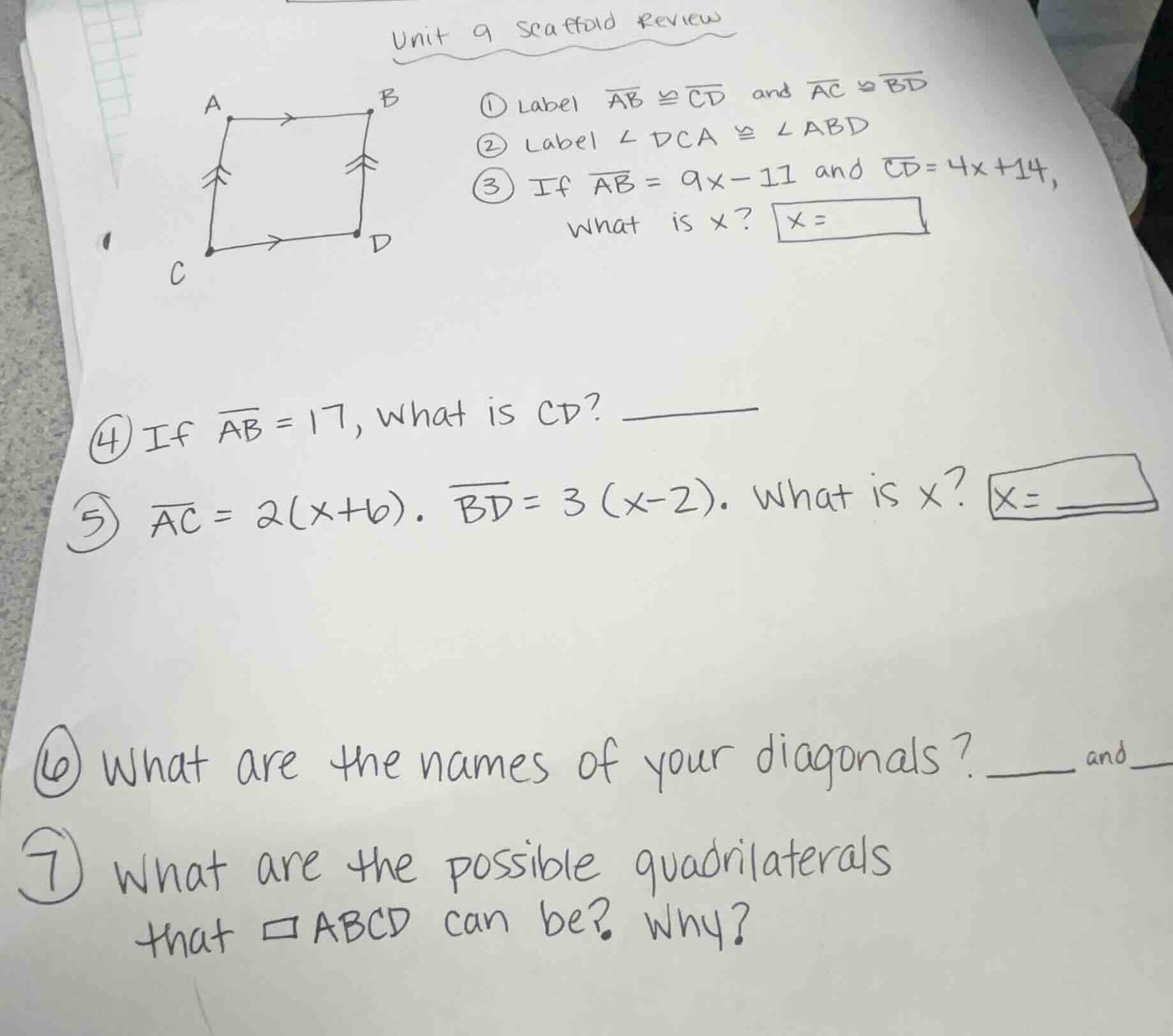
unit 9 scaffold review
① label \\(\overline{ab} \cong \overline{cd}\\) and \\(\overline{ac} \cong \overline{bd}\\)
② label \\(\angle dca \cong \angle abd\\)
③ if \\(\overline{ab} = 9x - 11\\) and \\(\overline{cd} = 4x + 14\\), what is \\(x\\)? \\(x = \\
④ if \\(\overline{ab} = 17\\), what is \\(cd\\)? \\
⑤ \\(\overline{ac} = 2(x + 6)\\). \\(\overline{bd} = 3(x - 2)\\). what is \\(x\\)? \\(x = \\
⑥ what are the names of your diagonals? \\(\underline{quad}\\) and \\
⑦ what are the possible quadrilaterals that \\(\square abcd\\) can be? why?
Step1: Set equal congruent segments
$9x - 11 = 4x + 14$
Step2: Isolate x terms
$9x - 4x = 14 + 11$
Step3: Simplify and solve for x
$5x = 25$
$x = \frac{25}{5} = 5$
Step4: Use segment congruence for CD
Since $\overline{AB} \cong \overline{CD}$, $CD = AB = 17$
Step5: Set equal congruent diagonals
$2(x + 6) = 3(x - 2)$
Step6: Expand both sides
$2x + 12 = 3x - 6$
Step7: Isolate x to solve
$12 + 6 = 3x - 2x$
$x = 18$

Snap & solve any problem in the app
Get step-by-step solutions on Sovi AI
Photo-based solutions with guided steps
Explore more problems and detailed explanations
- $x=5$
- $17$
- $x=18$
- $\overline{AC}$ and $\overline{BD}$
- Possible quadrilaterals are a rectangle or a square. This is because the figure has congruent opposite sides (defining a parallelogram) and congruent diagonals; in parallelograms, congruent diagonals only occur in rectangles (and squares, which are a special type of rectangle).