QUESTION IMAGE
Question
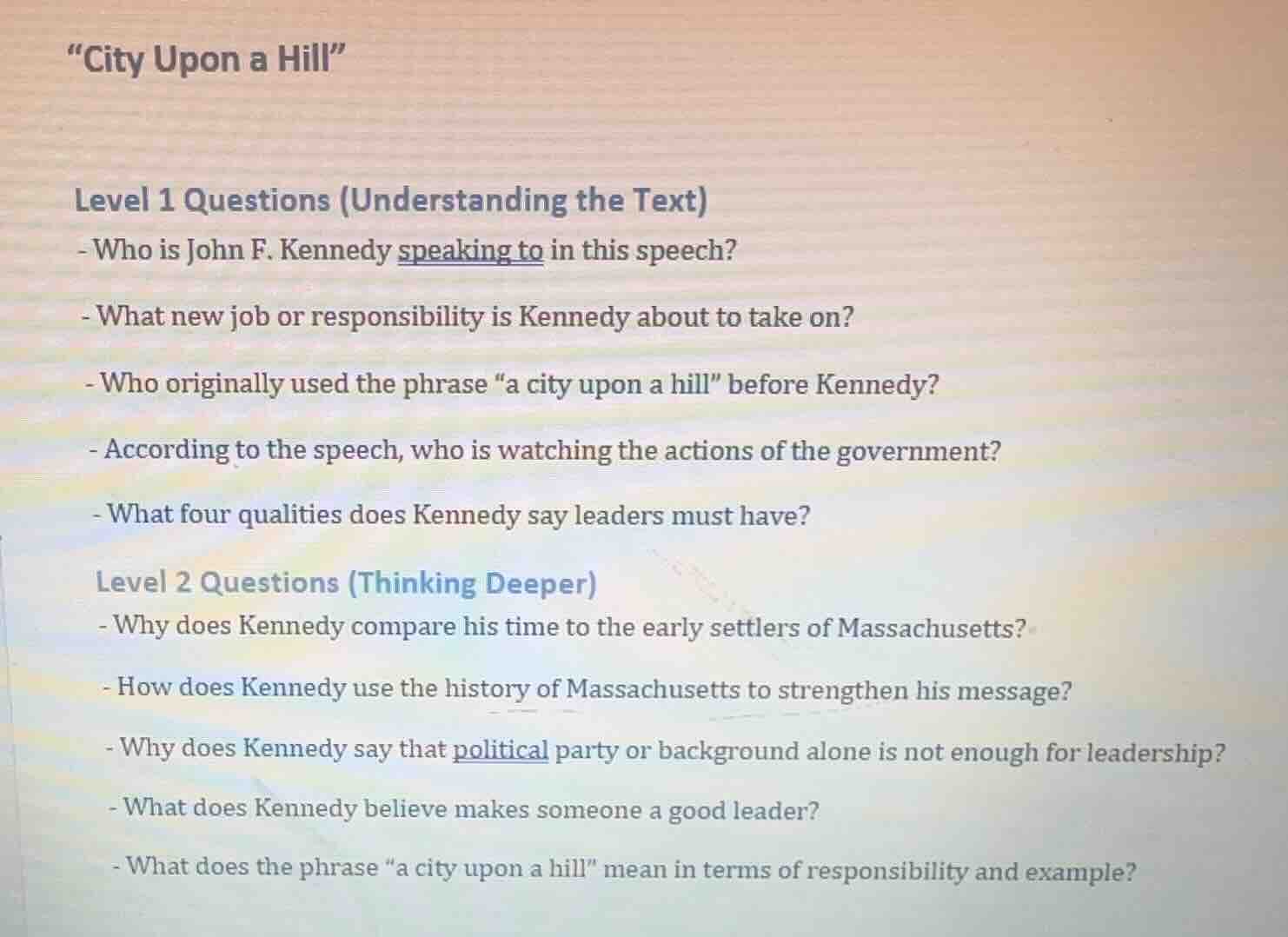
\city upon a hill\level 1 questions (understanding the text)- who is john f. kennedy speaking to in this speech?- what new job or responsibility is kennedy about to take on?- who originally used the phrase \a city upon a hill\ before kennedy?- according to the speech, who is watching the actions of the government?- what four qualities does kennedy say leaders must have?level 2 questions (thinking deeper)- why does kennedy compare his time to the early settlers of massachusetts?- how does kennedy use the history of massachusetts to strengthen his message?- why does kennedy say that political party or background alone is not enough for leadership?- what does kennedy believe makes someone a good leader?- what does the phrase \a city upon a hill\ mean in terms of responsibility and example?
All answers are based on John F. Kennedy's 1961 "City Upon a Hill" speech (to the Massachusetts General Court):
- For Level 1 questions, answers are direct factual details from the text.
- For Level 2 questions, answers analyze the rhetorical and thematic intent of the speech.

Snap & solve any problem in the app
Get step-by-step solutions on Sovi AI
Photo-based solutions with guided steps
Explore more problems and detailed explanations
Level 1 Questions
- John F. Kennedy is speaking to the Massachusetts General Court (the state legislature of Massachusetts).
- He is about to take on the role of President of the United States.
- The phrase was originally used by Puritan leader John Winthrop in his 1630 sermon A Model of Christian Charity.
- According to the speech, the entire world, as well as the American people, are watching the government's actions.
- Kennedy states leaders must have courage, judgment, integrity, and dedication.
Level 2 Questions
- He draws this parallel to frame his upcoming presidency as a new era of collective, high-stakes responsibility, mirroring the settlers' mission to build an exemplary community.
- He references the Massachusetts settlers' bold, principled founding of a community meant to be a model for others, tying this legacy to his call for modern Americans to uphold a similar standard of excellence and moral leadership.
- He argues this because effective leadership requires the ability to unite people across divides, prioritize the common good over partisan interests, and demonstrate the core qualities of courage, judgment, integrity, and dedication that are not tied to party affiliation.
- Kennedy believes a good leader is defined by courage to make hard choices, sound judgment, unwavering integrity, and selfless dedication to the public good, rather than just political ties or background.
- The phrase means the United States (and its government) has a responsibility to act as a moral, political, and social example for the entire world. Every action is visible, so the nation must uphold high standards of justice, integrity, and progress to fulfill this exemplary role.