QUESTION IMAGE
Question
use your answer to question 30 or 31 (document 3 below) and your knowledge of social studies.
document 9
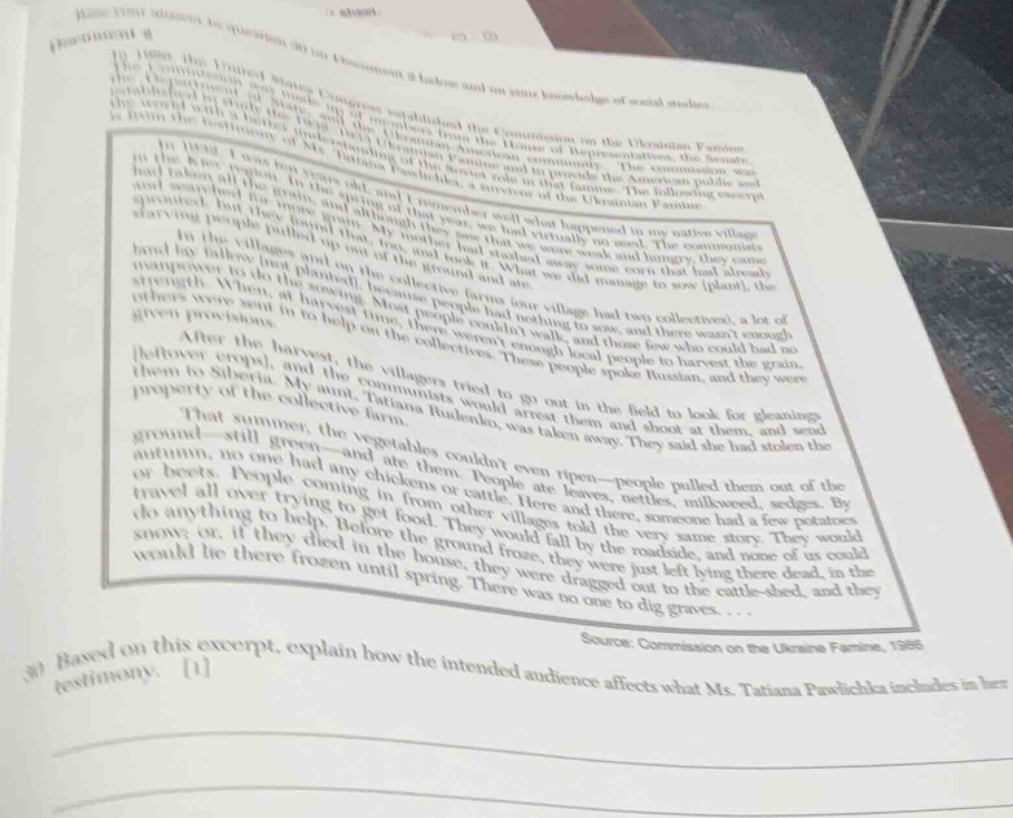
to the congress of the united states: i appeared before the commission on the ukrainian famine the testimony about the practice of requisitions from the house of representatives, the senate, the world and, they believe, in the ukrainian famine. a sense of patriotism: the american public was enlightened and a better understanding of the soviet role in perpetrating the ukrainian famine except is from the testimony of ms. tatiana pawlichka.
in 1933, i was 10 years old and i remember well what happened in my native village in the kiev region. the older people said that we were in need. the communists had taken all the grain and spring wheat that had virtually every corn and that had already sown seed, but they more grain, they had taken away. what we did manage to sow plant, the starving people pulled up out of the ground and ate.
in the villages and on the collective farms (our village had two collectives), a lot of land lay fallow not planted, because people couldnt walk to sow, and there wasnt enough strength. when, at harvest time, there werent enough local people to harvest the grain, others were sent in to help on the collectives. these people spoke russian, and they were given provisions.
after the harvest, the villagers tried to go out in the field to look for gleanings leftover crops, and the communists would arrest them and shoot at them, and send them to siberia. my aunt, tatiana riulenko, was taken. they said she had stolen the property of the collective farm.
that summer, the vegetables couldnt even ripen—people pulled them out of the ground—still green—and ate them. people ate leaves, nettles, milkweed, sedges. by autumn, no one had any chickens or cattle. here and there, someone had a few potatoes or beets. people coming in from other villages told the very same story. they would travel all over trying to get food. they would fall by the roadside, and none of us could do anything to help. before the ground froze, they were just left lying there dead, in the snow; or, if they died in the house, they were dragged out to the cattle - shed, and they would lie there frozen until spring. there was no one to dig graves....
source: commission on the ukraine famine, 1988
- based on this excerpt, explain how the intended audience affects what ms. tatiana pawlichka includes in her testimony. 1
The excerpt is a personal account of the Ukrainian Famine (Holodomor) under Soviet collectivization, presented to the Commission on the Ukrainian Famine (likely a U.S. body). The intended audience (U.S. policymakers, public, or those investigating the famine) influences Ms. Pawlichka’s testimony: she emphasizes human suffering (starvation, forced labor, arrests) to highlight the Soviet system’s cruelty, uses vivid details (village life, family experiences) to make the famine’s impact relatable, and contrasts Soviet policies (collectivization, repression) with the villagers’ desperation, aiming to persuade or inform the audience about the famine’s severity and Soviet culpability.

Snap & solve any problem in the app
Get step-by-step solutions on Sovi AI
Photo-based solutions with guided steps
Explore more problems and detailed explanations
Ms. Tatiana Pawlichka’s testimony is shaped by her intended audience (likely the U.S. Commission on the Ukrainian Famine, aiming to document Soviet-era atrocities). She includes vivid personal experiences of starvation, Soviet repression (arrests, deportation), and the failure of collectivization to emphasize human suffering, highlight Soviet cruelty, and persuade/inform the audience about the Ukrainian Famine’s severity.