QUESTION IMAGE
Question
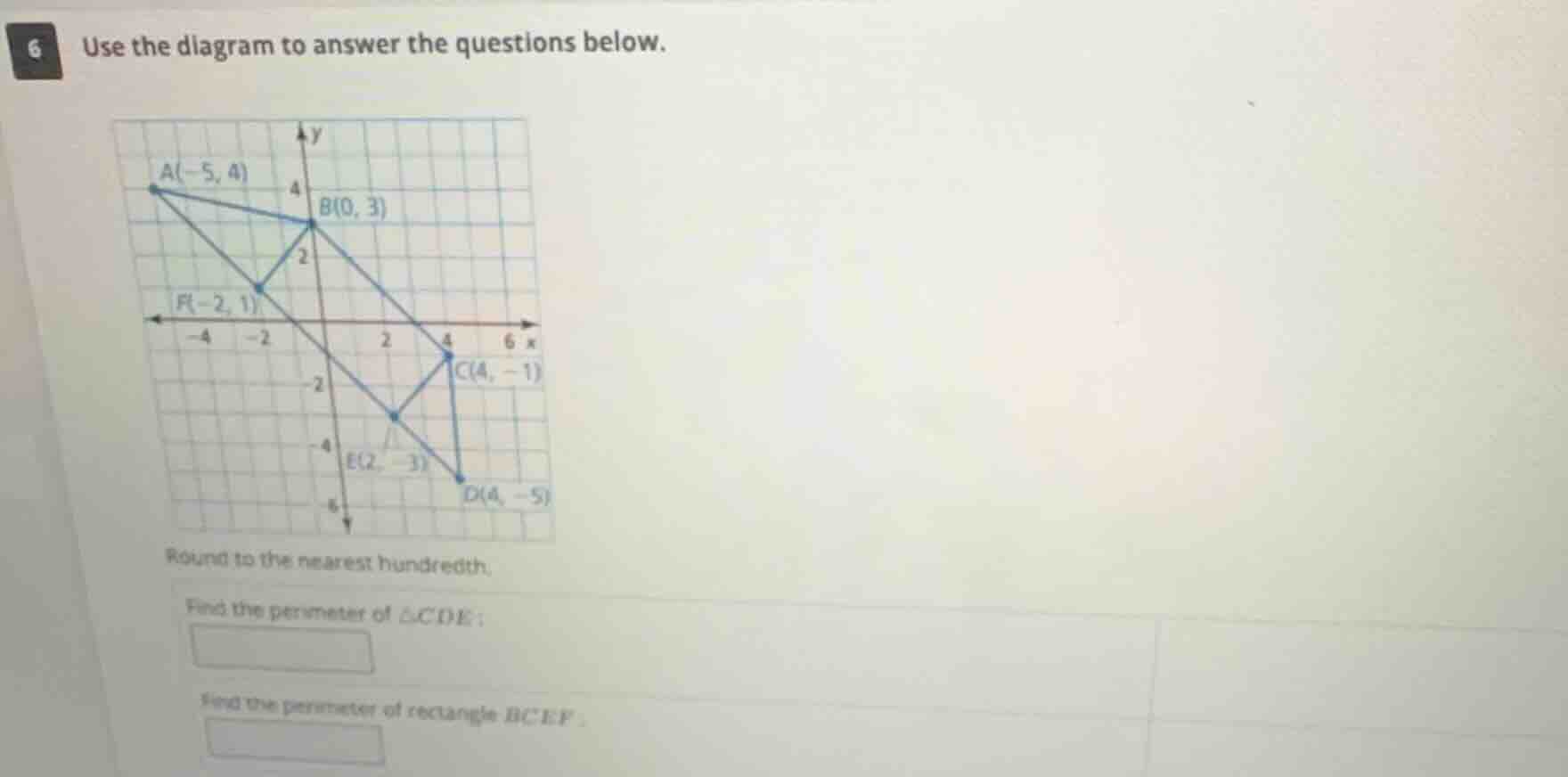
6 use the diagram to answer the questions below. round to the nearest hundredth. find the perimeter of \\( \triangle cde \\) : find the perimeter of rectangle \\( bcef \\).
Part 1: Perimeter of $\triangle CDE$
We use the distance formula $d = \sqrt{(x_2 - x_1)^2 + (y_2 - y_1)^2}$ to find the lengths of the sides of $\triangle CDE$. The coordinates are $C(4, -1)$, $D(4, -5)$, and $E(2, -3)$.
Step 1: Length of $CD$
Since $C$ and $D$ have the same $x$-coordinate, the distance is the absolute difference of the $y$-coordinates.
$CD = |-1 - (-5)| = |4| = 4$
Step 2: Length of $DE$
Using the distance formula:
$DE = \sqrt{(2 - 4)^2 + (-3 - (-5))^2} = \sqrt{(-2)^2 + (2)^2} = \sqrt{4 + 4} = \sqrt{8} \approx 2.83$
Step 3: Length of $CE$
Using the distance formula:
$CE = \sqrt{(2 - 4)^2 + (-3 - (-1))^2} = \sqrt{(-2)^2 + (-2)^2} = \sqrt{4 + 4} = \sqrt{8} \approx 2.83$
Step 4: Perimeter of $\triangle CDE$
Perimeter = $CD + DE + CE = 4 + 2.83 + 2.83 = 9.66$
Part 2: Perimeter of rectangle $BCEF$
First, find the lengths of the sides. The coordinates are $B(0, 3)$, $C(4, -1)$, $E(2, -3)$, and $F(-2, 1)$.
Step 1: Length of $BC$
Using the distance formula:
$BC = \sqrt{(4 - 0)^2 + (-1 - 3)^2} = \sqrt{16 + 16} = \sqrt{32} \approx 5.66$
Step 2: Length of $CE$ (already calculated as $\approx 2.83$)
In a rectangle, opposite sides are equal. So, the length of $BF$ is equal to $CE$, and the length of $EF$ is equal to $BC$. Wait, no—wait, let's check the coordinates again. Wait, actually, for rectangle $BCEF$, we can find the length and width.
Wait, alternatively, find the length and width by finding the distance between $B$ and $F$, and $B$ and $C$? Wait, no, let's use the coordinates of $B(0,3)$, $C(4,-1)$, $E(2,-3)$, $F(-2,1)$.
First, find the length of $BC$ (as above: $\sqrt{(4-0)^2 + (-1 - 3)^2} = \sqrt{16 + 16} = \sqrt{32} \approx 5.66$)
Then, find the length of $CE$ (as before: $\sqrt{(2 - 4)^2 + (-3 - (-1))^2} = \sqrt{4 + 4} = \sqrt{8} \approx 2.83$)
Wait, no—actually, in a rectangle, the perimeter is $2 \times (length + width)$. Let's confirm the sides.
Wait, $B$ to $C$: distance $\approx 5.66$
$C$ to $E$: distance $\approx 2.83$
$E$ to $F$: distance should be equal to $BC$
$F$ to $B$: distance should be equal to $CE$
So perimeter = $2 \times (5.66 + 2.83) = 2 \times 8.49 = 16.98$
Wait, but let's recalculate the distance between $B(0,3)$ and $F(-2,1)$:
$BF = \sqrt{(-2 - 0)^2 + (1 - 3)^2} = \sqrt{4 + 4} = \sqrt{8} \approx 2.83$
Distance between $F(-2,1)$ and $E(2,-3)$:
$FE = \sqrt{(2 - (-2))^2 + (-3 - 1)^2} = \sqrt{16 + 16} = \sqrt{32} \approx 5.66$
Ah, so the length is $FE \approx 5.66$ and the width is $BF \approx 2.83$
Thus, perimeter = $2 \times (5.66 + 2.83) = 2 \times 8.49 = 16.98$

Snap & solve any problem in the app
Get step-by-step solutions on Sovi AI
Photo-based solutions with guided steps
Explore more problems and detailed explanations
s:
- Perimeter of $\triangle CDE$: $\boxed{9.66}$
- Perimeter of rectangle $BCEF$: $\boxed{16.98}$