QUESTION IMAGE
Question
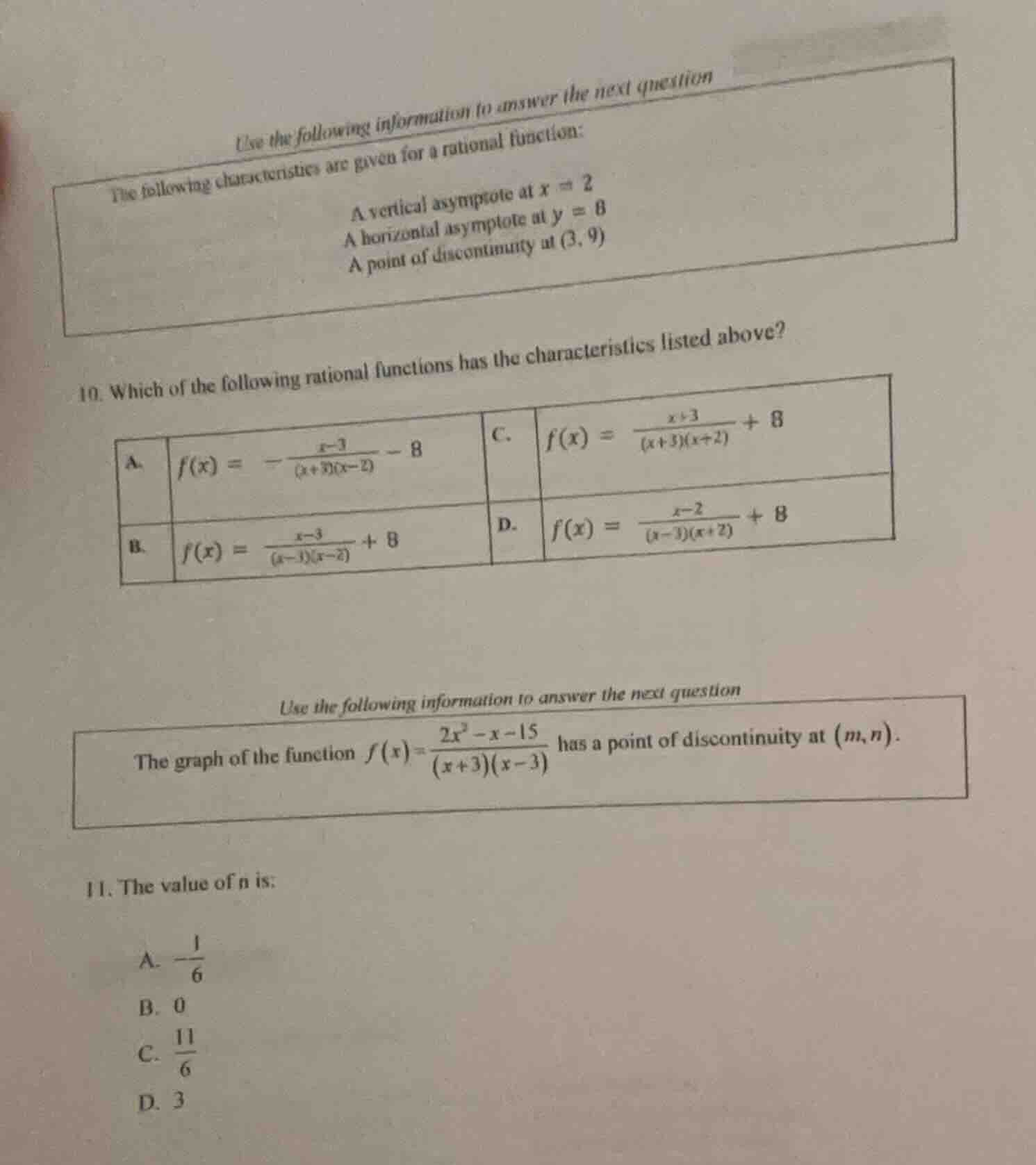
use the following information to answer the next question
the following characteristics are given for a rational function:
a vertical asymptote at ( x = 2 )
a horizontal asymptote at ( y = 8 )
a point of discontinuity at ( (3, 9) )
- which of the following rational functions has the characteristics listed above?
a. ( f(x) = -\frac{x - 3}{(x + 3)(x - 2)} - 8 )
c. ( f(x) = \frac{x + 3}{(x + 3)(x + 2)} + 8 )
b. ( f(x) = \frac{x - 3}{(x - 3)(x - 2)} + 8 )
d. ( f(x) = \frac{x - 2}{(x - 3)(x + 2)} + 8 )
use the following information to answer the next question
the graph of the function ( f(x) = \frac{2x^2 - x - 15}{(x + 3)(x - 3)} ) has a point of discontinuity at ( (m, n) ).
- the value of ( n ) is:
a. ( -\frac{1}{6} )
b. ( 0 )
c. ( \frac{11}{6} )
d. ( 3 )
---
Question 10
Step1: Check vertical asymptote $x=2$
A vertical asymptote at $x=2$ means $(x-2)$ is a non-canceling factor in the denominator.
- Option A: Denominator $(x+3)(x-2)$ → has $x-2$, no canceling.
- Option B: Denominator $(x-3)(x-2)$ → has $x-2$, no canceling.
- Option C: Denominator $(x+3)(x+2)$ → no $x-2$, eliminate.
- Option D: Denominator $(x-3)(x+2)$ → no $x-2$, eliminate.
Step2: Check horizontal asymptote $y=8$
For rational functions, horizontal asymptote is determined by leading terms:
- Option A: The rational term $\frac{-(x-3)}{(x+3)(x-2)}$ has degree 1 numerator, degree 2 denominator → approaches 0. So $f(x) \to 0 - 8 = -8$ → not $y=8$, eliminate.
- Option B: The rational term $\frac{x-3}{(x-3)(x-2)}$ simplifies to $\frac{1}{x-2}$ (for $x
eq3$), which approaches 0. So $f(x) \to 0 + 8 = 8$ → matches $y=8$.
Step3: Check point of discontinuity $(3,9)$
A point of discontinuity (hole) occurs when $(x-3)$ cancels in numerator/denominator. Substitute $x=3$ into simplified function:
- Option B: Simplified form (after canceling $x-3$) is $f(x)=\frac{1}{x-2}+8$. Substitute $x=3$:
$\frac{1}{3-2}+8 = 1 + 8 = 9$ → matches $(3,9)$.
Step1: Factor the numerator
Factor $2x^2 - x - 15$:
$2x^2 - x - 15 = (2x + 5)(x - 3)$
Step2: Identify canceling factor
Denominator is $(x+3)(x-3)$. The canceling factor is $(x-3)$, so the hole is at $x=3$ (since $x-3=0$ gives $x=3$).
Step3: Simplify the function
Cancel $(x-3)$ (for $x
eq3$):
$f(x) = \frac{(2x + 5)(x - 3)}{(x+3)(x-3)} = \frac{2x + 5}{x + 3}$
Step4: Calculate $n$ (y-value of hole)
Substitute $x=3$ into the simplified function:
$\frac{2(3) + 5}{3 + 3} = \frac{6 + 5}{6} = \frac{11}{6}$

Snap & solve any problem in the app
Get step-by-step solutions on Sovi AI
Photo-based solutions with guided steps
Explore more problems and detailed explanations
B. $f(x) = \frac{x-3}{(x-3)(x-2)} + 8$
---