QUESTION IMAGE
Question
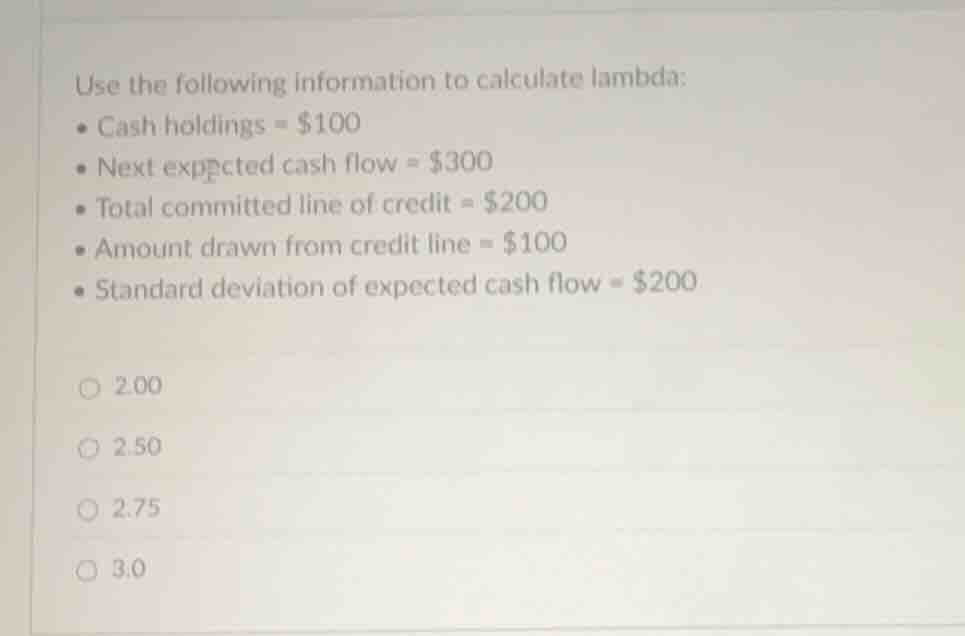
use the following information to calculate lambda: • cash holdings = $100 • next expected cash flow = $300 • total committed line of credit = $200 • amount drawn from credit line = $100 • standard deviation of expected cash flow = $200 ○ 2.00 ○ 2.50 ○ 2.75 ○ 3.0
Step1: Recall the formula for lambda
Lambda ($\lambda$) is calculated as the ratio of the sum of cash holdings and available credit line to the standard deviation of expected cash flow. The available credit line is total committed line of credit minus amount drawn from credit line. So first, calculate available credit line: $Available\ Credit = Total\ Committed\ Credit - Amount\ Drawn = 200 - 100 = 100$.
Step2: Calculate total liquidity
Total liquidity is cash holdings plus available credit: $Total\ Liquidity = Cash\ Holdings + Available\ Credit = 100 + 100 = 200$? Wait, no, wait. Wait, the formula for lambda in liquidity risk is $\lambda=\frac{Cash + (Committed\ Line - Drawn\ Amount)+ Expected\ Cash\ Flow}{Standard\ Deviation}$? Wait, no, maybe I mixed up. Wait, the correct formula for lambda (liquidity index) or the lambda for cash flow volatility: Lambda is the ratio of (Cash + Available Credit + Expected Cash Flow) to the standard deviation? No, wait, let's re - check. Wait, actually, the formula for lambda (the number of standard deviations of cash flow that can be covered by liquidity) is:
$\lambda=\frac{Cash + (Committed\ Line\ of\ Credit - Amount\ Drawn)+ Expected\ Cash\ Flow}{Standard\ Deviation\ of\ Cash\ Flow}$
Wait, no, let's recalculate. Cash holdings = 100, committed line = 200, drawn = 100, so available credit = 200 - 100 = 100. Expected cash flow = 300. So total resources: 100 (cash) + 100 (available credit) + 300 (expected cash flow)? No, that doesn't seem right. Wait, maybe the formula is $\lambda=\frac{Cash + (Committed\ Line - Drawn)+ Expected\ Cash\ Flow}{\sigma}$, where $\sigma$ is the standard deviation. Wait, let's plug in the numbers. Cash = 100, committed line - drawn = 200 - 100 = 100, expected cash flow = 300. Sum: 100 + 100 + 300 = 500. Standard deviation = 200. Then $\lambda=\frac{500}{200}=2.5$. Ah, that makes sense. So step by step:
- Calculate available credit: $200 - 100 = 100$.
- Calculate total liquidity - related resources: $100 (cash) + 100 (available credit) + 300 (expected cash flow)=500$.
- Divide by standard deviation: $\lambda=\frac{500}{200}=2.5$.

Snap & solve any problem in the app
Get step-by-step solutions on Sovi AI
Photo-based solutions with guided steps
Explore more problems and detailed explanations
2.50