QUESTION IMAGE
Question
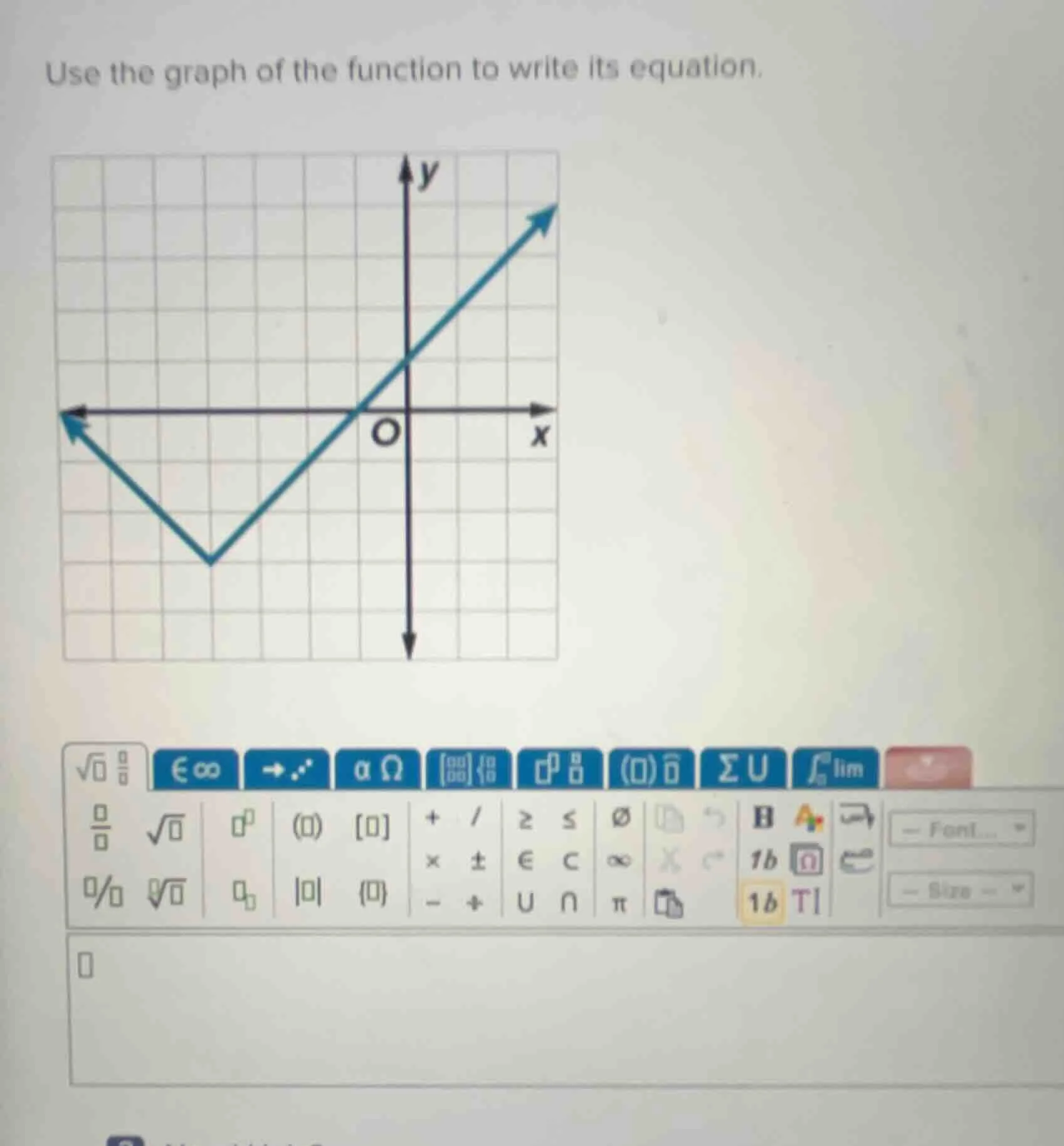
use the graph of the function to write its equation.
Step1: Identify the vertex and slopes
The graph is a piecewise linear function (absolute value - like). Let's find the vertex. From the graph, the vertex (the minimum point) seems to be at \((-4, -2)\)? Wait, no, let's check the grid. Wait, maybe I misread. Wait, the left part: let's take two points. Wait, the right part: when \(x = 0\), \(y = 1\)? Wait, no, let's re-examine. Wait, the graph has a vertex. Let's assume the vertex is at \((h, k)\). Let's find two points on each segment.
Wait, maybe the graph is \(y = |x + 4| - 2\)? No, wait, let's check the slope. Wait, the right segment: from the vertex to (0, 1)? Wait, no, maybe the vertex is at \((-4, -2)\), and the right slope is 1 (since for each x increase by 1, y increases by 1). So the equation of the right line: using point - slope form \(y - k = m(x - h)\), where \(m = 1\), \(h=-4\), \(k = -2\), so \(y - (-2)=1(x - (-4))\) → \(y + 2 = x + 4\) → \(y = x + 2\) for \(x\geq - 4\).
For the left segment: the slope should be - 1 (since it's a V - shape, symmetric in slope magnitude but opposite sign). Using the vertex \((-4, -2)\) and a point, say \(x=-5\), \(y=-1\)? Wait, no, let's take \(x = - 4\), \(y=-2\) and \(x=-8\), \(y = 2\)? No, maybe I made a mistake. Wait, let's look at the graph again. Wait, the right part: when \(x = 0\), \(y = 1\)? Wait, no, the grid: each square is 1 unit. Let's see, the vertex is at \((-4, -2)\), and when \(x=-3\), \(y=-1\); \(x=-2\), \(y = 0\); \(x=-1\), \(y = 1\); \(x = 0\), \(y = 2\)? Wait, maybe my initial vertex is wrong. Wait, maybe the vertex is at \((-4, -2)\), and the right slope is 1, so the equation is \(y=|x + 4|-2\)? Wait, no, when \(x=-4\), \(y = 0 - 2=-2\). When \(x=-3\), \(y = |-3 + 4|-2=1 - 2=-1\). When \(x=-2\), \(y = |-2 + 4|-2=2 - 2 = 0\). When \(x=-1\), \(y = |-1+4|-2 = 3 - 2 = 1\). When \(x = 0\), \(y = |0 + 4|-2=4 - 2 = 2\). Wait, but in the graph, when \(x = 0\), the y - value is 1? Wait, maybe I misread the graph. Wait, the original graph: the blue line crosses the y - axis at (0,1)? Wait, let's re - check the graph.
Wait, the graph: the right segment goes through (0,1) and (1,2), so slope \(m=\frac{2 - 1}{1 - 0}=1\). The vertex: let's find where the slope changes. Let's find the x - coordinate of the vertex. Let's take two points on the left segment: say (-5, 0) and (-4, -1)? No, wait, the left segment: from (-5, 0) to (-4, -1)? No, slope would be \(\frac{-1-0}{-4 + 5}=-1\). So the vertex is at (-4, -1)? No, this is confusing. Wait, maybe the correct equation is \(y = |x + 3| - 2\)? No, let's start over.
The general form of an absolute - value function is \(y=a|x - h|+k\), where \((h,k)\) is the vertex.
From the graph, let's find the vertex. The lowest point (vertex) is at \((-4, -2)\) (assuming the grid: moving 4 units left on x - axis and 2 units down on y - axis from the origin).
The slope of the right branch: take two points on the right branch, say \((-4, -2)\) and \((0, 2)\). The slope \(m=\frac{2-(-2)}{0 - (-4)}=\frac{4}{4}=1\). So \(a = 1\) (since the slope of the right branch of \(y = |x - h|+k\) is \(a\)).
So the equation is \(y=|x + 4|-2\) (since \(h=-4\), \(k = -2\), \(a = 1\)). Let's check:
When \(x=-4\), \(y=| - 4+4|-2=0 - 2=-2\) (correct, vertex).
When \(x=-3\), \(y=| - 3 + 4|-2=1 - 2=-1\) (matches the slope, as x increases by 1, y increases by 1).
When \(x = 0\), \(y=|0 + 4|-2=4 - 2=2\)? But in the graph, does the right branch pass through (0,2)? Looking at the graph, the blue line on the right goes up, so maybe (0,2) is on it. The left branch: take \(x=-5\), \(y=| - 5+4|-2=1 - 2=-1\)? No, wait,…

Snap & solve any problem in the app
Get step-by-step solutions on Sovi AI
Photo-based solutions with guided steps
Explore more problems and detailed explanations
\(y = |x + 4| - 2\)