QUESTION IMAGE
Question
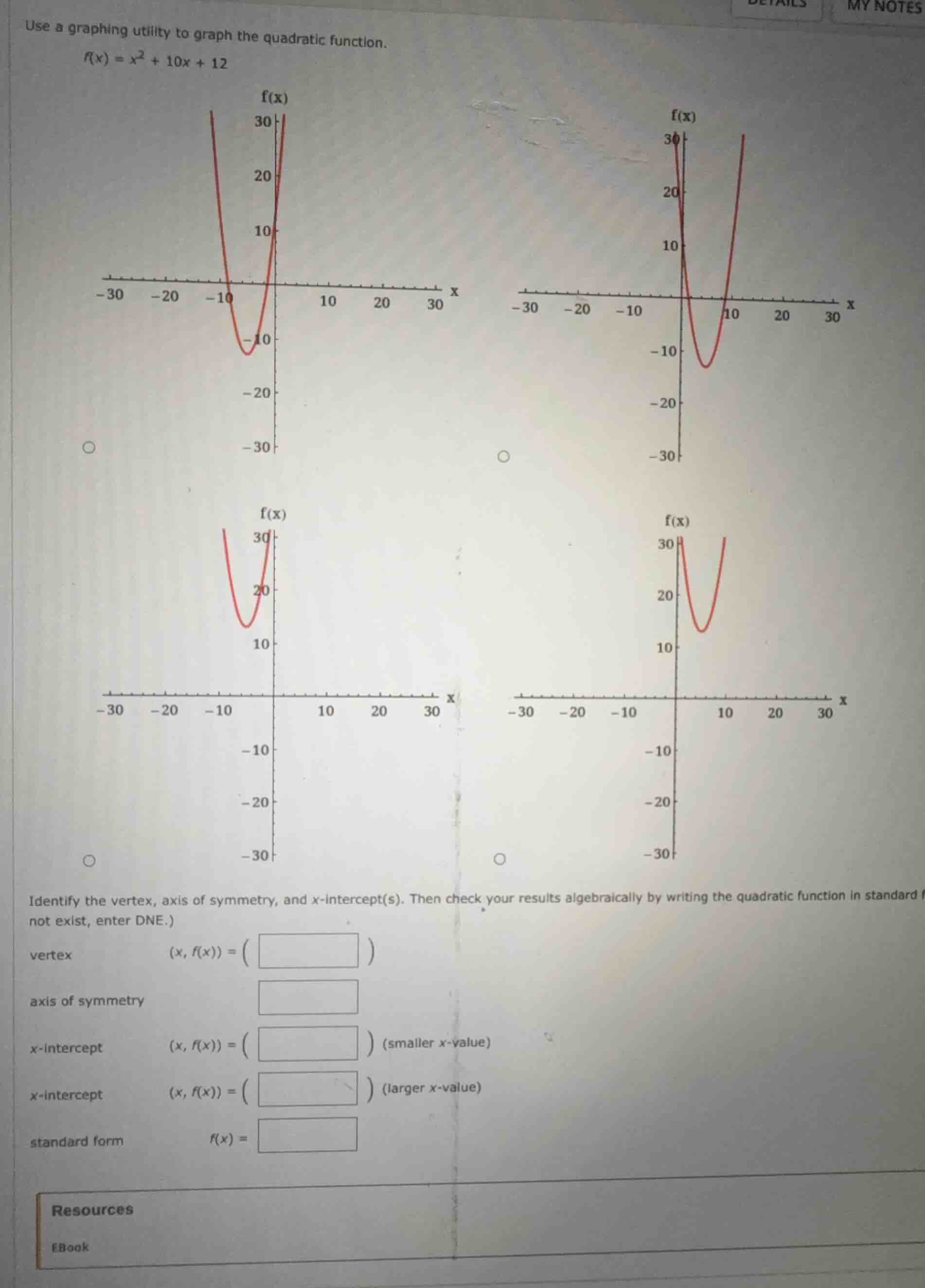
use a graphing utility to graph the quadratic function.
$f(x) = x^2 + 10x + 12$
identify the vertex, axis of symmetry, and x-intercept(s). then check your results algebraically by writing the quadratic function in standard form (if an answer does not exist, enter dne.)
vertex
$(x, f(x)) = \big(\quad\big)$
axis of symmetry
$\quad$
x-intercept
$(x, f(x)) = \big(\quad\big)$ (smaller x - value)
x - intercept
$(x, f(x)) = \big(\quad\big)$ (larger x - value)
standard form
$f(x) = \quad$
Step1: Find the vertex of the quadratic function
For a quadratic function \( f(x) = ax^2 + bx + c \), the x-coordinate of the vertex is given by \( x = -\frac{b}{2a} \). Here, \( a = 1 \), \( b = 10 \), so \( x = -\frac{10}{2\times1} = -5 \).
To find the y-coordinate, substitute \( x = -5 \) into the function: \( f(-5) = (-5)^2 + 10\times(-5) + 12 = 25 - 50 + 12 = -13 \). So the vertex is \( (-5, -13) \).
Step2: Find the axis of symmetry
The axis of symmetry of a quadratic function \( f(x) = ax^2 + bx + c \) is the vertical line \( x = -\frac{b}{2a} \), which we already found as \( x = -5 \).
Step3: Find the x-intercepts
Set \( f(x) = 0 \), so \( x^2 + 10x + 12 = 0 \). Using the quadratic formula \( x = \frac{-b \pm \sqrt{b^2 - 4ac}}{2a} \), where \( a = 1 \), \( b = 10 \), \( c = 12 \).
First, calculate the discriminant \( \Delta = b^2 - 4ac = 10^2 - 4\times1\times12 = 100 - 48 = 52 \).
Then \( x = \frac{-10 \pm \sqrt{52}}{2\times1} = \frac{-10 \pm 2\sqrt{13}}{2} = -5 \pm \sqrt{13} \).
Calculating the approximate values: \( \sqrt{13} \approx 3.6055 \), so the smaller x-value is \( -5 - \sqrt{13} \approx -5 - 3.6055 = -8.6055 \), and the larger x-value is \( -5 + \sqrt{13} \approx -5 + 3.6055 = -1.3945 \). At x-intercepts, \( f(x) = 0 \), so the x-intercepts are \( (-5 - \sqrt{13}, 0) \) (smaller x - value) and \( (-5 + \sqrt{13}, 0) \) (larger x - value).
Step4: Write the function in standard form
The standard form of a quadratic function is \( f(x) = a(x - h)^2 + k \), where \( (h, k) \) is the vertex. Here, \( a = 1 \), \( h = -5 \), \( k = -13 \), so \( f(x) = (x + 5)^2 - 13 \). Expanding this: \( (x + 5)^2 - 13 = x^2 + 10x + 25 - 13 = x^2 + 10x + 12 \), which matches the original function.

Snap & solve any problem in the app
Get step-by-step solutions on Sovi AI
Photo-based solutions with guided steps
Explore more problems and detailed explanations
vertex: \((-5, -13)\)
axis of symmetry: \(x = -5\)
x - intercept (smaller x - value): \((-5 - \sqrt{13}, 0)\)
x - intercept (larger x - value): \((-5 + \sqrt{13}, 0)\)
standard form: \(f(x) = (x + 5)^2 - 13\)