QUESTION IMAGE
Question
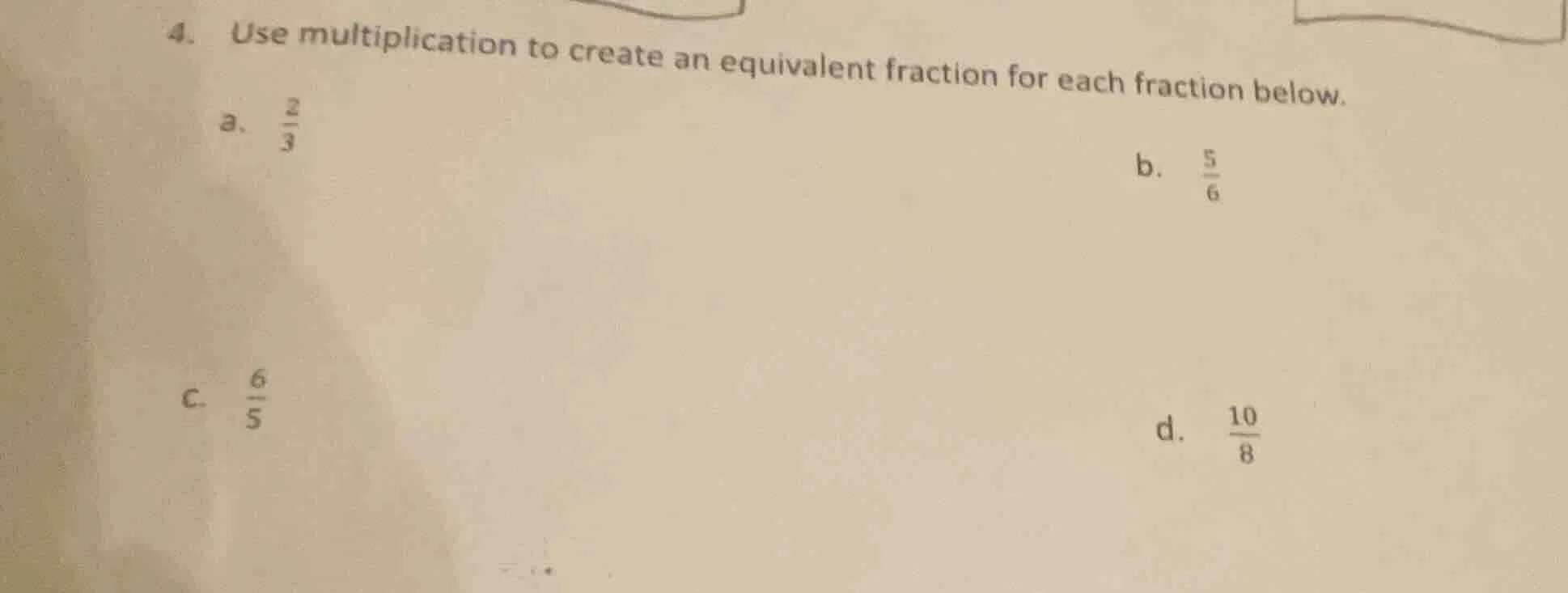
- use multiplication to create an equivalent fraction for each fraction below.
a. \\(\frac{2}{3}\\) b. \\(\frac{5}{6}\\)
c. \\(\frac{6}{5}\\) d. \\(\frac{10}{8}\\)
Part a: $\boldsymbol{\frac{2}{3}}$
Step1: Choose a multiplier (e.g., 2)
To find an equivalent fraction, multiply numerator and denominator by the same non - zero number. Let's choose 2.
$\frac{2\times2}{3\times2}$
Step2: Calculate the new fraction
$2\times2 = 4$ and $3\times2=6$, so the equivalent fraction is $\frac{4}{6}$. (Note: We could also choose other non - zero numbers. For example, if we choose 3, we get $\frac{2\times3}{3\times3}=\frac{6}{9}$)
Step1: Choose a multiplier (e.g., 2)
Multiply the numerator and denominator of $\frac{5}{6}$ by 2.
$\frac{5\times2}{6\times2}$
Step2: Calculate the new fraction
$5\times2 = 10$ and $6\times2 = 12$, so the equivalent fraction is $\frac{10}{12}$. (We can also use other multipliers. For instance, if we use 3, we have $\frac{5\times3}{6\times3}=\frac{15}{18}$)
Step1: Choose a multiplier (e.g., 2)
Multiply the numerator and denominator of $\frac{6}{5}$ by 2.
$\frac{6\times2}{5\times2}$
Step2: Calculate the new fraction
$6\times2=12$ and $5\times2 = 10$, so the equivalent fraction is $\frac{12}{10}$. (If we choose 3 as the multiplier, we get $\frac{6\times3}{5\times3}=\frac{18}{15}$)

Snap & solve any problem in the app
Get step-by-step solutions on Sovi AI
Photo-based solutions with guided steps
Explore more problems and detailed explanations
$\frac{4}{6}$ (or other equivalent fractions like $\frac{6}{9}$, $\frac{8}{12}$, etc.)