QUESTION IMAGE
Question
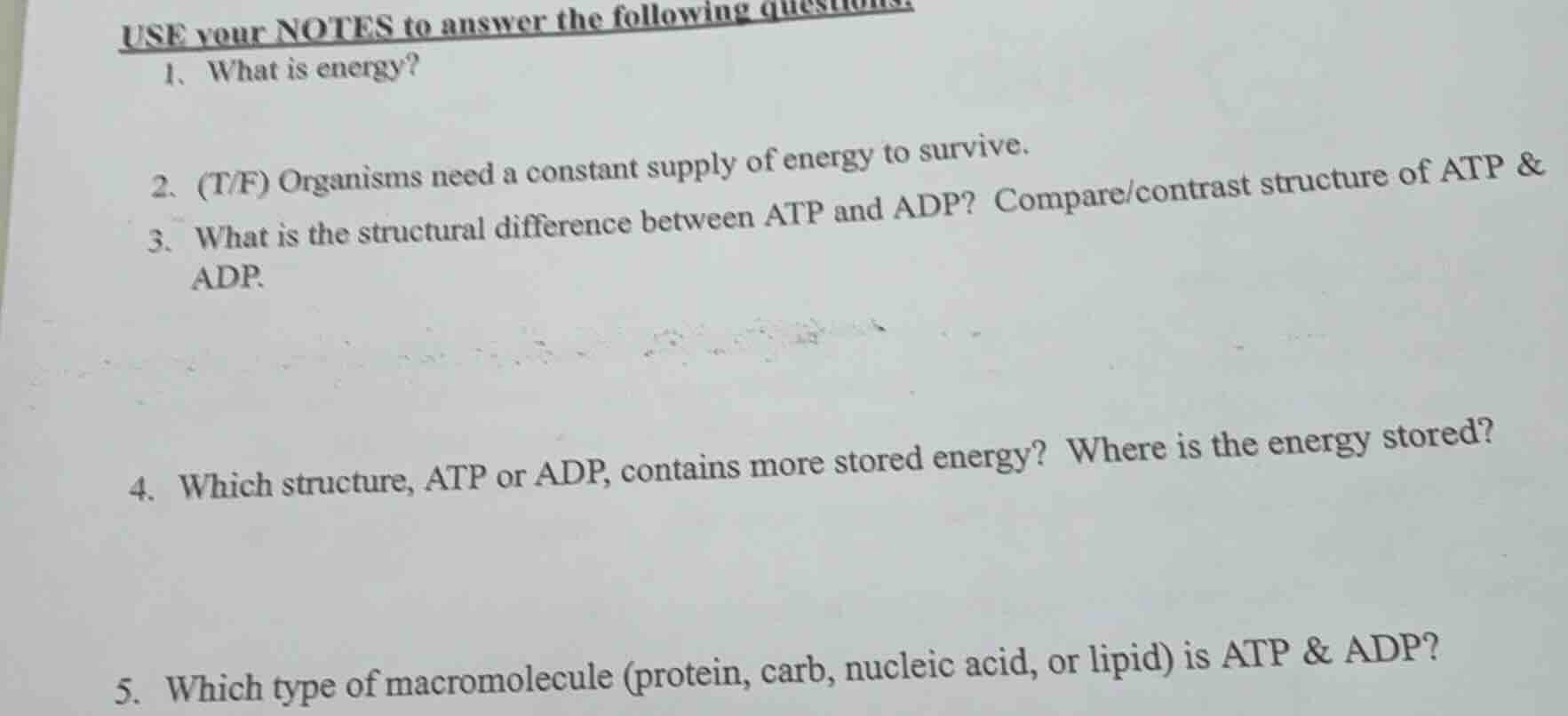
use your notes to answer the following questions.
- what is energy?
- (t/f) organisms need a constant supply of energy to survive.
- what is the structural difference between atp and adp? compare/contrast structure of atp & adp.
- which structure, atp or adp, contains more stored energy? where is the energy stored?
- which type of macromolecule (protein, carb, nucleic acid, or lipid) is atp & adp?
Brief Explanations
- Defined as the capacity to do work or cause change, usable by biological systems.
- All living organisms require ongoing energy for cellular processes like metabolism, growth, and reproduction.
- ATP (adenosine triphosphate) has 3 phosphate groups; ADP (adenosine diphosphate) has 2. Both share an adenine base and ribose sugar.
- ATP has an additional high-energy phosphate bond that stores more potential energy.
- ATP and ADP are derived from nucleotide building blocks, which are the monomers of nucleic acids.

Snap & solve any problem in the app
Get step-by-step solutions on Sovi AI
Photo-based solutions with guided steps
Explore more problems and detailed explanations
- Energy is the capacity to do work or cause change, specifically the ability to power cellular and biological processes in organisms.
- True (T)
- ATP has three phosphate groups attached to its ribose sugar, while ADP has only two. Both molecules have an adenine base and a ribose sugar backbone.
- ATP contains more stored energy. The energy is stored in the high-energy covalent bond between its second and third phosphate groups.
- ATP and ADP are nucleic acids (specifically, modified nucleotides).