QUESTION IMAGE
Question
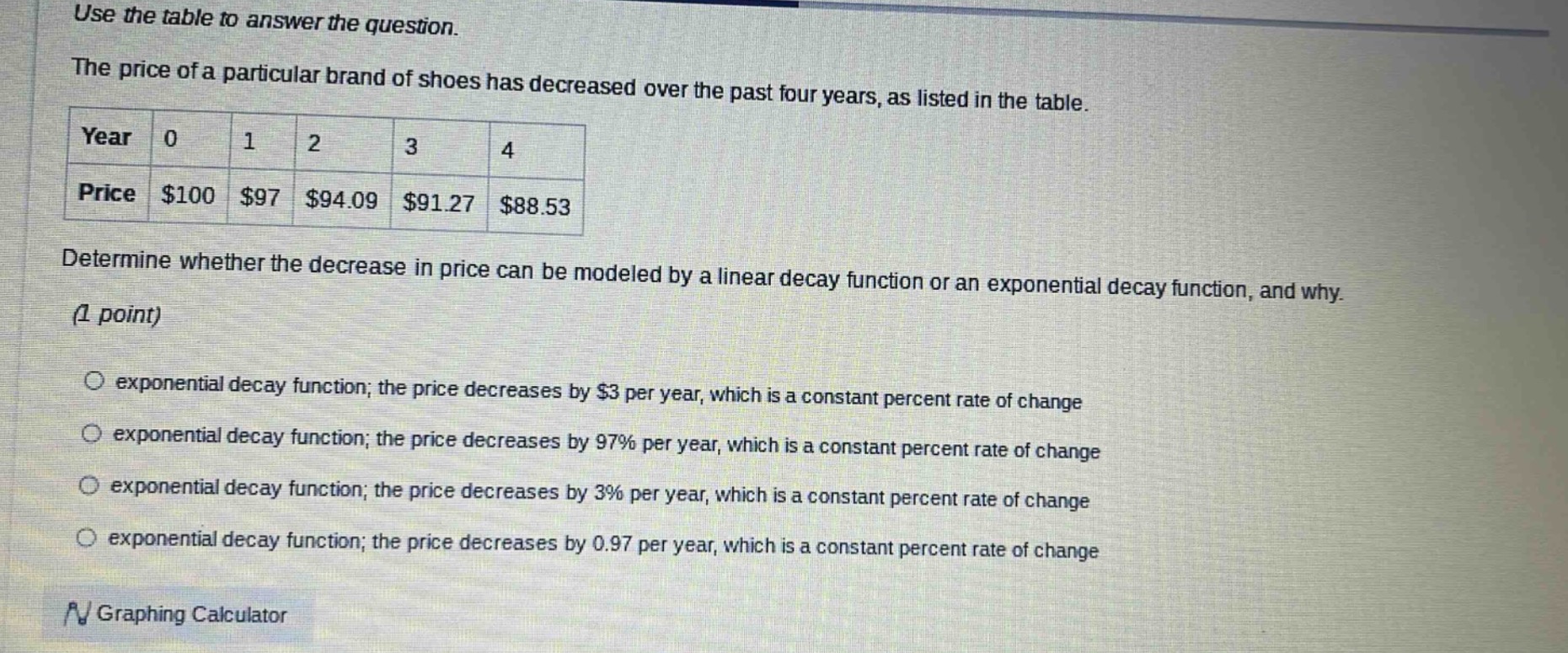
use the table to answer the question. the price of a particular brand of shoes has decreased over the past four years, as listed in the table. | year | 0 | 1 | 2 | 3 | 4 | | price | $100 | $97 | $94.09 | $91.27 | $88.53 | determine whether the decrease in price can be modeled by a linear decay function or an exponential decay function, and why. (1 point) - exponential decay function; the price decreases by $3 per year, which is a constant percent rate of change - exponential decay function; the price decreases by 97% per year, which is a constant percent rate of change - exponential decay function; the price decreases by 3% per year, which is a constant percent rate of change - exponential decay function; the price decreases by 0.97 per year, which is a constant percent rate of change
Step1: Check linear vs exponential
To determine if it's linear or exponential, we check the differences (for linear) and ratios (for exponential) between consecutive prices.
- Linear decay would have a constant difference (slope) between consecutive years.
- Exponential decay would have a constant ratio (common factor) between consecutive years.
Step2: Calculate differences (linear check)
- From year 0 to 1: \( 100 - 97 = 3 \)
- From year 1 to 2: \( 97 - 94.09 = 2.91 \)
- From year 2 to 3: \( 94.09 - 91.27 = 2.82 \)
- From year 3 to 4: \( 91.27 - 88.53 = 2.74 \)
The differences are not constant, so it's not linear.
Step3: Calculate ratios (exponential check)
- From year 0 to 1: \( \frac{97}{100} = 0.97 \)
- From year 1 to 2: \( \frac{94.09}{97} = 0.97 \)
- From year 2 to 3: \( \frac{91.27}{94.09} = 0.97 \)
- From year 3 to 4: \( \frac{88.53}{91.27} = 0.97 \)
The ratio is constant (0.97), which means the price is decreasing by \( 1 - 0.97 = 0.03 \) or 3% per year. This is a constant percent rate of change, characteristic of exponential decay.

Snap & solve any problem in the app
Get step-by-step solutions on Sovi AI
Photo-based solutions with guided steps
Explore more problems and detailed explanations
exponential decay function; the price decreases by 3% per year, which is a constant percent rate of change