QUESTION IMAGE
Question
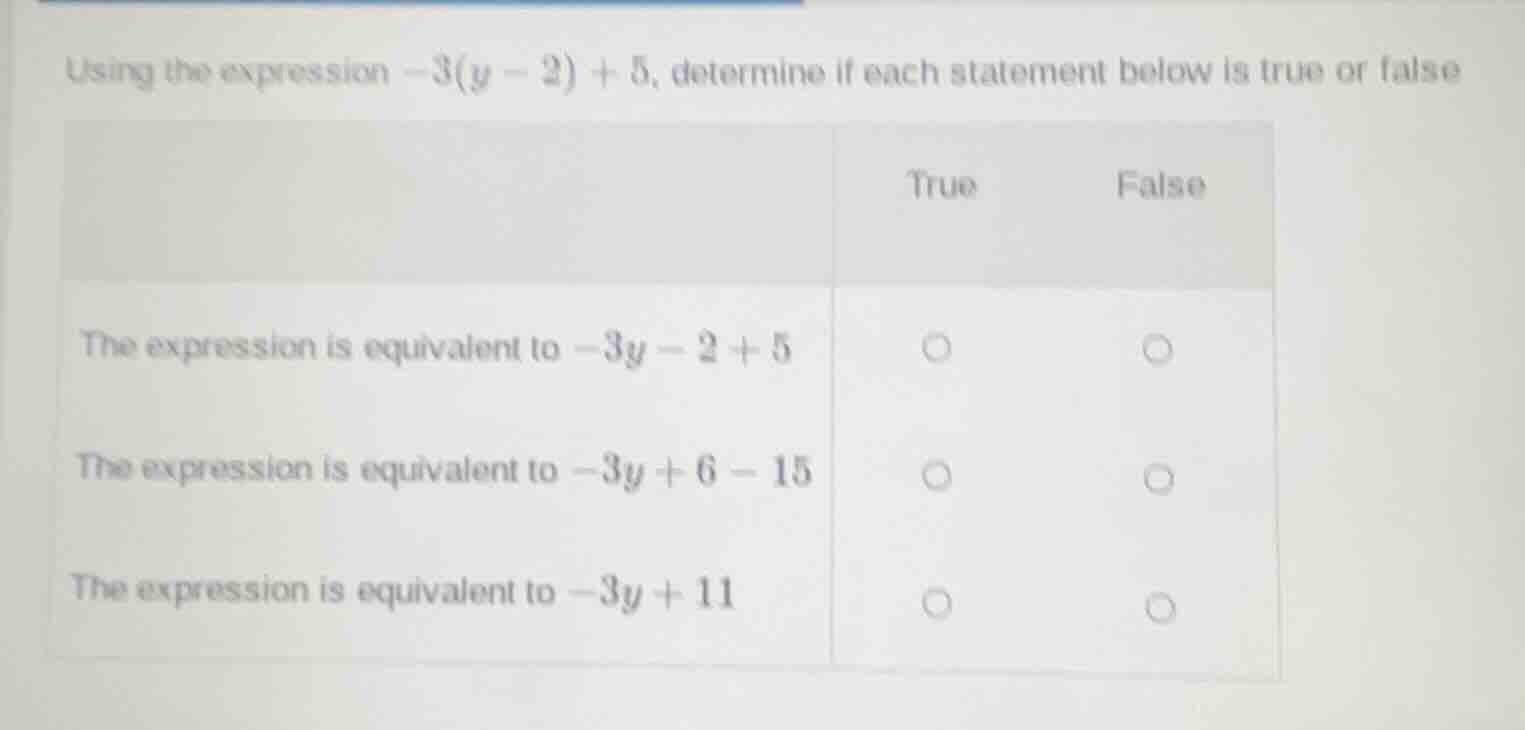
using the expression $-3(y - 2) + 5$, determine if each statement below is true or false
| true | false | |
|---|---|---|
| the expression is equivalent to $-3y + 6 - 15$ | $\circ$ | $\circ$ |
| the expression is equivalent to $-3y + 11$ | $\circ$ | $\circ$ |
To determine the truth value of each statement, we first simplify the given expression \(-3(y - 2) + 5\) using the distributive property \(a(b - c)=ab - ac\).
Step 1: Simplify \(-3(y - 2)+5\)
Using the distributive property on \(-3(y - 2)\), we get:
\[
-3\times y-3\times(- 2)+5=-3y + 6+5
\]
Then combine like terms:
\[
-3y+(6 + 5)=-3y+11
\]
Statement 1: The expression is equivalent to \(-3y-2 + 5\)
From our simplification, we have \(-3(y - 2)+5=-3y + 6+5\). The term \(-3(y - 2)\) expands to \(-3y+6\), not \(-3y - 2\). So this statement is False.
Statement 2: The expression is equivalent to \(-3y + 6-15\)
Our simplified form is \(-3y+6 + 5=-3y + 11\), and \(-3y+6-15=-3y-9\), which is not equal to \(-3y + 11\). So this statement is False.
Statement 3: The expression is equivalent to \(-3y + 11\)
From our simplification in Step 1, we found that \(-3(y - 2)+5=-3y+11\). So this statement is True.
Final Answers for each statement:
- The expression is equivalent to \(-3y - 2+5\): False
- The expression is equivalent to \(-3y + 6-15\): False
- The expression is equivalent to \(-3y + 11\): True
For the table:
- For "The expression is equivalent to \(-3y - 2+5\)", mark False.
- For "The expression is equivalent to \(-3y + 6-15\)", mark False.
- For "The expression is equivalent to \(-3y + 11\)", mark True.

Snap & solve any problem in the app
Get step-by-step solutions on Sovi AI
Photo-based solutions with guided steps
Explore more problems and detailed explanations
To determine the truth value of each statement, we first simplify the given expression \(-3(y - 2) + 5\) using the distributive property \(a(b - c)=ab - ac\).
Step 1: Simplify \(-3(y - 2)+5\)
Using the distributive property on \(-3(y - 2)\), we get:
\[
-3\times y-3\times(- 2)+5=-3y + 6+5
\]
Then combine like terms:
\[
-3y+(6 + 5)=-3y+11
\]
Statement 1: The expression is equivalent to \(-3y-2 + 5\)
From our simplification, we have \(-3(y - 2)+5=-3y + 6+5\). The term \(-3(y - 2)\) expands to \(-3y+6\), not \(-3y - 2\). So this statement is False.
Statement 2: The expression is equivalent to \(-3y + 6-15\)
Our simplified form is \(-3y+6 + 5=-3y + 11\), and \(-3y+6-15=-3y-9\), which is not equal to \(-3y + 11\). So this statement is False.
Statement 3: The expression is equivalent to \(-3y + 11\)
From our simplification in Step 1, we found that \(-3(y - 2)+5=-3y+11\). So this statement is True.
Final Answers for each statement:
- The expression is equivalent to \(-3y - 2+5\): False
- The expression is equivalent to \(-3y + 6-15\): False
- The expression is equivalent to \(-3y + 11\): True
For the table:
- For "The expression is equivalent to \(-3y - 2+5\)", mark False.
- For "The expression is equivalent to \(-3y + 6-15\)", mark False.
- For "The expression is equivalent to \(-3y + 11\)", mark True.