QUESTION IMAGE
Question
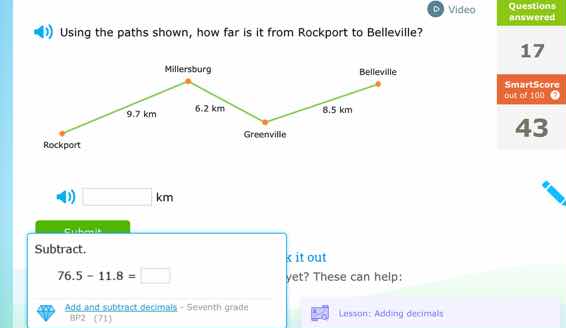
using the paths shown, how far is it from rockport to belleville? rockport to millersburg: 9.7 km, millersburg to greenville: 6.2 km, greenville to belleville: 8.5 km. subtract. 76.5 - 11.8 =
For the distance from Rockport to Belleville:
Step1: Identify the path segments
The path from Rockport to Belleville goes through Millersburg and Greenville. So we need to add the distances: Rockport to Millersburg (9.7 km), Millersburg to Greenville (6.2 km), and Greenville to Belleville (8.5 km).
Step2: Add the first two distances
First, add 9.7 and 6.2. $9.7 + 6.2 = 15.9$
Step3: Add the result to the third distance
Now add 15.9 and 8.5. $15.9 + 8.5 = 24.4$
Step1: Align the decimals
Write the numbers vertically with decimals aligned:
 76.5
-11.8
------
Step2: Subtract the tenths place
Subtract the tenths: 5 - 8. Can't do, so borrow 1 from the ones place. 6 becomes 5, and 5 becomes 15. Now 15 - 8 = 7.
Step3: Subtract the ones place
Subtract the ones: 5 - 1 = 4 (since we borrowed earlier, the 6 in 76.5 became 5, but wait, original ones place was 6, after borrowing for tenths, it's 5? Wait, no: 76.5 is 7 tens, 6 ones, 5 tenths. When we borrow 1 from the ones place (6 ones) for the tenths place, the ones place becomes 5 ones, and the tenths place becomes 15 tenths. Then subtract tenths: 15 - 8 = 7. Then ones place: 5 - 1 = 4. Then tens place: 7 - 0 (wait, 11.8 has 1 ten) so 7 - 1 = 6? Wait, no, 76.5 - 11.8:
Tens place: 7 - 1 = 6
Ones place: 6 - 1 = 5? Wait, no, I messed up the borrowing. Let's do it correctly.
76.5 - 11.8:
- Tenths: 5 - 8. Borrow 1 from the ones digit (6) to make the tenths digit 15. So tenths: 15 - 8 = 7.
- Ones: The ones digit was 6, but we borrowed 1, so it's 5. Now subtract ones: 5 - 1 = 4.
- Tens: 7 - 1 = 6.
Wait, no, 76.5 - 11.8:
76.5
-11.8
= (70 + 6.5) - (10 + 1.8)
= (70 - 10) + (6.5 - 1.8)
= 60 + 4.7
= 64.7? Wait, no, that's wrong. Wait, 6.5 - 1.8 is 4.7? No, 6.5 - 1.8: 6 - 1 = 5, 0.5 - 0.8 = -0.3, so 5 - 0.3 = 4.7? Wait, no, better to do decimal subtraction:
76.5 - 11.8 = (76.5) - (11.8) = 64.7? Wait, no, 76.5 - 11.8:
Subtract the decimals: 0.5 - 0.8 = -0.3. Then subtract the whole numbers: 76 - 11 = 65. Then add the two results: 65 - 0.3 = 64.7. Yes, that's correct. Wait, or do it directly:
76.5 - 11.8 = 64.7. Let's check with another method: 76.5 - 10 = 66.5, then subtract 1.8: 66.5 - 1.8 = 64.7. Yes.
Wait, my initial step - by - step was wrong. Let's correct it:
Step1: Subtract the decimal parts
0.5 - 0.8 = -0.3. Since we can't have negative, we adjust the whole number part.
Step2: Adjust the whole number
Take 1 from the whole number part (76) to make it 75, and add 1 (as 1.0) to the decimal part: 75 + 1.5 - 11.8 = 75 - 11.8 + 1.5
Step3: Subtract the whole numbers
75 - 11 = 64, 64 - 0.8 = 63.2
Step4: Add the decimal part
63.2 + 1.5 = 64.7
Alternatively, the correct way is:
76.5
-11.8
------
64.7 (because 76.5 - 10 = 66.5; 66.5 - 1.8 = 64.7)

Snap & solve any problem in the app
Get step-by-step solutions on Sovi AI
Photo-based solutions with guided steps
Explore more problems and detailed explanations
24.4