QUESTION IMAGE
Question
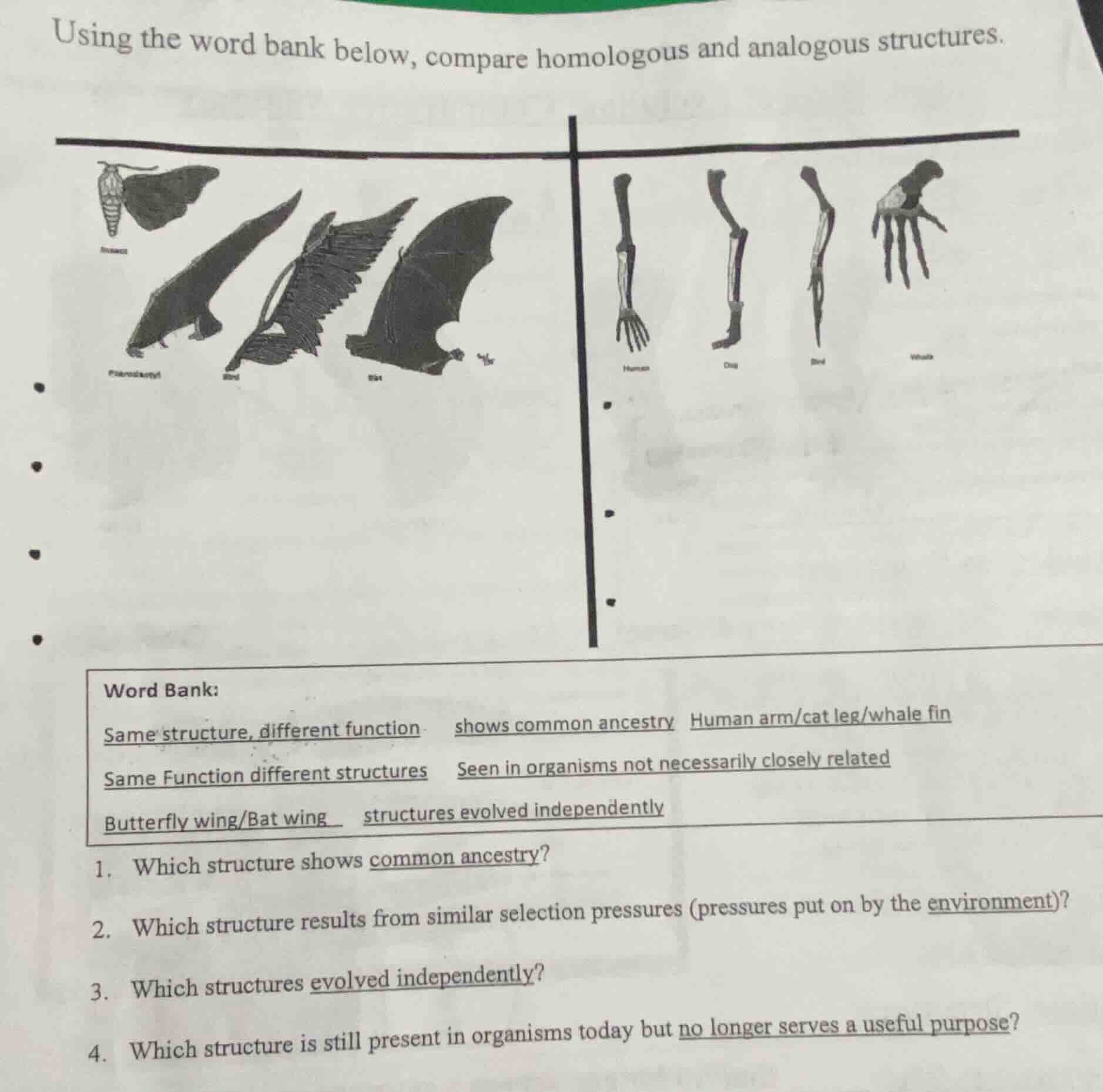
using the word bank below, compare homologous and analogous structures.
word bank:
same structure, different function shows common ancestry human arm/cat leg/whale fin
same function different structures seen in organisms not necessarily closely related
butterfly wing/bat wing structures evolved independently
- which structure shows common ancestry?
- which structure results from similar selection pressures (pressures put on by the environment)?
- which structures evolved independently?
- which structure is still present in organisms today but no longer serves a useful purpose?
Question 1
Homologous structures show common ancestry. The human arm, cat leg, whale fin (and also the bird wing in the diagram) have the same basic structure (bone arrangement) but different functions, indicating a common ancestor. So the structure that shows common ancestry is "Human arm/cat leg/whale fin" (and the vertebrate limbs in the diagram).
Analogous structures result from similar selection pressures (environmental pressures) as they have the same function (e.g., flying) but different structures. The butterfly wing, bat wing, bird wing, pterosaur wing have the same function (flight) but different structures, evolving due to similar environmental pressures for flight. So structures with "Same Function different structures" like butterfly wing/bat wing/bird wing/pterosaur wing.
Analogous structures evolve independently. The butterfly wing (insect) and bat wing (mammal), bird wing (bird), pterosaur wing (reptile) have different evolutionary origins but same function, so they evolved independently. The word bank also has "Butterfly wing/Bat wing" and "structures evolved independently" associated.

Snap & solve any problem in the app
Get step-by-step solutions on Sovi AI
Photo-based solutions with guided steps
Explore more problems and detailed explanations
Human arm/cat leg/whale fin (and the vertebrate limb structures shown, e.g., human, dog, bird, whale limbs)