QUESTION IMAGE
Question
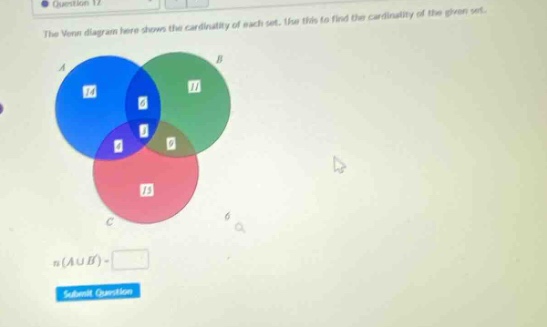
the venn diagram here shows the cardinality of each set. use this to find the cardinality of the given set.
$n(a\cup b)=\square$
Step1: Recall the formula for \( n(A \cup B) \)
The formula for the cardinality of the union of two sets \( A \) and \( B \) is \( n(A \cup B)=n(A)+n(B)-n(A \cap B) \). First, we need to find \( n(A) \), \( n(B) \), and \( n(A \cap B) \) from the Venn diagram.
Step2: Calculate \( n(A) \)
To find \( n(A) \), we sum the numbers in the regions of set \( A \). The regions of \( A \) are: the part only in \( A \) (16), the part in \( A \cap B \) (6), and the part in \( A \cap C \) (4), and the part in \( A \cap B \cap C \) (1). Wait, no, actually, for set \( A \), the regions are: only \( A \) (16), \( A \cap B \) (6 + 1), \( A \cap C \) (4 + 1)? Wait, no, let's look at the Venn diagram. The Venn diagram has three sets \( A \), \( B \), \( C \). The regions:
- Only \( A \): 16
- \( A \cap B \) only (not including \( C \)): 6
- \( A \cap C \) only (not including \( B \)): 4
- \( A \cap B \cap C \): 1
- Only \( B \): 11
- \( B \cap C \) only (not including \( A \)): 2
- Only \( C \): 15
Wait, maybe a better way: \( n(A) \) is the sum of all regions inside \( A \). So inside \( A \): only \( A \) (16), \( A \cap B \) (6 + 1), \( A \cap C \) (4 + 1). Wait, no, the intersection of \( A \) and \( B \) is the region where \( A \) and \( B \) overlap, which includes the part with \( C \) too? Wait, no, the standard Venn diagram for three sets:
- Region 1: Only \( A \): 16
- Region 2: \( A \cap B \) only (no \( C \)): 6
- Region 3: Only \( B \): 11
- Region 4: \( B \cap C \) only (no \( A \)): 2
- Region 5: Only \( C \): 15
- Region 6: \( A \cap C \) only (no \( B \)): 4
- Region 7: \( A \cap B \cap C \): 1
So, \( n(A) \) is the sum of regions 1, 2, 6, 7. So \( n(A)=16 + 6+4 + 1=27 \).
Step3: Calculate \( n(B) \)
\( n(B) \) is the sum of regions inside \( B \): region 2, 3, 4, 7. So \( n(B)=6 + 11+2 + 1=20 \).
Step4: Calculate \( n(A \cap B) \)
\( n(A \cap B) \) is the sum of regions where \( A \) and \( B \) overlap, which are regions 2 and 7. So \( n(A \cap B)=6 + 1=7 \).
Step5: Apply the union formula
Now, using \( n(A \cup B)=n(A)+n(B)-n(A \cap B) \). We have \( n(A)=27 \), \( n(B)=20 \), \( n(A \cap B)=7 \). Wait, wait, let's recalculate \( n(A) \) and \( n(B) \) again. Wait, maybe I made a mistake. Let's re-express:
Wait, the regions:
- Only \( A \): 16
- \( A \cap B \) (excluding \( C \)): 6
- \( A \cap C \) (excluding \( B \)): 4
- \( A \cap B \cap C \): 1
- Only \( B \): 11
- \( B \cap C \) (excluding \( A \)): 2
- Only \( C \): 15
So \( n(A) \) is only \( A \) + \( A \cap B \) (including \( C \)) + \( A \cap C \) (including \( C \))? No, no. The correct way: \( n(A) \) is the number of elements in \( A \), which is the sum of all elements in the circle labeled \( A \). So the circle \( A \) includes:
- Only \( A \): 16
- \( A \cap B \) (the part where \( A \) and \( B \) overlap, regardless of \( C \)): 6 (only \( A \cap B \)) + 1 ( \( A \cap B \cap C \))
- \( A \cap C \) (the part where \( A \) and \( C \) overlap, regardless of \( B \)): 4 (only \( A \cap C \)) + 1 ( \( A \cap B \cap C \))
Wait, no, that's double - counting the \( A \cap B \cap C \) region. The correct way is that the elements in \( A \) are:
Only \( A \): 16
\( A \cap B \) only (not in \( C \)): 6
\( A \cap C \) only (not in \( B \)): 4
\( A \cap B \cap C \): 1
So \( n(A)=16 + 6+4 + 1=27 \)
Similarly, \( n(B) \) is:
Only \( B \): 11
\( A \cap B \) only (not in \( C \)): 6
\( B \cap C \) only (not in \( A \)): 2
\( A \cap B \cap C \): 1
So \( n(B)=11 + 6+2 + 1=20 \)
\( n(A \cap B) \) is the number of elements in the intersection…

Snap & solve any problem in the app
Get step-by-step solutions on Sovi AI
Photo-based solutions with guided steps
Explore more problems and detailed explanations
\( \boxed{40} \)