QUESTION IMAGE
Question
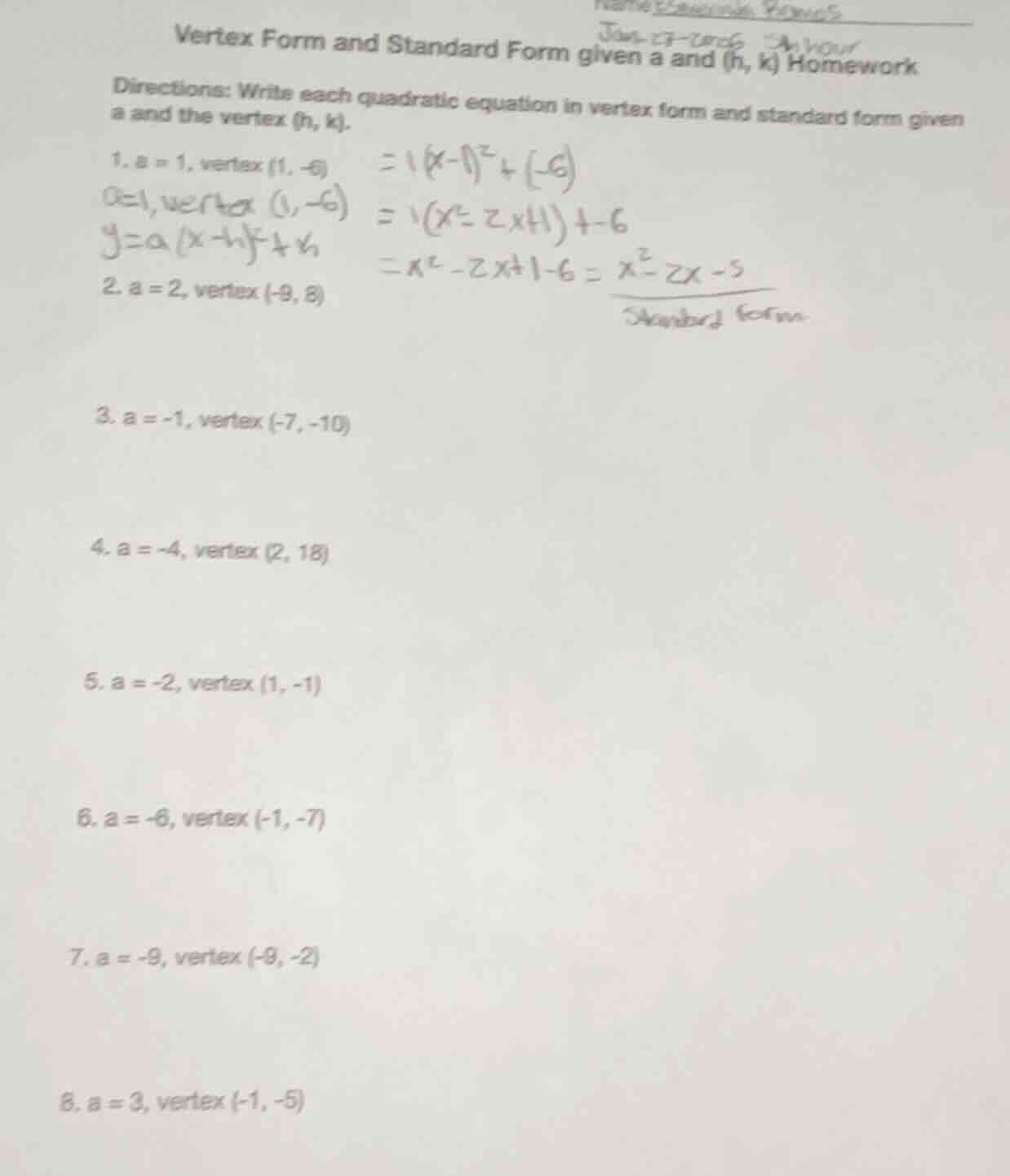
vertex form and standard form given a and (h, k) homework
directions: write each quadratic equation in vertex form and standard form given
a and the vertex (h, k).
- a = 1, vertex (1, -6)
- a = 2, vertex (-9, 8)
- a = -1, vertex (-7, -10)
- a = -4, vertex (2, 18)
- a = -2, vertex (1, -1)
- a = -6, vertex (-1, -7)
- a = -9, vertex (-9, -2)
- a = 3, vertex (-1, -5)
Let's solve each quadratic equation step by step. The vertex form of a quadratic equation is \( y = a(x - h)^2 + k \), where \((h, k)\) is the vertex. The standard form is \( y = ax^2 + bx + c \).
Problem 2: \( a = 2 \), vertex \((-9, 8)\)
Step 1: Write in Vertex Form
Using the vertex form formula \( y = a(x - h)^2 + k \), substitute \( a = 2 \), \( h = -9 \), and \( k = 8 \).
\( y = 2(x - (-9))^2 + 8 \)
Simplify the expression inside the parentheses:
\( y = 2(x + 9)^2 + 8 \)
Step 2: Expand to Standard Form
First, expand \((x + 9)^2\):
\( (x + 9)^2 = x^2 + 18x + 81 \)
Multiply by \( 2 \):
\( 2(x^2 + 18x + 81) = 2x^2 + 36x + 162 \)
Add \( 8 \):
\( y = 2x^2 + 36x + 162 + 8 \)
Simplify:
\( y = 2x^2 + 36x + 170 \)
Problem 3: \( a = -1 \), vertex \((-7, -10)\)
Step 1: Write in Vertex Form
Substitute \( a = -1 \), \( h = -7 \), and \( k = -10 \) into \( y = a(x - h)^2 + k \):
\( y = -1(x - (-7))^2 + (-10) \)
Simplify:
\( y = -1(x + 7)^2 - 10 \)
Step 2: Expand to Standard Form
Expand \((x + 7)^2\):
\( (x + 7)^2 = x^2 + 14x + 49 \)
Multiply by \( -1 \):
\( -1(x^2 + 14x + 49) = -x^2 - 14x - 49 \)
Subtract \( 10 \):
\( y = -x^2 - 14x - 49 - 10 \)
Simplify:
\( y = -x^2 - 14x - 59 \)
Problem 4: \( a = -4 \), vertex \((2, 18)\)
Step 1: Write in Vertex Form
Substitute \( a = -4 \), \( h = 2 \), and \( k = 18 \) into \( y = a(x - h)^2 + k \):
\( y = -4(x - 2)^2 + 18 \)
Step 2: Expand to Standard Form
Expand \((x - 2)^2\):
\( (x - 2)^2 = x^2 - 4x + 4 \)
Multiply by \( -4 \):
\( -4(x^2 - 4x + 4) = -4x^2 + 16x - 16 \)
Add \( 18 \):
\( y = -4x^2 + 16x - 16 + 18 \)
Simplify:
\( y = -4x^2 + 16x + 2 \)
Problem 5: \( a = -2 \), vertex \((1, -1)\)
Step 1: Write in Vertex Form
Substitute \( a = -2 \), \( h = 1 \), and \( k = -1 \) into \( y = a(x - h)^2 + k \):
\( y = -2(x - 1)^2 - 1 \)
Step 2: Expand to Standard Form
Expand \((x - 1)^2\):
\( (x - 1)^2 = x^2 - 2x + 1 \)
Multiply by \( -2 \):
\( -2(x^2 - 2x + 1) = -2x^2 + 4x - 2 \)
Subtract \( 1 \):
\( y = -2x^2 + 4x - 2 - 1 \)
Simplify:
\( y = -2x^2 + 4x - 3 \)
Problem 6: \( a = -6 \), vertex \((-1, -7)\)
Step 1: Write in Vertex Form
Substitute \( a = -6 \), \( h = -1 \), and \( k = -7 \) into \( y = a(x - h)^2 + k \):
\( y = -6(x - (-1))^2 + (-7) \)
Simplify:
\( y = -6(x + 1)^2 - 7 \)
Step 2: Expand to Standard Form
Expand \((x + 1)^2\):
\( (x + 1)^2 = x^2 + 2x + 1 \)
Multiply by \( -6 \):
\( -6(x^2 + 2x + 1) = -6x^2 - 12x - 6 \)
Subtract \( 7 \):
\( y = -6x^2 - 12x - 6 - 7 \)
Simplify:
\( y = -6x^2 - 12x - 13 \)
Problem 7: \( a = -9 \), vertex \((-9, -2)\)
Step 1: Write in Vertex Form
Substitute \( a = -9 \), \( h = -9 \), and \( k = -2 \) into \( y = a(x - h)^2 + k \):
\( y = -9(x - (-9))^2 + (-2) \)
Simplify:
\( y = -9(x + 9)^2 - 2 \)
Step 2: Expand to Standard Form
Expand \((x + 9)^2\):
\( (x + 9)^2 = x^2 + 18x + 81 \)
Multiply by \( -9 \):
\( -9(x^2 + 18x + 81) = -9x^2 - 162x - 729 \)
Subtract \( 2 \):
\( y = -9x^2 - 162x - 729 - 2 \)
Simplify:
\( y = -9x^2 - 162x - 731 \)
Problem 8: \( a = 3 \), vertex \((-1, -5)\)
Step 1: Write in Vertex Form
Substitute \( a = 3 \), \( h = -1 \), and \( k = -5 \) into \( y = a(x - h)^2 + k \):
\( y = 3(x - (-1))^2 + (-5) \)
Simplify:
\( y = 3(x + 1)^2 - 5 \)
Step 2: Expand to Standard Form
Expand \((x + 1)^2\):
\( (x + 1)^2 = x^2 + 2x + 1 \)
Multiply by \( 3 \):
\( 3(x^2 + 2x + 1) = 3x^2 + 6x + 3 \)
Subtract \( 5 \):
\( y = 3x^2 + 6x + 3 - 5 \)
Simplify:
\( y = 3x^2 + 6x - 2 \)
Summary of Answers:
- Vertex Form: \( \boldsymbol{y = 2(x + 9)^2 + 8} \); Standard Form: \( \boldsymbo…

Snap & solve any problem in the app
Get step-by-step solutions on Sovi AI
Photo-based solutions with guided steps
Explore more problems and detailed explanations
Let's solve each quadratic equation step by step. The vertex form of a quadratic equation is \( y = a(x - h)^2 + k \), where \((h, k)\) is the vertex. The standard form is \( y = ax^2 + bx + c \).
Problem 2: \( a = 2 \), vertex \((-9, 8)\)
Step 1: Write in Vertex Form
Using the vertex form formula \( y = a(x - h)^2 + k \), substitute \( a = 2 \), \( h = -9 \), and \( k = 8 \).
\( y = 2(x - (-9))^2 + 8 \)
Simplify the expression inside the parentheses:
\( y = 2(x + 9)^2 + 8 \)
Step 2: Expand to Standard Form
First, expand \((x + 9)^2\):
\( (x + 9)^2 = x^2 + 18x + 81 \)
Multiply by \( 2 \):
\( 2(x^2 + 18x + 81) = 2x^2 + 36x + 162 \)
Add \( 8 \):
\( y = 2x^2 + 36x + 162 + 8 \)
Simplify:
\( y = 2x^2 + 36x + 170 \)
Problem 3: \( a = -1 \), vertex \((-7, -10)\)
Step 1: Write in Vertex Form
Substitute \( a = -1 \), \( h = -7 \), and \( k = -10 \) into \( y = a(x - h)^2 + k \):
\( y = -1(x - (-7))^2 + (-10) \)
Simplify:
\( y = -1(x + 7)^2 - 10 \)
Step 2: Expand to Standard Form
Expand \((x + 7)^2\):
\( (x + 7)^2 = x^2 + 14x + 49 \)
Multiply by \( -1 \):
\( -1(x^2 + 14x + 49) = -x^2 - 14x - 49 \)
Subtract \( 10 \):
\( y = -x^2 - 14x - 49 - 10 \)
Simplify:
\( y = -x^2 - 14x - 59 \)
Problem 4: \( a = -4 \), vertex \((2, 18)\)
Step 1: Write in Vertex Form
Substitute \( a = -4 \), \( h = 2 \), and \( k = 18 \) into \( y = a(x - h)^2 + k \):
\( y = -4(x - 2)^2 + 18 \)
Step 2: Expand to Standard Form
Expand \((x - 2)^2\):
\( (x - 2)^2 = x^2 - 4x + 4 \)
Multiply by \( -4 \):
\( -4(x^2 - 4x + 4) = -4x^2 + 16x - 16 \)
Add \( 18 \):
\( y = -4x^2 + 16x - 16 + 18 \)
Simplify:
\( y = -4x^2 + 16x + 2 \)
Problem 5: \( a = -2 \), vertex \((1, -1)\)
Step 1: Write in Vertex Form
Substitute \( a = -2 \), \( h = 1 \), and \( k = -1 \) into \( y = a(x - h)^2 + k \):
\( y = -2(x - 1)^2 - 1 \)
Step 2: Expand to Standard Form
Expand \((x - 1)^2\):
\( (x - 1)^2 = x^2 - 2x + 1 \)
Multiply by \( -2 \):
\( -2(x^2 - 2x + 1) = -2x^2 + 4x - 2 \)
Subtract \( 1 \):
\( y = -2x^2 + 4x - 2 - 1 \)
Simplify:
\( y = -2x^2 + 4x - 3 \)
Problem 6: \( a = -6 \), vertex \((-1, -7)\)
Step 1: Write in Vertex Form
Substitute \( a = -6 \), \( h = -1 \), and \( k = -7 \) into \( y = a(x - h)^2 + k \):
\( y = -6(x - (-1))^2 + (-7) \)
Simplify:
\( y = -6(x + 1)^2 - 7 \)
Step 2: Expand to Standard Form
Expand \((x + 1)^2\):
\( (x + 1)^2 = x^2 + 2x + 1 \)
Multiply by \( -6 \):
\( -6(x^2 + 2x + 1) = -6x^2 - 12x - 6 \)
Subtract \( 7 \):
\( y = -6x^2 - 12x - 6 - 7 \)
Simplify:
\( y = -6x^2 - 12x - 13 \)
Problem 7: \( a = -9 \), vertex \((-9, -2)\)
Step 1: Write in Vertex Form
Substitute \( a = -9 \), \( h = -9 \), and \( k = -2 \) into \( y = a(x - h)^2 + k \):
\( y = -9(x - (-9))^2 + (-2) \)
Simplify:
\( y = -9(x + 9)^2 - 2 \)
Step 2: Expand to Standard Form
Expand \((x + 9)^2\):
\( (x + 9)^2 = x^2 + 18x + 81 \)
Multiply by \( -9 \):
\( -9(x^2 + 18x + 81) = -9x^2 - 162x - 729 \)
Subtract \( 2 \):
\( y = -9x^2 - 162x - 729 - 2 \)
Simplify:
\( y = -9x^2 - 162x - 731 \)
Problem 8: \( a = 3 \), vertex \((-1, -5)\)
Step 1: Write in Vertex Form
Substitute \( a = 3 \), \( h = -1 \), and \( k = -5 \) into \( y = a(x - h)^2 + k \):
\( y = 3(x - (-1))^2 + (-5) \)
Simplify:
\( y = 3(x + 1)^2 - 5 \)
Step 2: Expand to Standard Form
Expand \((x + 1)^2\):
\( (x + 1)^2 = x^2 + 2x + 1 \)
Multiply by \( 3 \):
\( 3(x^2 + 2x + 1) = 3x^2 + 6x + 3 \)
Subtract \( 5 \):
\( y = 3x^2 + 6x + 3 - 5 \)
Simplify:
\( y = 3x^2 + 6x - 2 \)
Summary of Answers:
- Vertex Form: \( \boldsymbol{y = 2(x + 9)^2 + 8} \); Standard Form: \( \boldsymbol{y = 2x^2 + 36x + 170} \)
- Vertex Form: \( \boldsymbol{y = -1(x + 7)^2 - 10} \); Standard Form: \( \boldsymbol{y = -x^2 - 14x - 59} \)
- Vertex Form: \( \boldsymbol{y = -4(x - 2)^2 + 18} \); Standard Form: \( \boldsymbol{y = -4x^2 + 16x + 2} \)
- Vertex Form: \( \boldsymbol{y = -2(x - 1)^2 - 1} \); Standard Form: \( \boldsymbol{y = -2x^2 + 4x - 3} \)
- Vertex Form: \( \boldsymbol{y = -6(x + 1)^2 - 7} \); Standard Form: \( \boldsymbol{y = -6x^2 - 12x - 13} \)
- Vertex Form: \( \boldsymbol{y = -9(x + 9)^2 - 2} \); Standard Form: \( \boldsymbol{y = -9x^2 - 162x - 731} \)
- Vertex Form: \( \boldsymbol{y = 3(x + 1)^2 - 5} \); Standard Form: \( \boldsymbol{y = 3x^2 + 6x - 2} \)